AI assisted swing trading uses software to help identify, rank and review trades held for several days or weeks. It can screen a watchlist, measure volatility, flag a possible trend change or compare current conditions with a written setup. The trader still decides what counts as a valid signal, how much to risk and when to exit. That distinction matters: a polished score or chart annotation is not proof that a trade has an edge.
Swing trading gives a strategy more time to work than most intraday approaches, but it brings its own problems. Prices can gap while markets are closed, a setup can fail before a trader checks it again, and holding a position overnight can add costs or exposure to unexpected news. AI can help organize evidence around those decisions. It cannot remove uncertainty from the market, or turn weak rules into a reliable strategy.
Where AI fits in a swing trading process
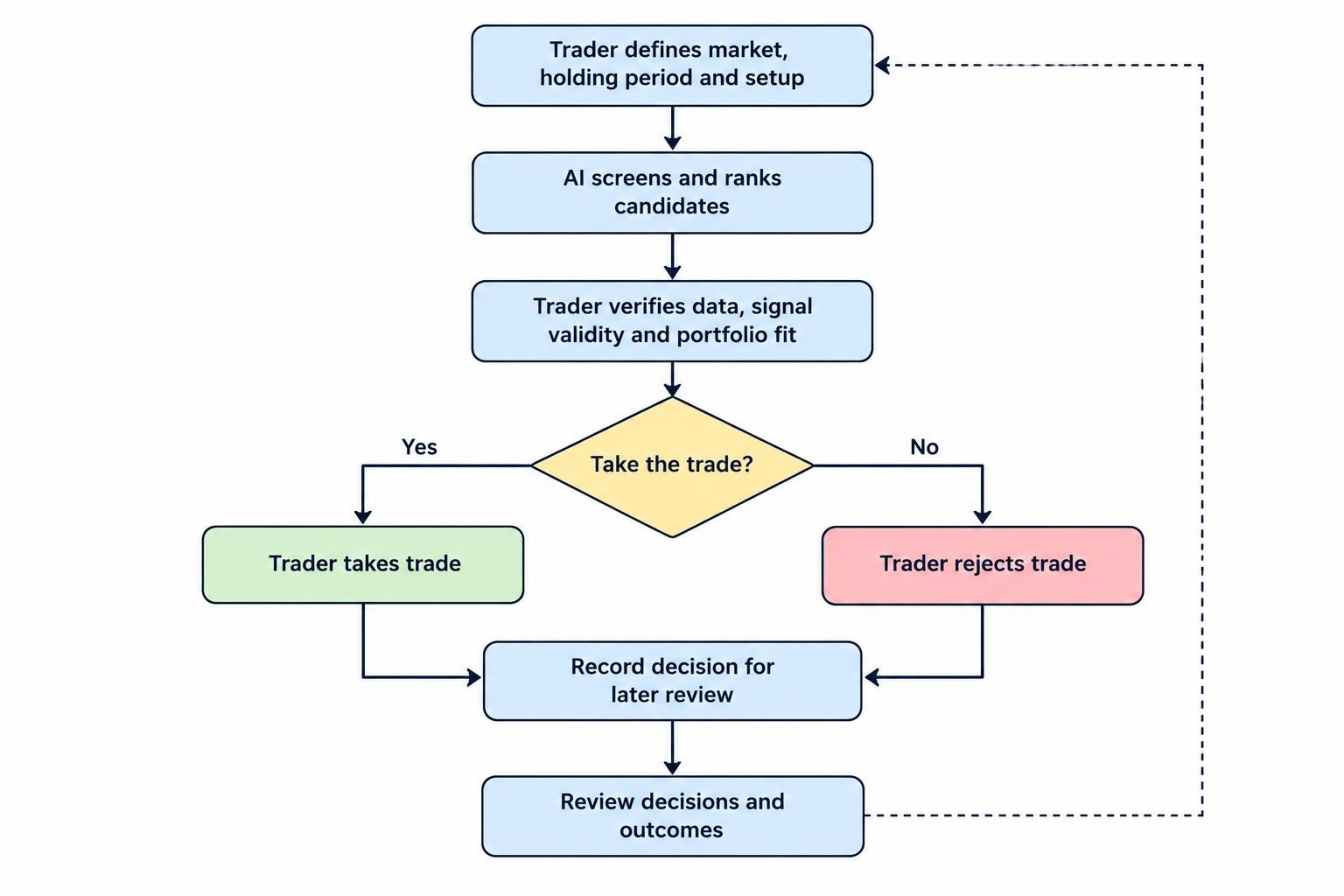
A practical system separates research from execution. First, define the market, holding period and setups you intend to trade. Then use data or a model to screen for candidates, assess whether they meet your conditions, and record the reason for taking or rejecting each trade. The model should support a repeatable process rather than invent a new explanation after every price move. Traders looking at the broader use of these tools can start with this guide to AI trading for retail traders.
For swing trades, AI is often more useful as a filter than as a stand-alone price caller. A screen might identify shares above a chosen moving average, with rising volume and volatility within a preset range. A second step can rank those candidates by a defined combination of trend strength, liquidity and distance from a planned entry. The output narrows the list; it does not say that a trade must be placed.
This setup also makes errors easier to spot. If a model flags a candidate, the trader can check whether the data is current, whether the signal is still valid at the intended entry time, and whether the trade fits the portfolio. If no one can explain why the system selected a trade in terms of the written rules, the result is hard to evaluate and harder to trust.
Start with a defined swing trading setup
Choose one setup before choosing a model. A trend-following approach might look for a pullback in an established uptrend, while a mean-reversion setup might look for a short-term move away from a reference level. These are different ideas, with different failure conditions; blending them into one label can leave a model learning a muddle. See the guide to AI assisted trend-following signals for a focused example of one setup type.
Write the rules in plain language, then convert them into conditions that can be checked. Define the instruments you will scan, the chart interval, the signal that makes a candidate eligible, and the event that invalidates it. Include a planned holding period or a rule for reviewing the trade. “Buy when the chart looks strong” is not a testable rule. “Consider a long entry after a pullback within an established trend, if price closes above the setup level and the planned loss remains within the risk limit” is closer, though each term still needs a precise definition.
Market conditions matter because a setup that behaves well in a steady trend may struggle in a choppy range or during a volatility jump. A model can help categorize conditions using inputs such as recent returns, volatility or trend measures, but those labels are estimates, not facts about what the market will do next. A separate guide covers market regime detection for trends, ranges and volatility changes.
Use AI to screen candidates, not manufacture certainty
A screening model can sort a large watchlist by conditions that matter to the chosen setup. Useful inputs might include price relative to recent highs or lows, trading volume, realized volatility, distance from a planned trigger, and whether the broader market supports the trade. The model might produce a ranked list, a probability estimate or a simple pass or fail. None of those outputs means “this trade will work.” A ranking is useful only if its inputs and purpose are clear.
| Screening task | Possible AI contribution | Trader’s check |
|---|---|---|
| Trend context | Rank instruments by defined trend and momentum measures | Confirm the chosen trend rules and relevant market context |
| Setup candidates | Flag pullbacks, breakouts or other prewritten conditions | Check that the pattern is complete and has not already failed |
| Volatility and risk | Estimate recent movement and group candidates by volatility | Set a position size and loss limit that fit the plan |
| News review | Summarize supplied reports or flag named events for review | Open the original report and confirm date, facts and relevance |
| Trade review | Sort journal entries by setup, exit reason or market condition | Check the underlying records before changing a rule |
Feature choice shapes the result. If the screen is meant to find pullbacks in rising trends, use inputs that describe that setup rather than piling in every indicator available. Extra inputs can make a model look clever in historical tests while making it harder to understand what it has learned. The guide to choosing features for a trading model covers the role of price, volume, volatility and context.
Be precise about what the model predicts. Predicting whether price will rise is different from estimating a future return, ranking several candidates, or estimating the probability that a defined setup reaches its target before its stop. Each prediction needs a time horizon and an outcome definition. The distinction between predicting prices, returns, direction and probabilities matters because a model can score well on one target yet offer little help with the actual trade decision.
Turn a candidate into a planned trade
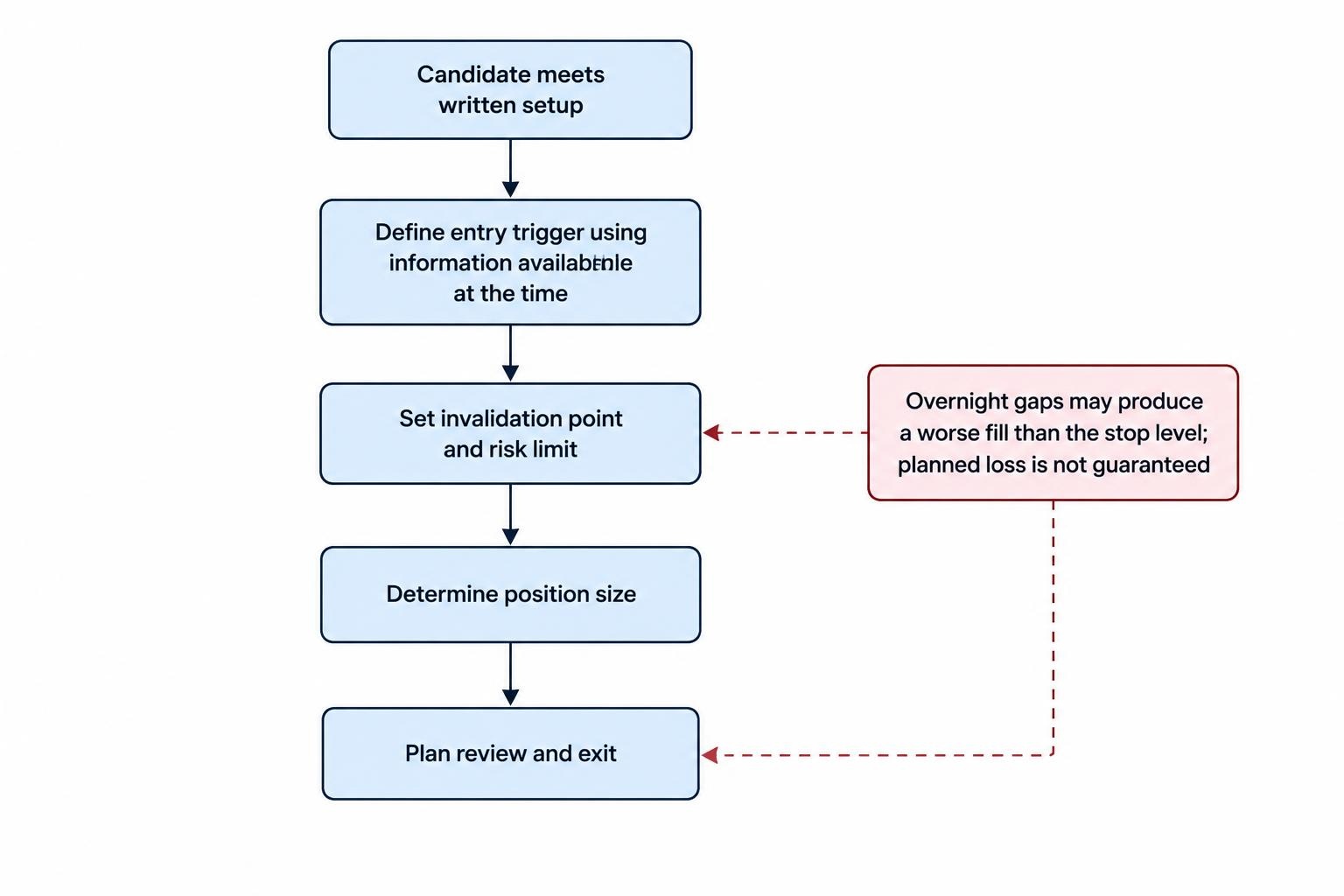
Before an entry, record the setup, trigger, invalidation point, position size and intended review schedule. The entry condition should use information available at that moment. If the model needs the closing price to confirm a signal, a backtest should not assume an entry at that same close unless the execution method could actually achieve it. A system that quietly uses tomorrow’s data to decide yesterday’s trade has not found an edge; it has used information from the future.
Position size follows the distance between the entry and the point where the trade idea is no longer valid, subject to the trader’s risk limit. A useful system can calculate or check those figures, but the limit itself should be set before the signal arrives. A high model score is not a reason to increase risk without a written rule. Consider portfolio exposure as well: several different stocks may react to the same sector or market move, so a list of separate signals can still amount to one concentrated bet.
For overnight positions, plan for the possibility that the next available price is worse than the stop level. A stop order can define an exit instruction, but it cannot guarantee a particular fill price in every market condition. The trade plan should account for gaps and avoid treating the planned loss as a promise. This is especially relevant when the setup depends on a scheduled event or a thinly traded instrument.
Test the rules before relying on the results
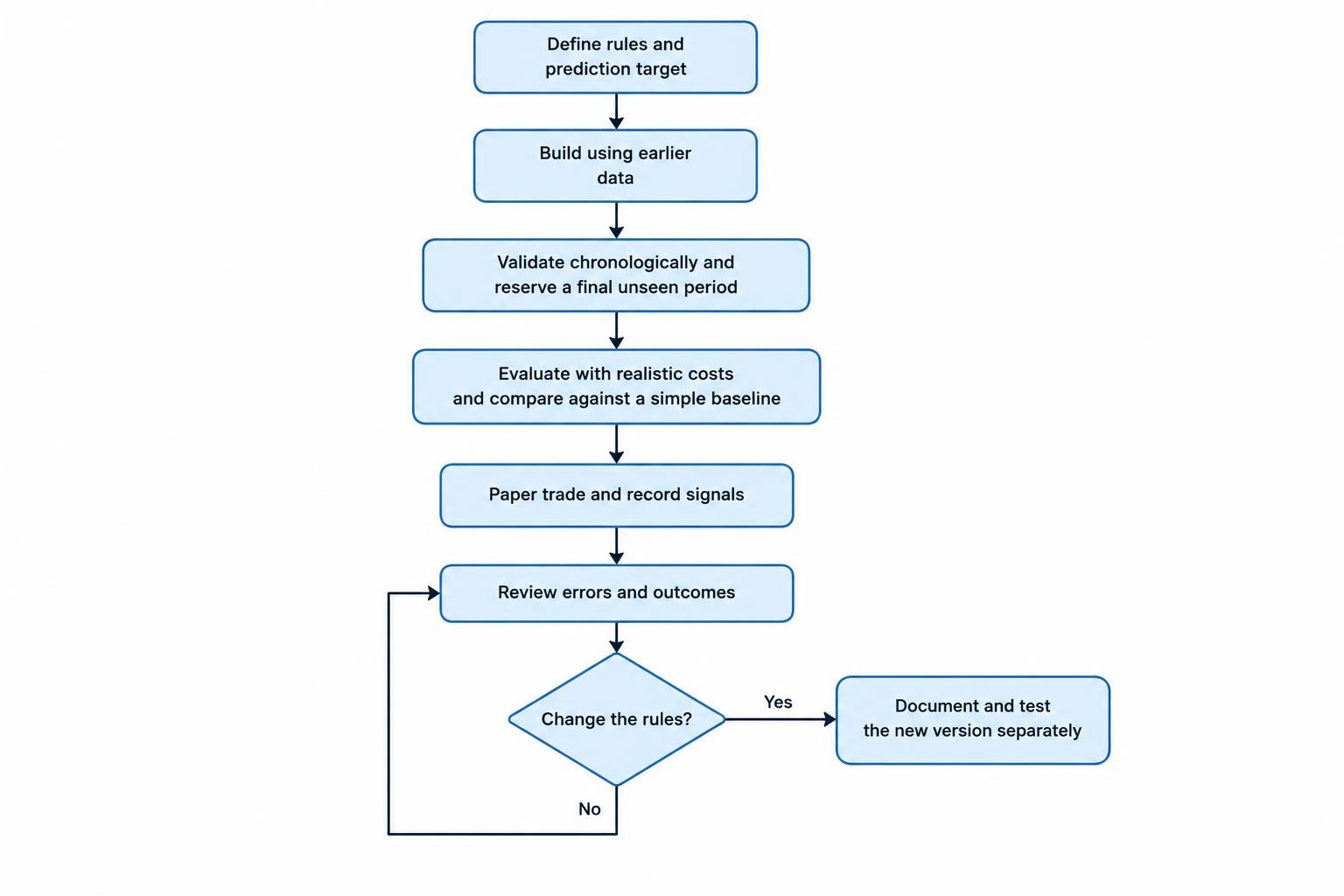
Historical testing is a way to reject weak ideas and find errors in the process. It is not a forecast. Split time series in chronological order so the model does not learn from records that would only have existed after the simulated trade. Keep a separate period for final evaluation, and avoid repeatedly tuning the strategy against that same period. The guide to training, validation and test sets for financial time series explains how these roles differ.
Watch for look-ahead bias and data leakage. They can enter through revised data, incorrectly aligned indicators, future corporate actions, or labels that overlap with the period used to create the signal. Even a small timing mistake can make performance appear better than a strategy could have achieved in real time. A separate explanation of overfitting, look-ahead bias and data leakage can help identify these errors.
Include realistic trading costs. Swing strategies may trade less often than intraday systems, but spreads, commissions, slippage, financing charges and other costs can still change the result. Test with assumptions that reflect the instruments and order types you plan to use, and check whether the strategy still holds up when costs rise. See how to include fees, spreads, slippage and financing costs in backtests.
Review returns alongside drawdowns, losing streaks, exposure and performance across different periods or market conditions. A high win rate on its own says little about the size of winning and losing trades. A strategy can win often and still lose money if its occasional losses are much larger than its gains. The guide to measuring trading performance beyond win rate covers other measures to inspect.
Then test the rules on data that was not used to build them, using a walk-forward process where appropriate. Change the period, universe or cost assumptions and see whether the result collapses. Compare the model with a simple baseline, such as the original rule without AI ranking. If the model adds complexity but does not improve a meaningful measure after costs, there may be no reason to keep it.
Paper trading and live review
Paper trading can reveal practical problems that a historical test misses: delayed data, confusing alerts, missed checks, or signals that arrive too late to act on. It cannot prove that live fills will match simulated ones, or that results will continue. Record every signal, including rejected candidates, and compare the planned entry and exit with the prices that would have been available under your process. The guide to what paper trading can establish about an AI system sets out its limits.
Keep a journal with the model output, the data available at the time, the decision made and the eventual result. Review errors by category: bad data, a valid setup that lost, an invalid signal, execution slippage, or a rule that was not followed. That is more useful than changing the model after every losing trade. If the model changes, document what changed and test the new version separately, so its results do not get mixed with the old one.
Common mistakes with AI assisted swing trading
- Letting a score replace a setup. A numeric ranking needs a defined purpose and an entry rule. Without them, it can create false precision.
- Testing too many variations. Repeatedly adjusting indicators, thresholds and dates can select a strategy that fits historical noise. Preserve an untouched evaluation period.
- Ignoring gaps and costs. A backtest built from closing prices alone may misstate what a swing trader could have earned after execution costs and overnight price changes.
- Changing risk after a signal. A model’s confidence score does not justify a larger position unless that sizing rule was defined and tested in advance.
- Trusting claims without evidence. A vendor’s screenshots, selected winning trades or impressive AI labels do not establish independently verifiable performance.
Check what an AI service actually does before granting it access to accounts or paying for automated signals. FINRA warns that some auto-trading promotions make unsupported performance claims or overstate their use of AI, and recommends checking the provider and monitoring account activity. Its guidance on risks of auto-trading services is relevant when evaluating a third-party service. The SEC has also described alleged schemes that used supposed AI trading signals and fake platforms; its September 29, 2026 enforcement announcement is a reminder to verify a provider and its claims independently.
A sound AI assisted swing trading process is modest by design: a clear setup, a defined screen, a planned entry and exit, realistic testing, and regular review. The model helps sort information and apply rules consistently. The trader remains responsible for deciding whether the trade fits the plan, controlling risk and stopping when the evidence no longer supports the approach.