Using AI for trading does not require a degree in computer science. It does require enough market knowledge to judge the output, enough data literacy to test a claim, and enough discipline to keep a flawed signal from turning into an expensive trade. AI can help screen markets, summarize information, or generate code, but a trader still has to decide what question to ask, whether the answer is reliable, and how much risk to take.
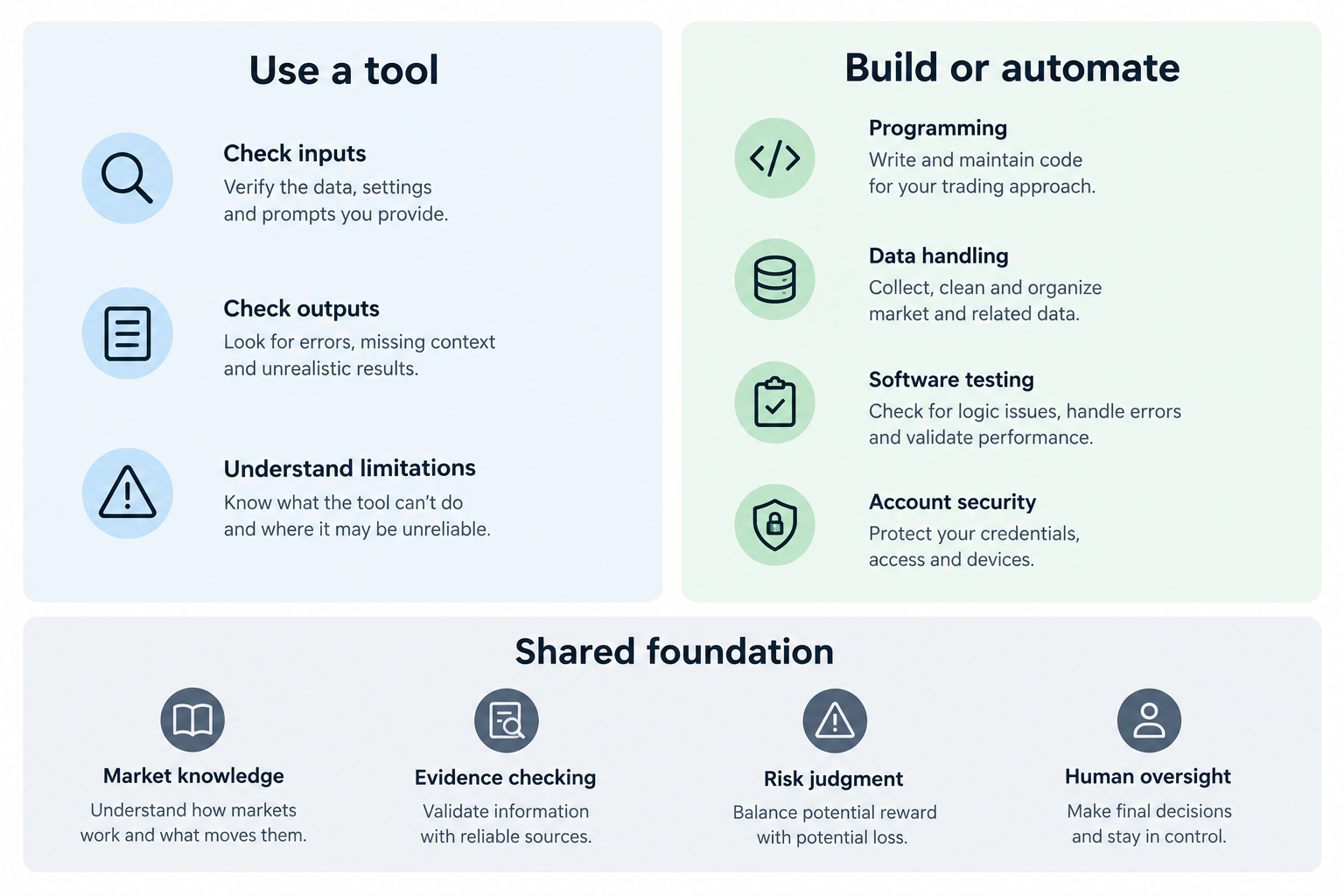
The skills you need depend on the job you want the tool to do. A trader using an AI assistant to organize research needs a different level of technical knowledge from someone training a model or connecting it to an account. The common ground is practical judgment: understand the market, check the evidence, and keep control of the decision. A useful starting point is to know what AI can and cannot do for retail traders.
Market knowledge comes first
AI tools can identify patterns in data, but they do not automatically know whether a pattern matters in the market you trade. A trader needs to understand how orders, spreads, liquidity, volatility, trading hours, and fees affect a strategy. Without that context, a model may flag a price move that looks promising in a chart but would be difficult to trade at the quoted price. A strategy that works on one asset or timeframe may also fail under different conditions.
Start with the market and strategy, not the model. Be able to explain what creates the signal, when it should work, and what conditions would make it fail. If an AI tool says a market is “bullish,” ask what data supports that label and what it means in terms of a tradeable rule. A broad description is not an entry plan. This knowledge also helps you spot outputs that sound confident but confuse correlation with a useful trading reason.
Data literacy and basic statistics
Many AI trading tasks are data tasks in disguise. You should be comfortable checking where data came from, what each field means, how often it updates, and whether it contains gaps or bad values. Price data can be adjusted, delayed, or recorded at different intervals. Volume can be defined differently across markets. News feeds may contain duplicates or timestamps that do not match the time a trader could have acted.
Basic statistics help you interpret results without being dazzled by a clean chart. Learn the difference between an average and a median, how sample size affects confidence, and why a high win rate says little about profitability if losses are much larger than gains. You do not need advanced mathematics for every AI tool, but you should question small samples, unstable results, and performance that depends on a narrow date range. For model research, understand how historical observations are prepared and why the data must reflect what was actually available at the time: see this guide to preparing historical market data for AI trading research.
Testing skills: separate a promising idea from a reliable result
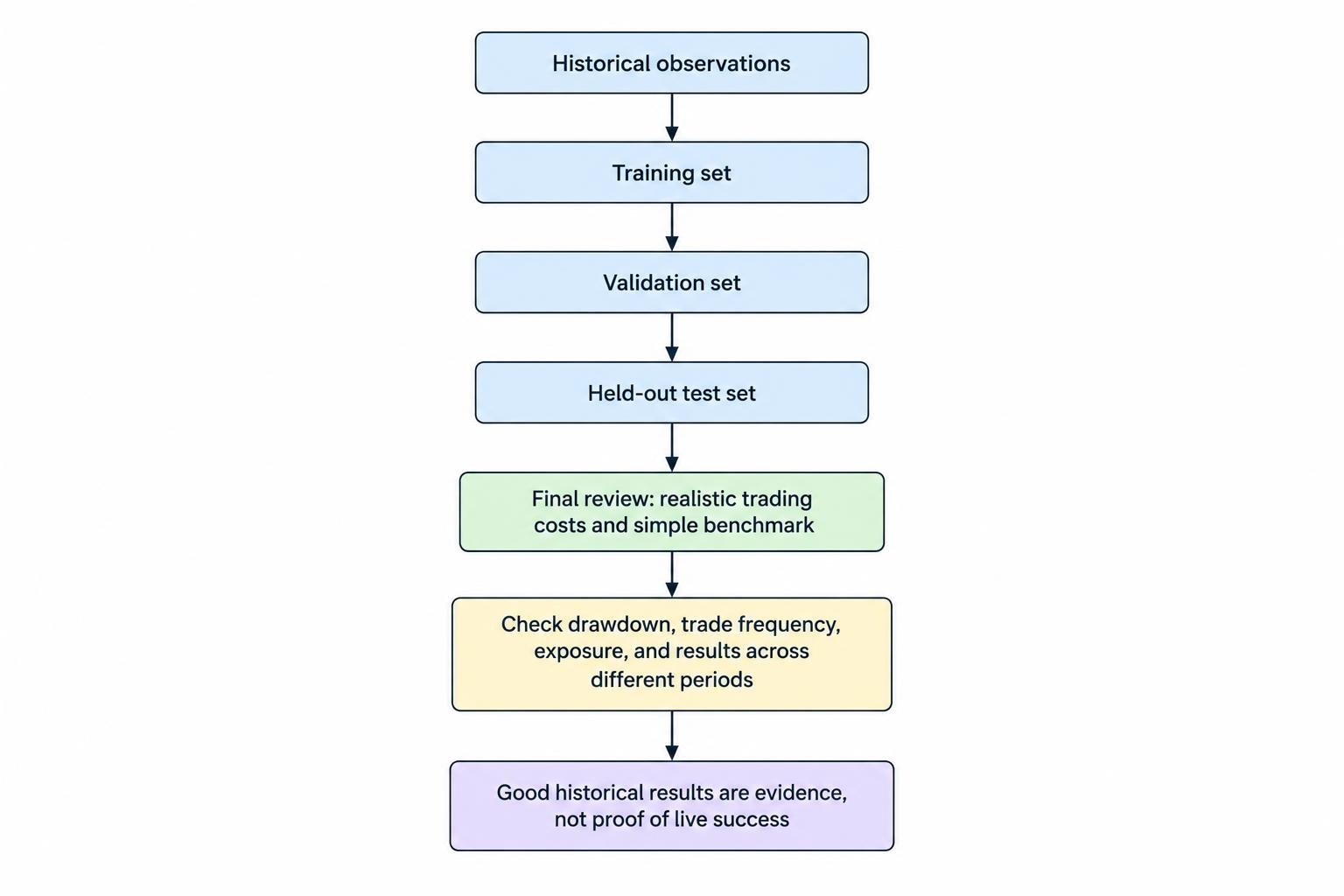
A backtest is evidence about how a set of rules behaved on selected historical data. It is not proof that those rules will work in live markets. To evaluate one, you need to know whether the model was tested on data it had not already seen, whether the test process introduced look-ahead bias, and whether realistic trading costs were included. If you try enough versions of a strategy, some will look impressive by chance. That is one reason a single strong result should not settle the question.
Learn to compare an AI strategy with a simple benchmark and to review more than headline returns. Drawdown, trade frequency, exposure, and performance across different periods can reveal weaknesses that a win-rate figure hides. Keep a record of which version of the model produced each result; otherwise, it is easy to lose track of what was changed and why. Guides to training, validation and test sets and overfitting and data leakage cover two common ways research results can become misleading.
Prompting and model literacy
If you use a general AI assistant, clear instructions help it produce more useful work. State the task, the relevant market and timeframe, the format you want, and what the assistant must not assume. Ask it to identify missing information rather than fill gaps with guesses. For example, asking it to summarize a provided earnings release is more controlled than asking whether a stock is a good buy without defining the data, horizon, or criteria.
It also helps to know the difference between a language model and a predictive trading model. A language model generates text based on patterns in its training and the information supplied to it; it is not automatically receiving live market data or calculating a validated probability of future returns. Other models may classify data or estimate a value, but their outputs still depend on the quality of their inputs and testing. Knowing how machine learning differs from large language models in trading helps you choose an appropriate tool and interpret its limits.
Risk management and execution awareness
A useful signal can still lead to a poor trade if position sizing, stop conditions, or execution are handled badly. Traders should know how much they can afford to lose on a position, how correlated trades affect total exposure, and what happens when prices move faster than an order can be filled. A backtest may assume an execution price that is not available in a live market, particularly during volatile periods or in less liquid instruments.
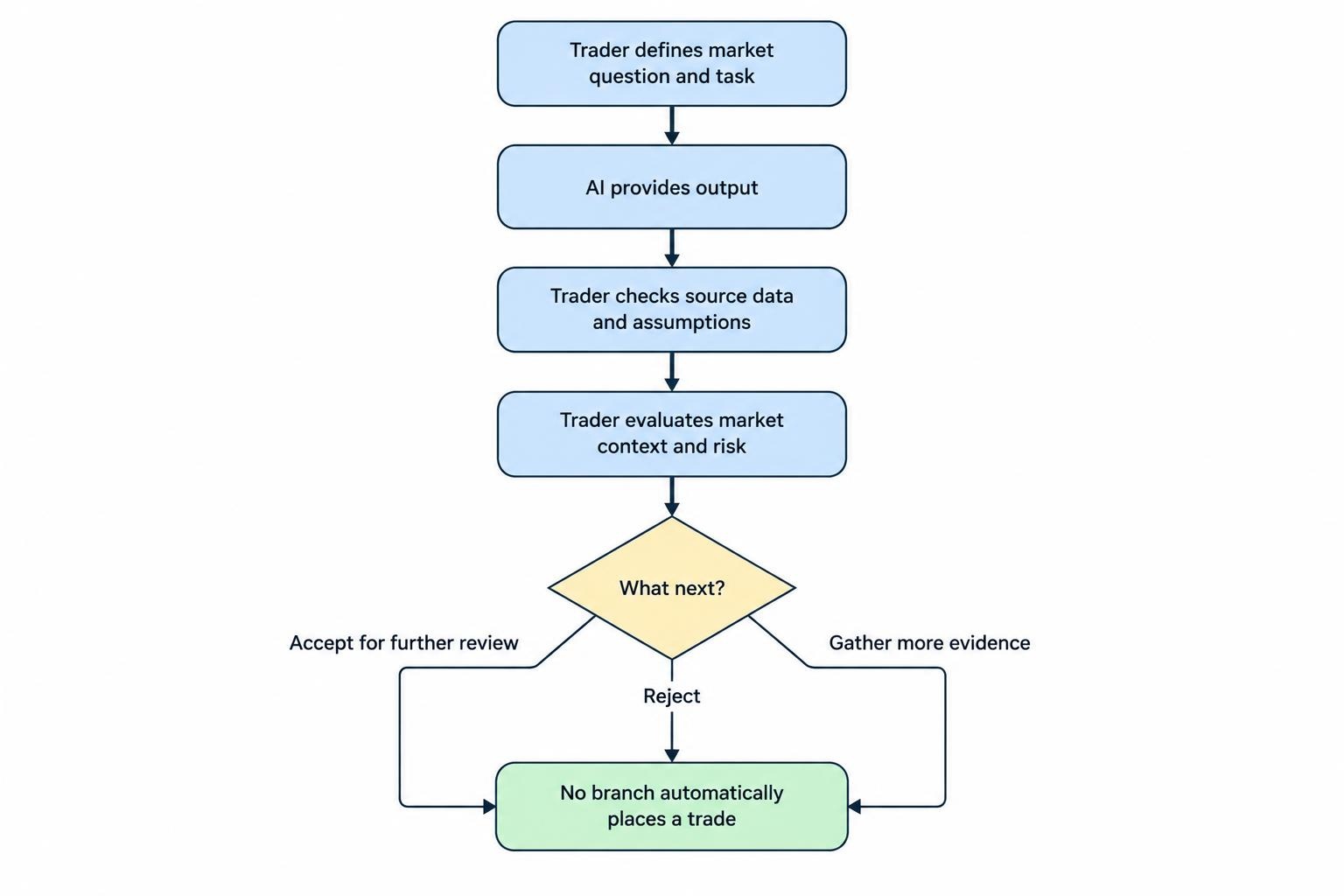
For an AI system that can place orders, add technical and operational awareness to your market skills. You should understand what permissions a connection has, how to stop automated orders, and how to check whether the system’s recorded position matches the account. Automation does not remove oversight; it changes what needs monitoring. The AI assisted trading workflow is a useful way to separate research, review, and execution rather than treating them as one automatic step.
Source checking, privacy, and scam awareness
AI output can include incorrect facts, stale figures, or references that do not support the claim being made. Check important statements against the original filing, exchange data, regulator notice, or other primary record. Do not treat a fluent answer as evidence. Be especially careful when a service makes performance claims that are difficult to reproduce or promises returns with little risk.
Protect account credentials and personal financial information. A tool that only summarizes public information does not need your brokerage password. Before connecting any service to an account, understand what data it receives and what actions it can take. The SEC’s investor alert on AI related investment fraud warns about unregistered platforms and claims that AI trading systems can guarantee returns. FINRA also flags data and account access concerns in its guidance on auto trading services offered by unregistered entities.
Do you need to know how to code?
No, not for every form of AI assisted trading. A trader can use tools to summarize documents, organize a watchlist, or check a manually defined idea without building a model. Coding becomes more useful when you want to clean large datasets, automate repeatable tests, or connect a strategy to an execution system. Python is common in data work, but learning it is not a substitute for understanding trading assumptions or testing methods.
Choose skills according to the task. If you are using a no code product, focus on evaluating its inputs, outputs, and limitations. If you are building a system, add programming, data handling, software testing, and account security to the list. In either case, keep a written record of the question you asked, the evidence you checked, and the reason you accepted or rejected the result. That habit makes mistakes easier to find, and helps distinguish a repeatable process from a plausible sounding answer.