Where a trading system runs affects whether it can keep operating when a home computer sleeps, a connection drops, or an operating system restarts. A local computer, a virtual private server (VPS), and a cloud service can all run trading software, but they place different demands on the trader. The right choice depends on what the system does: a script that checks prices once an hour has different hosting needs from one that sends orders automatically throughout the trading session.
Hosting is one part of a wider operational setup. The system also needs reliable market data, secure credentials, monitoring, and a defined response to failures. Moving a bot off a personal computer may reduce some interruptions, but it does not make the strategy safer or guarantee that an order will reach a broker. Before choosing a location, define the system’s operating hours, data needs, response time, recovery plan, and the level of maintenance you can handle.
What “local,” “VPS,” and “cloud” mean
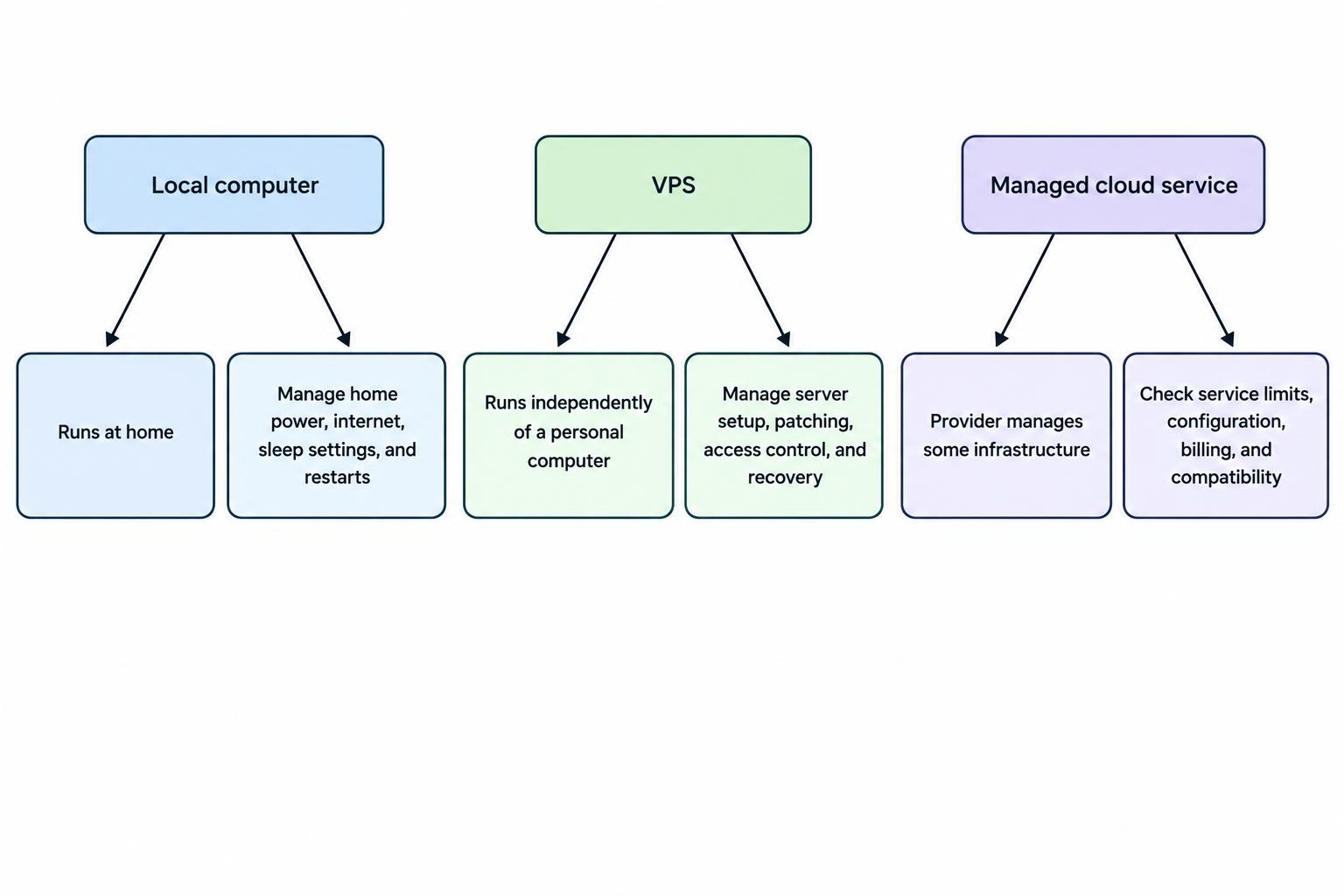
A local system runs on a computer you control, such as a desktop or a small home server. Your computer, internet connection, router, and power supply are part of the system’s operating environment. You choose the hardware and manage its software, but interruptions at home can stop the process.
A VPS is a rented virtual computer hosted in a data center. You usually connect to it remotely and install the operating system, trading application, and monitoring tools yourself. It can run while your personal computer is off, but you remain responsible for much of its setup and upkeep.
Cloud hosting is a broader category. It includes virtual machines similar to VPSs, as well as managed services where the provider handles more of the underlying software or infrastructure. The label alone says little about how much work you must do. Check what the service actually manages, what you must configure, and how billing works before committing.
These terms overlap in everyday use. A VPS may itself be hosted by a cloud provider, while a cloud platform may offer a virtual machine that behaves much like a conventional VPS. The practical distinction is often the amount of control and maintenance: more control can mean more responsibility.
Compare the hosting options
| Option | Works well for | Main operational concern |
|---|---|---|
| Local computer | Research, alerts, scheduled scripts, and supervised testing | Home power, internet, sleep settings, and restarts |
| VPS | Processes that should run independently of a personal computer | Server setup, patching, access control, and recovery |
| Managed cloud service | Workloads that fit a provider’s supported platform and operating model | Service limits, configuration, billing, and provider dependence |
This is a starting point, not a ranking. A local machine may be enough for a strategy that generates end-of-day research and requires human review. A VPS may suit a process that needs to remain online during market hours, provided the operator can maintain it. Managed services can reduce some maintenance work, but only if the trading software, data feed, and broker connection are compatible with the service.
Running a trading system locally
A local computer is often the simplest place to develop and test a system. Files, logs, and data are easy to inspect, and there is no remote server to configure. It can also be a sensible choice for research tools that do not need to operate continuously. A system that produces a watchlist before the session, for example, may not need a dedicated server at all.
The trade-off is that the computer is exposed to ordinary household interruptions. It may sleep, reboot for updates, lose internet access, or shut down during a power cut. A laptop can close its lid and pause a process; a desktop can still lose its network connection when the router or internet service fails. These are manageable issues for supervised research, but they matter more if software is expected to monitor markets or submit orders without someone watching.
Adjusting sleep and restart settings can reduce avoidable stops, but it does not turn a home setup into a fault-tolerant system. A battery backup may help with brief power interruptions, and a wired network connection can avoid some wireless dropouts. Neither solves an internet outage or a failed computer. Keep a clear record of what the program was doing before it stopped, and make sure a restart cannot blindly repeat an order that was already accepted.
Local hosting also makes it easier to see how the system behaves during development. That convenience can encourage an unsafe shortcut: using live credentials on the same computer used for everyday browsing, or leaving a trading process running without checking its status. Separate development from live operation where possible. Use restricted credentials, protect the computer with a strong login, and keep a manual way to check or stop the process.
Running a trading system on a VPS
A VPS keeps the trading process separate from your personal computer. You can disconnect from the remote session while the server continues running, and the provider maintains the physical data center and hardware. This makes a VPS useful when a strategy or data process needs to remain active during defined hours, or when the system should not depend on a home computer staying awake.
A VPS does not remove operational work. You may need to install software, configure a firewall, create user accounts, apply security updates, check storage, and arrange backups. If the virtual machine restarts, the trading program may not restart automatically. If it does restart, it needs to restore its state safely, confirm the broker connection, and avoid submitting duplicate orders. Plan and test those behaviors instead of assuming the server will simply continue as before.
Choose a server location based on practical requirements, not a promise of faster trading. The route between the server, market data provider, broker, and execution venue affects delays; placing a virtual machine near one endpoint does not guarantee a faster or more reliable path to all the others. For many retail systems, clean data handling and correct order management matter more than small differences in network delay. If rapid execution is central to the strategy, measure the complete route under realistic conditions rather than relying on a provider’s location label.
Also check the VPS terms and technical limits. CPU and memory allocations, network capacity, storage, restart policies, and support arrangements differ. A low-cost plan may be sufficient for a modest process, but do not assume that a listed resource allocation guarantees consistent performance under every workload. Record the service configuration and test how your application behaves when it loses a feed, restarts, or reaches a resource limit.
Using cloud services
Cloud services range from rented virtual machines to platforms that run selected code without requiring you to manage a full operating system. A virtual machine offers familiar control, with familiar chores. A managed platform may handle more of the maintenance, but can impose restrictions on runtime length, network access, storage, or supported libraries. Read the service documentation against the actual requirements of your trading application.
Cloud hosting can also make it easier to separate components, such as a research job, a data store, and an alert service. That can help with organization, but each component adds configuration and potential failure points. A process that depends on several services must handle the case where one is delayed or unavailable. Keep the architecture as simple as the workload permits, especially when a single person is responsible for operating it.
Cloud providers and customers have different security duties. For example, infrastructure providers may manage physical facilities and underlying hardware, while customers remain responsible for parts of the virtual machine, its applications, data, identities, and configuration. The exact division depends on the service model. Review the provider’s cloud shared responsibility model and the documentation for the service you select; renting cloud infrastructure does not transfer every security task to the provider.
Latency, uptime, and the limits of location
Hosting decisions are sometimes framed as a search for the lowest latency. Latency is the time taken for data or a request to travel through a system, but the relevant measure is not simply the distance from your server to one exchange. A trading workflow may rely on a market data provider, a broker’s API, and other network services. Delays or interruptions at any point can affect the result.
For a retail strategy that makes decisions over minutes, hours, or days, a small difference in network delay may have little practical value. Data quality, correct timestamps, order handling, and realistic trading costs can matter more. A strategy designed around very short-lived signals has different requirements, and should be assessed with measured end-to-end delay and the execution access actually available to the trader. Do not treat a provider’s marketing description as proof that your system will achieve a particular execution speed.
Uptime claims need similar care. A provider’s service availability is not the same as the availability of your entire trading workflow. Your application can fail while the virtual machine is online; a data feed or broker connection can fail while the server is healthy. Define what counts as an interruption for your system, monitor each dependency, and decide what the system should do if a price update becomes stale or an order acknowledgement does not arrive.
Security and access controls
A remote server can be exposed to account misuse if login details, API credentials, or administrative access are poorly protected. Use unique credentials, enable multi-factor authentication where available, restrict remote access, and grant the trading process only the permissions it needs. If broker credentials support separate permissions, avoid enabling withdrawals or other functions the system does not require. Keep API keys out of source files and ordinary logs, and replace them if they may have been exposed.
Updates and backups need an operating plan. Apply security updates in a controlled way, then confirm that the trading application starts and connects correctly. Keep copies of configuration and essential records somewhere separate from the machine, with access protected. A backup is useful only if you can restore it and determine which orders, positions, and data were current at the time of failure.
For a cloud virtual machine, security is shared between the provider and the person configuring the workload. The responsibility may change when using a managed platform instead of a virtual machine. AWS guidance on shared security responsibilities describes how responsibilities vary by service, including management of guest operating systems and application software on virtual machines. Review the matching documentation for whichever provider and service you use.
Monitoring and recovery matter more than the hosting label
A trading process should report whether it is running, whether it is receiving fresh data, and whether it can communicate with the broker. Logs should record meaningful state changes, errors, and order events without exposing passwords or secret keys. Alerts can notify you when the process stops or loses a required connection, but an alert is not a recovery plan. Decide who will respond, what actions are safe, and how to confirm the current account position before restarting order activity.
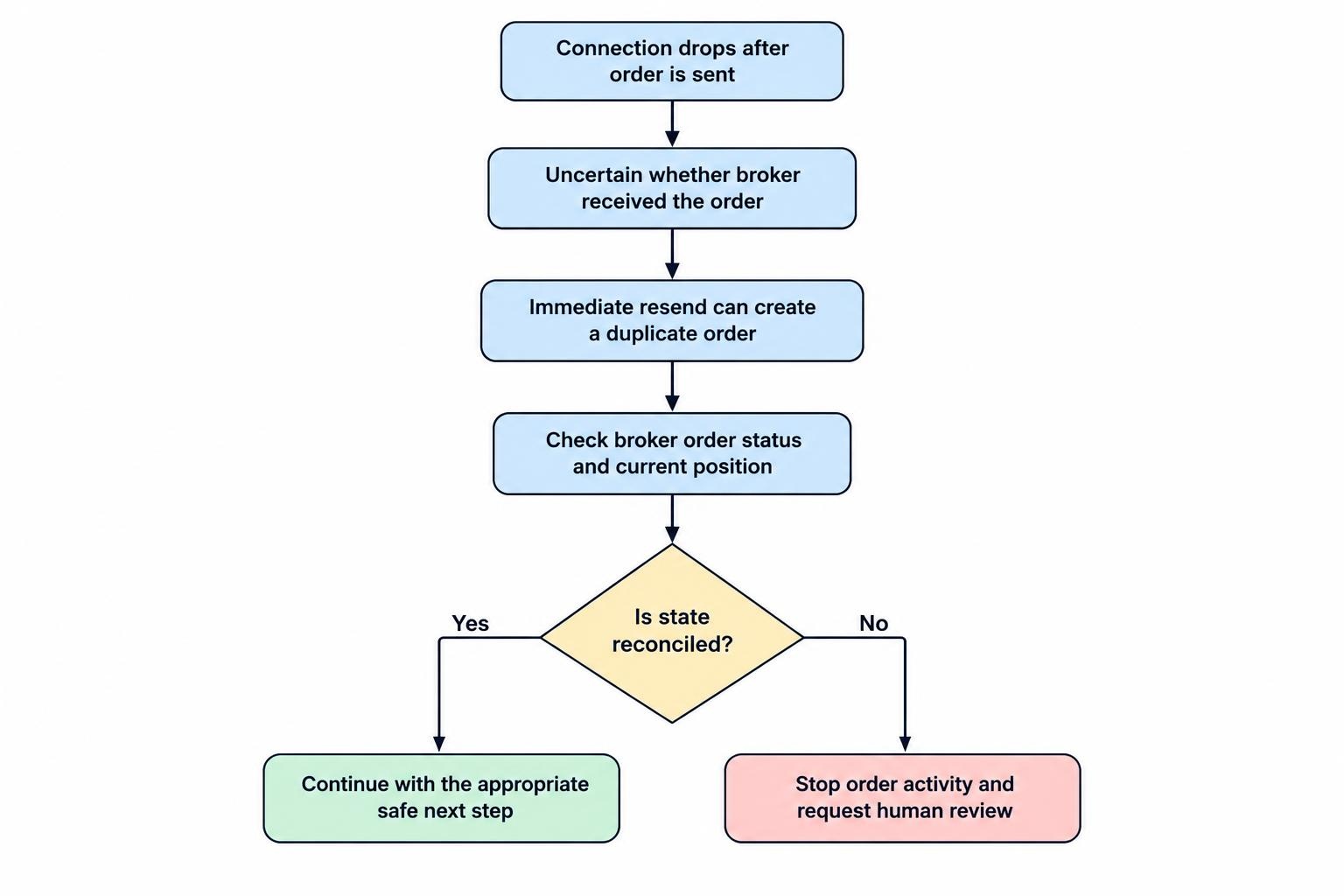
Build recovery behavior around uncertainty. If a connection drops after an order is sent, the system may not know whether the broker received it. Resending immediately can create a duplicate. The safer design checks the order and position state before acting again, and stops for human review when it cannot reconcile the account. This is one reason hosting choices should be considered alongside connection failure and duplicate order handling, rather than as a standalone infrastructure decision.
Monitoring should cover the whole workflow, not only server health. Check for stale or missing market data, failed authentication, rejected orders, unexpected position changes, and a process that is technically alive but no longer doing useful work. A simple scheduled report may be enough for a low-frequency system. A system that can place orders unattended needs tighter checks, clear alerts, and defined limits on what it may do before a person intervenes. See monitoring an automated trading system for the role of logs and alerts in day-to-day operation.
How to choose a host
Start with operating requirements, then choose the simplest setup that meets them. Write down when the process must run, which services it depends on, how quickly it needs to react, and what should happen after a restart. Include who will apply updates, review alerts, restore backups, and verify account state. If those responsibilities are unclear, moving the program to a server may just move the same uncertainty to a different computer.
- Choose local hosting when the task is supervised, intermittent, or mainly for research and development.
- Consider a VPS when the program must run independently of a personal computer and you can maintain a remote machine.
- Consider a managed cloud service when its runtime and network features fit the application and the reduction in system maintenance is worth its restrictions and cost.
Before allowing a hosted system to place live orders, run it in a non-live mode and test planned failures. Restart the machine, interrupt the data connection, revoke or rotate a test credential, and confirm that alerts arrive. Verify that the application restores its state without treating an old signal as a new one. Test what happens when an order is pending during a disconnect. The aim is not to prove that failures can never happen; it is to make their effects visible and bounded.
Hosting is one component of the wider automated trading setup. It should support a tested strategy, sensible order controls, and a recovery process—not compensate for missing ones. Start with a modest configuration, measure how it behaves, and expand only when the added complexity solves a real operational problem. A system that is easy to inspect and stop is often more useful than a more elaborate server setup whose failure modes nobody has tested.