AI trading risks arise from more than a model making a poor forecast. A system can be trained on faulty data, appear successful in a backtest that does not reflect real trading, place orders the user did not intend, or be marketed with claims that have little evidence behind them. An “AI” label does not show that a product works, protects an account, or suits a trader’s needs. Some tools only analyze information; others can connect to a brokerage account and act on it.
Protection starts with separating those uses. Check what the system can access, what decisions it can make, and what happens when its data or connection fails. Then judge its performance and provider using evidence that can be checked independently. A useful review of AI errors, outdated information and source verification can help with research tools, while automated systems need controls that still work when the model’s output is wrong.
Where AI trading risks come from
AI systems identify patterns from data and use them to produce an output, such as a forecast, trade signal, or order. Their output can be wrong even when the software runs as designed. Market conditions change, data may be delayed or incomplete, and a pattern that appeared in historical prices may not persist. A model can also produce a plausible answer that lacks reliable support. It does not know that a confident response is correct simply because the response sounds convincing.
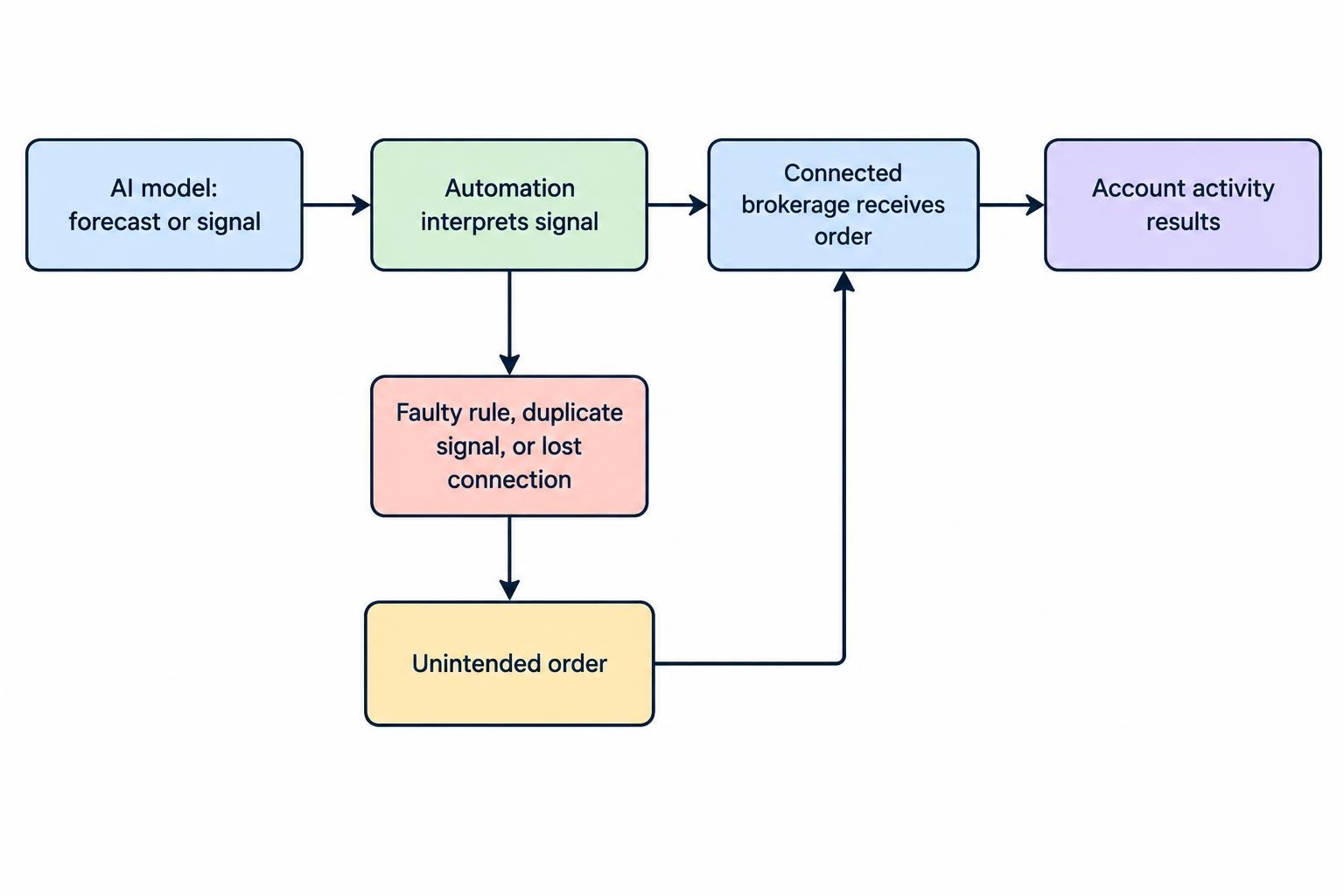
Automation adds another layer of risk. A research assistant may offer a mistaken suggestion, but a connected system could turn that suggestion into a transaction. A flawed rule, duplicate signal, or lost connection might lead to trades the user did not plan. The potential loss depends on the assets, position size, leverage, and order controls—not on whether the interface describes its technology as intelligent. Traders considering automated execution should understand trading limits, kill switches and human oversight before granting a tool authority to act.
| Risk | What it can look like | Protection to consider |
|---|---|---|
| Incorrect output | A false claim, stale fact, or weak signal is presented as reliable. | Check the underlying data and confirm important claims with independent sources. |
| Misleading performance | A backtest highlights winning periods and hides costs or losing trades. | Ask how results were produced and test realistic fees, spreads, and execution. |
| Unwanted account activity | A system sends repeated, oversized, or unsuitable orders. | Use restricted permissions, position limits, alerts, and a tested stop mechanism. |
| Fraud or misrepresentation | A provider promises guaranteed profits or uses “AI” without explaining the product. | Verify the provider, its registration where relevant, and its claims independently. |
| Personal or account data exposure | A tool requests passwords, account access, or sensitive financial information. | Share as little as possible and review permissions before connecting an account. |
Model errors, weak data and overfitting
A model can only work with the information it receives. Missing prices, incorrect timestamps, inconsistent corporate action adjustments, or data from an unreliable source can distort its output. The same problem can appear when a language model summarizes market news: it may confuse dates, misstate a filing, or blend a verified fact with an unsupported explanation. Confirm material claims at their original source before using them to make a trading decision.
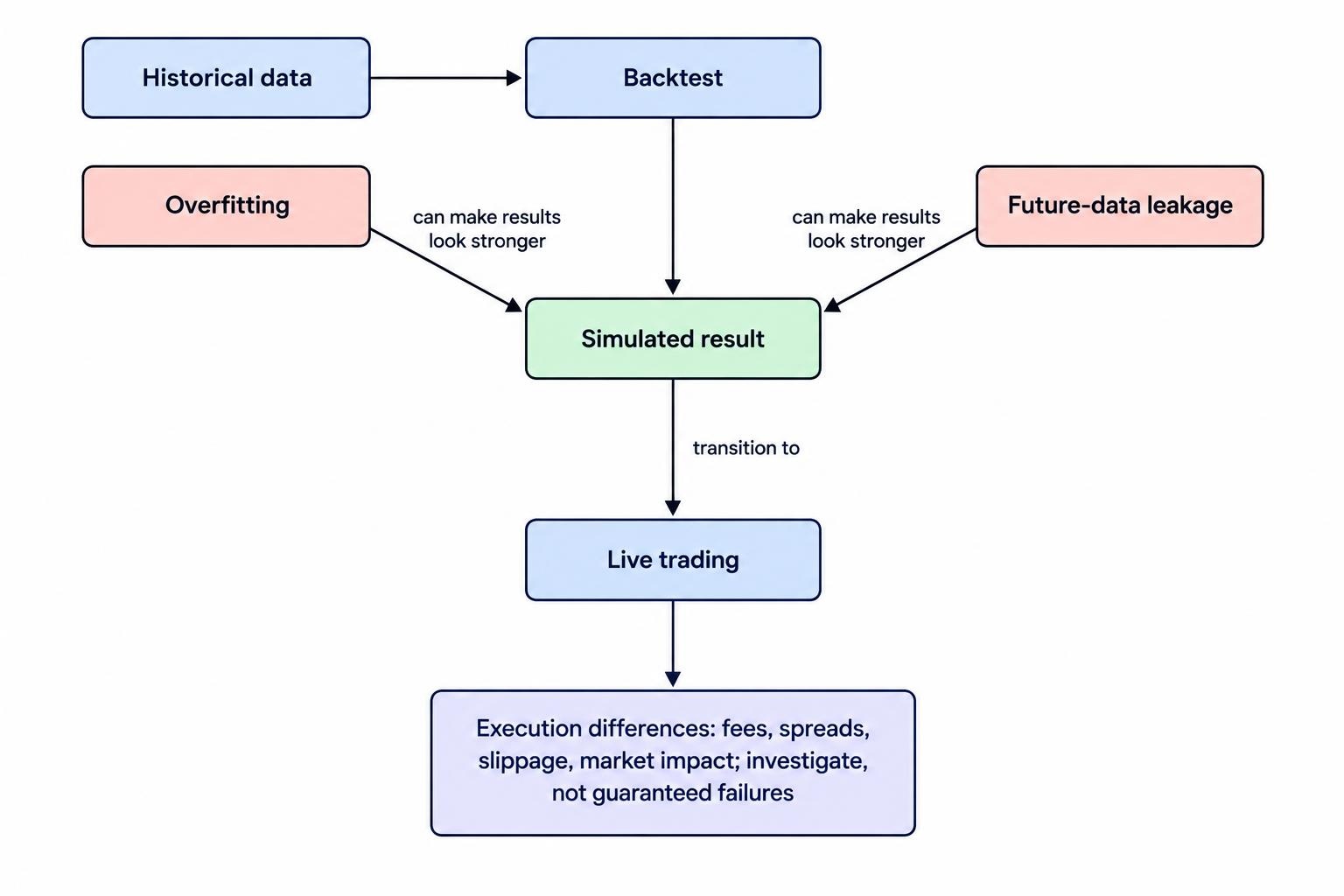
Historical testing brings its own hazards. A model may be adjusted repeatedly until it fits past data unusually well, then perform poorly on new observations. Testing can also leak information from the future into the model’s training process, making results look stronger than they could have been in real time. These are research design problems, not proof that AI itself is either useful or useless. Learn how overfitting and data leakage can distort trading tests, and treat polished charts as a starting point for questions, not proof of an edge.
Backtests also simplify the act of trading. They may assume an order fills at a price that was briefly available, leave out spreads or fees, or fail to reflect slippage and market impact. A simulated result does not show that a strategy would have survived changing conditions or the trader’s response to a loss. The CFTC warns that hypothetical trading results have inherent limits and may omit execution conditions and costs; its advisory on commodity trading systems and hypothetical results lists issues to check before relying on advertised performance.
Automation, account access and operational failures
Automated trading can magnify a small configuration error. A sizing rule may use the wrong account balance, a signal may be processed twice, or an order may remain open after a connection drops. If the system has access to a live account, even a brief failure can matter. Start by establishing what actions it is authorized to take, which markets it can trade, and whether it can withdraw or transfer funds. An analysis tool does not need the same permissions as a trade execution service.
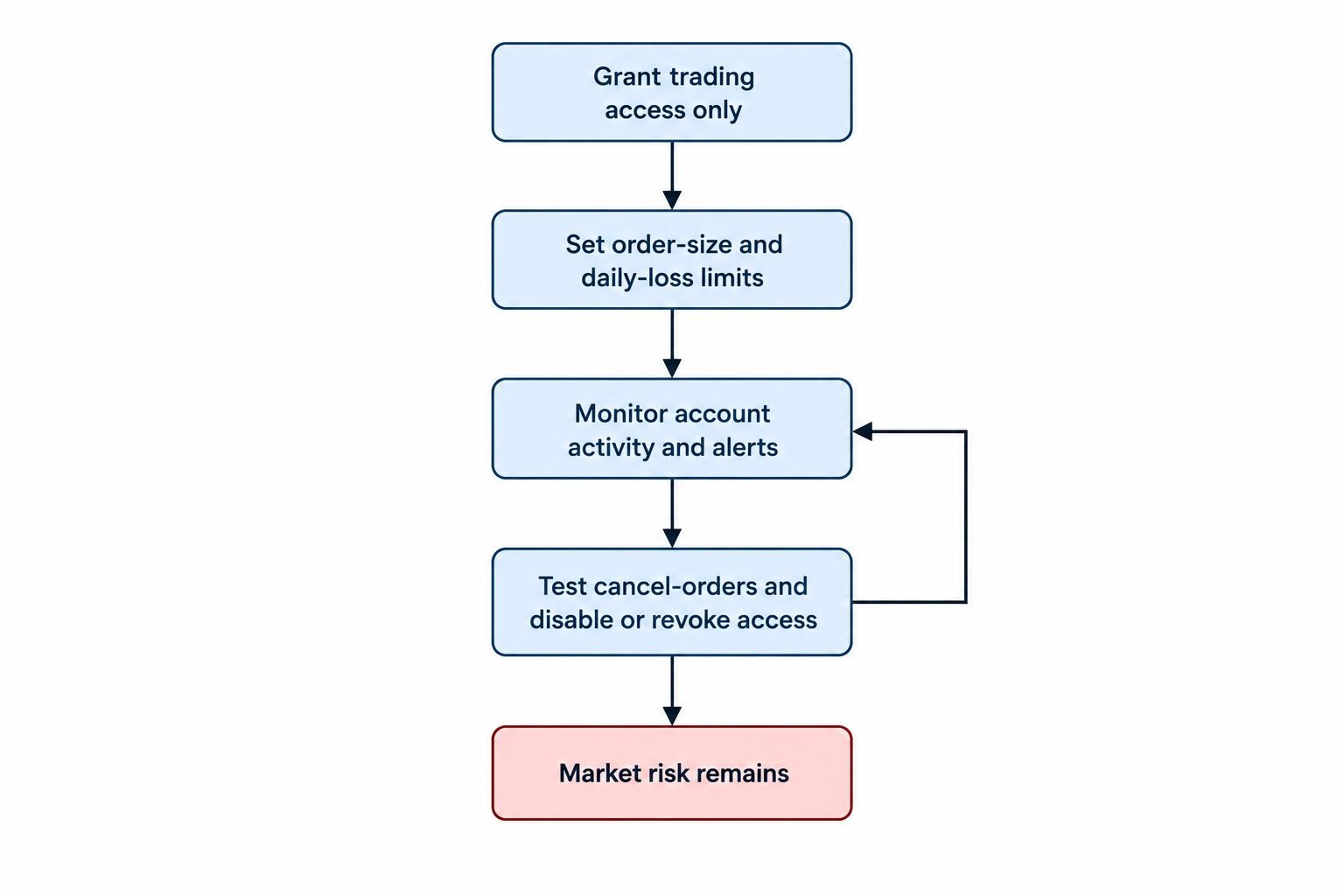
Give the system the narrowest access it needs. Where the provider and brokerage support it, use separate credentials or API keys with trading permissions only, not withdrawal permissions. Set maximum order sizes and daily loss limits, monitor account activity, and know how to cancel open orders or disable access. Test the process before connecting meaningful funds. A plan for duplicate orders and connection failures is useful because failures do not always stop trading cleanly.
Account activity should remain visible to the trader. Review confirmations, open positions, and account statements rather than assuming that a dashboard’s summary tells the full story. Alerts can flag unexpected orders, but alerts are not a substitute for limits or a way to stop execution. If a service acts on an account without timely notice, the user may discover a problem only after multiple trades have been placed. FINRA’s discussion of auto-trading services highlights the possibility of unsuitable trades, unsupported claims, and account data risks, especially when an unregistered provider controls instructions sent to a brokerage account.
Privacy and security risks
Market research prompts and trading journals can include more personal information than users realize. Account balances, holdings, order history, risk limits, and investment plans may reveal sensitive details. Before submitting them to an AI service, read its data-handling terms and check whether inputs may be stored, shared, or used to improve a product. Avoid submitting passwords, full account numbers, identity documents, or other information the task does not require. The guide to protecting financial data when using AI tools covers the questions to ask before sharing trading information.
Security also depends on how access is granted and removed. Use strong, unique passwords and multifactor authentication where available. Do not hand brokerage login details to a provider simply because its interface asks for them; verify the provider and the connection method independently. If a service is no longer needed, revoke its permissions and check the account for unexpected activity. FINRA specifically warns that sharing brokerage credentials with auto-trading services can create privacy and financial safety concerns.
Scams, AI washing and unsupported claims
Some products use “AI” as a sales label without providing a clear account of what the software does. Others advertise guaranteed returns, a near-perfect win rate, or large profits with little risk. Those promises are warning signs, not evidence of a dependable strategy. The CFTC cautions that AI cannot predict the future or sudden market changes and describes schemes that falsely promoted bots and AI-based trading programs. Its advisory on AI trading bots and guaranteed-return claims offers practical checks for researching a provider.
Look beyond screenshots and testimonials. Ask whether performance comes from live accounts or simulations, whether losing periods are included, which fees and spreads were counted, and whether an independent party verified the results. Be wary of pressure to deposit quickly, pay by an unusual method, recruit other users, or move a conversation to a private messaging app. The SEC, NASAA, and FINRA have warned that scammers use AI claims to promote unregistered platforms, unrealistic returns, and fabricated investment information. Their joint investor alert on AI-related investment fraud also advises checking the people and platforms involved.
In the United States, registration checks depend on the service and activity; a tool’s marketing page is not enough to establish its status. Use official regulator search tools and contact a firm through independently verified details if it claims an affiliation. Outside the United States, check the relevant local regulator’s register and investor guidance. Registration is not a promise of profits, but a provider that cannot be verified deserves extra scrutiny. For more warning signs, see how to recognize AI trading bot scams and misleading marketing.
A practical protection routine
Before using an AI tool, decide whether it will provide research, signals, or live execution. Check the data it uses and how it handles uncertainty; do not treat a confident answer as a guarantee. If performance is part of the pitch, request enough detail to reproduce or independently assess the test. A model that cannot be explained at a useful level may still produce output, but the user has less basis for judging where it can fail.
Then set boundaries before connecting any account. Define the maximum amount at risk, position size, markets, and times when the system must stop. Keep the ability to review and cancel orders, and test alerts and emergency controls. Start with simulated trading or a low-risk test only if it helps evaluate the workflow; simulated results do not establish that live results will match. The steps for moving from paper trading to live trading with defined risk limits can help structure that transition.
Review the system after changes to its model, data, settings, or permissions. Record what it was meant to do and compare that with actual account activity. If results deteriorate, unexplained trades appear, or the provider changes its claims, pause access while you investigate. AI can assist with research and rule-based decisions, but it cannot remove market risk or take responsibility for the account. Keep that responsibility visible in the process.