Paper trading can show whether a strategy follows its rules in a simulated account. It cannot show exactly how you will react when a loss is real, or guarantee that live orders will fill at the prices shown in the simulation. Moving to live trading should therefore be a controlled change in risk, not a reward for a good-looking practice account. Start with an amount you can afford to lose, set written limits before placing an order, and define what results would make you pause. For an AI-assisted system, include both the model’s signals and the surrounding process: data, order handling, costs, and human oversight. A small live position can test parts of that process, but it does not prove that a strategy will remain profitable.
What paper trading can—and cannot—establish
A simulated account is useful for checking whether signals arrive as expected, whether an entry and exit rule is clear, and whether you can follow a routine without improvising every trade. It can also reveal operational problems, such as a missing price field or an alert that arrives after a setup has passed. Those are useful findings, but they are not proof of live profitability. Simulations may assume fills that would not have been available, omit costs, or fail to reproduce the emotional pressure of risking money. The limits of paper trading an AI system matter when deciding what a practice record actually demonstrates.
Live execution can differ from a simulated fill. Prices move, available liquidity changes, and an order may be delayed, partially filled, or filled at a different price than the one on screen. A market order does not guarantee a particular price, while a limit order may not execute at all. The SEC’s explanation of market and limit order execution covers these trade-offs for stock orders. Different asset classes and platforms have their own mechanics, so check the rules and order behavior for the instrument you intend to trade.
Simulated performance has broader limits, too. The CFTC warns that hypothetical results may not reflect actual trading conditions, including the effects of liquidity and financial risk. That difference matters even when a simulation uses live prices: the account still has not experienced real fills, losses, or the pressure to keep following a plan. Treat paper results as evidence about process and technical readiness, not as a forecast of what a live account will earn.
Write risk limits before funding the account
Decide the maximum amount of money you are willing to put at risk before you connect a strategy to a funded account. This should be money whose loss would not interfere with essential expenses or obligations. An account balance is not automatically a suitable risk budget: money needed for rent, debt payments, emergencies, or near-term plans should not be treated as trading capital. Avoid borrowing to fund an early live test. Your limits should cover the account, individual trades, daily losses, and total exposure, and they should be written down in plain language before the first order.
One starting point is a maximum planned loss per trade, expressed as a fixed dollar amount or a small share of the account’s net liquidation value. Net liquidation value reflects the account’s current value after open positions are marked to market, rather than just its original deposit. A trader might, for example, set a hypothetical limit of $50 in planned risk per position. That figure is an illustration, not a recommended amount or percentage. The appropriate limit depends on the trader’s circumstances and the product’s risks; a number copied from someone else’s plan has no special merit.
A position size can be estimated by dividing the planned dollar risk by the loss per unit between the entry and the stop level. Suppose a hypothetical trader sets a $50 trade limit and the planned exit is $2 per share below the entry. The calculation gives 25 shares before accounting for commissions and other costs. It is a planning estimate, not a guarantee that the realized loss will stay at $50. Gaps, slippage, partial fills, and execution failures can make the actual result worse. The effect of trading costs on test results should be included when estimating risk and evaluating a system.
| Limit | What it controls | Example of a written rule |
|---|---|---|
| Per trade | Planned loss on one position | Set a maximum dollar loss before placing the order. |
| Daily | Losses across the account in one session | Stop opening new positions once the daily loss threshold is reached. |
| Account drawdown | Decline from a defined account equity peak | Pause live trading and review the system after the agreed threshold is breached. |
| Exposure | Combined risk across open, related positions | Do not add a position if it would exceed the account’s total exposure cap. |
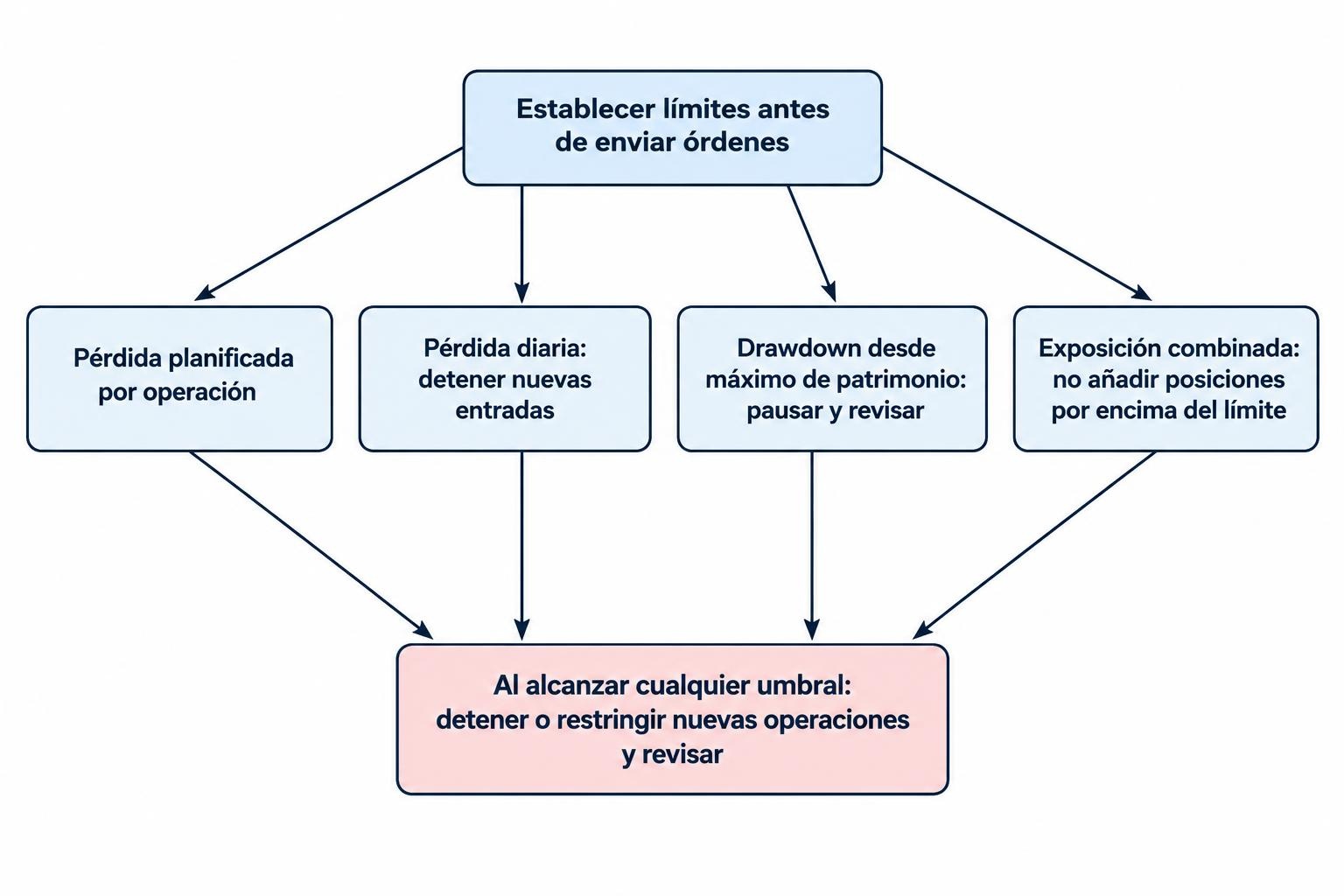
Set a daily stop and a drawdown threshold
A daily loss limit prevents a difficult session from turning into an open-ended attempt to win money back. Define how it is measured—such as realized and unrealized losses together—and what happens when it is reached. A rule might require the trader to cancel unfilled entry orders, stop opening positions, and review the session after the market closes. If the strategy is automated, the system should enforce the limit where possible, rather than relying on a trader to notice a message while orders are still active. A daily cap does not prevent every loss; fast markets, gaps, or a connection problem can push the account past a threshold before the system can respond.
An account drawdown is a decline from a chosen equity high to a later account value. Specify whether it is measured from the initial balance or from the account’s highest recorded equity, and whether open losses count. A peak-to-current measure can make a losing streak visible even if the account remains above its starting balance. For example, a hypothetical account that rises from $10,000 to $10,800 and then falls to $10,260 has declined $540 from its peak. A trader who set a $500 review threshold would pause, even though the account is still $260 above its starting balance.
Make the response to a threshold concrete. “Be careful” is not an operating rule. A response could be to disable live orders, check fills and data, compare actual trades with expected ones, and return to simulation until a documented review is complete. Choose thresholds that fit your finances and system; a universal drawdown percentage cannot account for every strategy, product, or personal situation. The system’s kill switches and trading limits should match the written plan, including what happens if the model stops responding or the account state cannot be confirmed.
Check exposure across positions
A trade-by-trade limit can understate risk when several positions depend on the same market move. Multiple assets may be correlated, or different strategies may all hold exposure to the same sector, currency, or factor. A set of positions that each appears small in isolation can create a large combined loss if the shared assumption fails. Count open positions together, including orders waiting to fill, and decide whether the limit applies to gross exposure, planned stop risk, or another clearly defined measure. The relevant measure depends on the instruments and strategy; a single simple formula does not capture every form of risk.
Leverage deserves a separate check. A small amount of account equity can control a larger position, so a modest price move may cause a large account-level loss. Products such as futures, options, and margin positions have different loss mechanics, and some can involve losses beyond the initial amount deposited. Understand the product’s contract terms and the broker’s liquidation and margin rules before trading it. A strategy that looks calm in a paper account may behave very differently if a sudden move triggers forced position reductions. Review leverage and correlated strategy exposure as part of the account-level risk plan.
Use a staged move to live trading
There is no need to switch from simulation to full intended size in one step. A staged process lets you verify operations with small amounts of capital while keeping the possible loss bounded by pre-set limits. Decide what each stage is meant to test; otherwise, a string of profitable trades can tempt you to increase size without resolving basic problems. A sensible sequence may include a final simulation check, a small live test, a review of real fills and costs, and only then a decision about whether to continue at the same size or change it.
- Check the setup: Confirm the instrument, account permissions, market data, order types, and time settings. Verify that the strategy’s entries and exits match its written rules.
- Test the process: Start with one or a few small positions, sized so the planned loss fits within your written limit. Do not raise the limit to accommodate a trade.
- Reconcile each order: Compare the intended order with what the account actually accepted, filled, or left open. Confirm the account position and available funds after execution.
- Review the evidence: Compare live fills, fees, slippage, missed trades, and system behavior with the assumptions used in testing.
- Make a documented decision: Continue, reduce size, return to simulation, or stop. Do not treat a profitable stretch by itself as proof that the model is reliable.
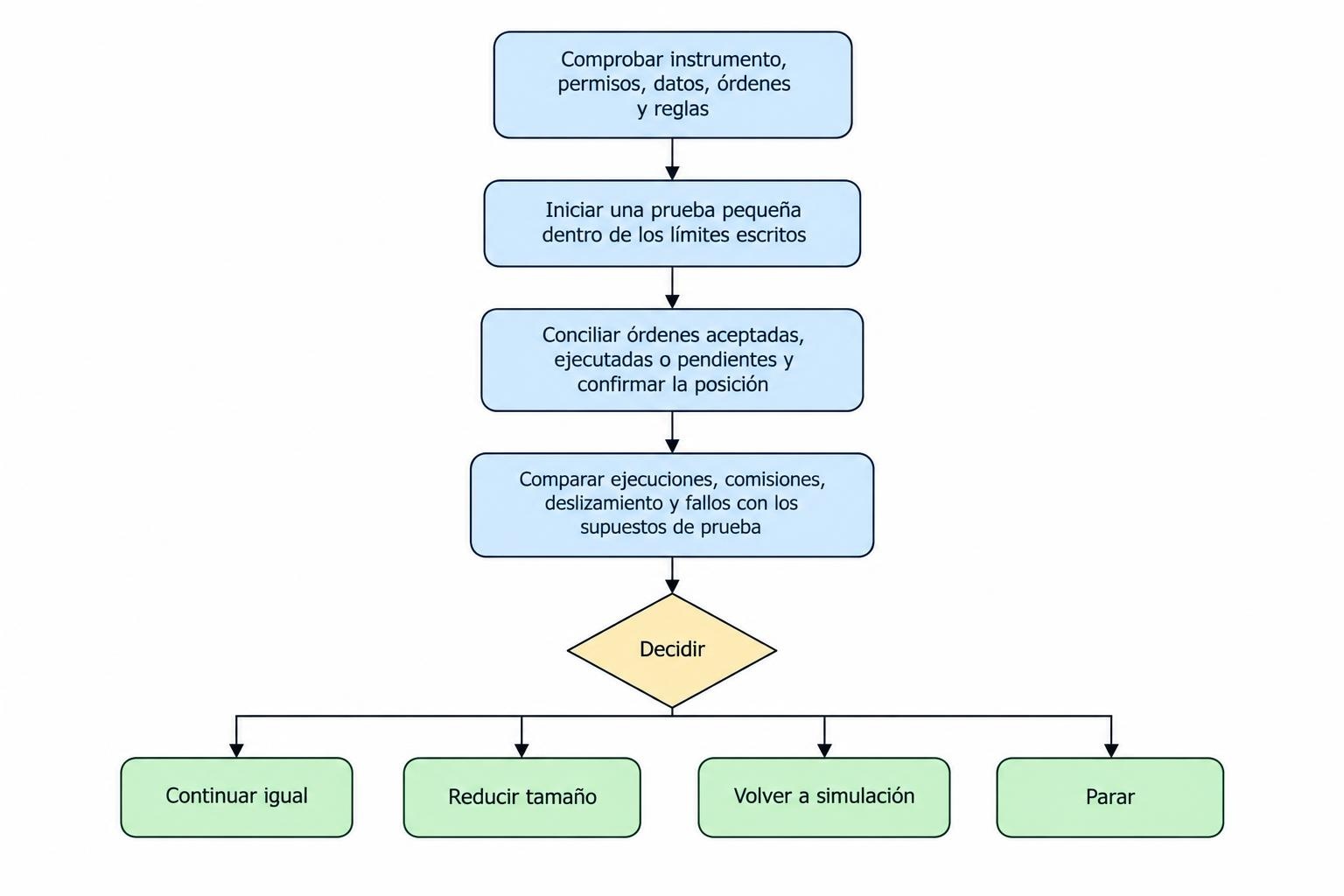
Keep the live test small enough that a run of losses will not force you to abandon the plan for financial reasons. A small test is still real trading, and even a single position can lose more than expected if the market moves sharply or an exit does not execute as intended. If the strategy uses automation, begin with controls that prevent accidental repeat orders and make it possible to halt new trading. The procedures for handling duplicate orders and connection failures are part of readiness, not a technical detail to leave until something breaks.
Review actual results against the plan
Record each live trade and the reason it was opened, including whether the model’s signal matched the rule that was supposed to trigger it. Save the order time, requested price, fills, fees, exit, and any error or manual intervention. Compare actual outcomes with the simulation’s assumptions, but do not judge a strategy from a handful of trades. A short sample can show operational defects; it usually cannot establish that a strategy has a lasting advantage. To assess performance, look beyond the percentage of winning trades and include the size of losses, costs, exposure, and the period covered. A broader set of trading performance measures helps distinguish a useful signal from a flattering but incomplete statistic.
Define review triggers in advance. These might include a daily loss cap, an account drawdown limit, a pattern of fills that are materially worse than assumed, repeated system errors, or a change in market conditions that invalidates the strategy’s operating assumptions. Set a review date as well, rather than waiting for a dramatic loss to force one. During a pause, check whether the result came from ordinary variance, a faulty signal, a data issue, a software defect, or a change in execution. Do not relax the limit simply because the next signal looks especially convincing.
Keep the system’s version and settings with each trade record. If model weights, prompts, data sources, thresholds, or execution rules change, mark when the change took effect. Otherwise, it becomes difficult to tell whether the results came from the original method or from later adjustments. Any material change should trigger a fresh test, because evidence from one configuration does not automatically apply to another. Review model drift and performance decay when deciding whether a weakening result calls for investigation, retraining, or a stop.
Decide when to pause or stop
Pause live trading if the account reaches a pre-set loss or drawdown threshold, if orders cannot be reconciled, or if the system is using data you cannot verify. A pause is also appropriate when a model begins producing signals outside its tested conditions, when trade costs consistently exceed assumptions, or when an unexpected manual intervention becomes routine. Define who can restart the system and what checks are required first. For an automated strategy, a kill switch should stop new orders; it should not leave the trader guessing about positions that are already open.
Do not treat a pause as a failure to follow through. Risk controls exist to limit damage while a problem is examined. A positive simulation record does not remove uncertainty, and a profitable initial live run does not justify increasing exposure without review. If you cannot explain the strategy’s current positions, determine whether its limits are active, or verify what happened to its latest orders, stop new trading until you can. The checks for claims about win rates and simulated returns are also useful when someone else’s results are influencing your decision to fund or scale a system.
Live trading should proceed only while the account’s exposure stays within limits you can afford and monitor. Keep a written record of the risk budget, stop conditions, review triggers, and restart criteria. Revisit them when your finances, strategy, or execution setup changes. If any limit is reached, follow the rule you wrote before the trade, not the one that would make the current position easier to hold.