AI hallucinations are fluent answers that contain false, unsupported, or internally inconsistent claims. In trading research, a chatbot might invent an earnings date, misread a ticker symbol, quote a price that was never current, or cite a report that does not exist. The answer can sound tidy and confident. That is not evidence that it is correct.
The risk grows when a trader treats generated text as verified market data or as a reason to place an order. AI can help organize research and test questions, but its output needs checking against dependable records. This guide explains common errors, how outdated information differs from hallucination, and a repeatable way to verify AI-generated trading research before acting on it.
What an AI hallucination means in trading
The National Institute of Standards and Technology uses the term “confabulation” for generative AI output that confidently presents false or erroneous content, departs from its input, or contradicts earlier statements. “Hallucination” is the more familiar term. The distinction matters because an answer may be grammatically sound and still be wrong. Language models generate text based on learned patterns; they do not automatically confirm every sentence against a live, authoritative record. NIST notes that the risk is especially relevant to open-ended responses and topics requiring context or expertise. Its Generative AI Risk Management Profile also describes how fabricated explanations or citations can make a false answer look more convincing.
In trading, an error can appear in a factual statement, a calculation, or the link between evidence and a conclusion. A model may get a company’s name right but attach the wrong ticker. It may summarize a filing while overlooking a footnote, or calculate a percentage change using mismatched dates. It can also present a plausible explanation for a price move without evidence that the proposed cause actually drove it. Each error needs a different check: confirm identity, recalculate numbers, inspect the original document, and separate observed facts from interpretation.
Hallucinations are one part of the wider set of AI trading risks. They are not the same as a losing forecast. A forecast can be wrong even when its inputs and calculations are accurate; a hallucination introduces or distorts information the analysis relies on. That distinction helps with review. Check whether the underlying facts were real before judging whether the trading idea was sound.
Common hallucination patterns in AI trading research
Some mistakes are easy to spot; others hide inside a plausible summary. A chatbot may create a nonexistent company announcement, attribute a quote to the wrong executive, or mix details from two companies with similar names. It might supply an incorrect earnings date, dividend amount, analyst estimate, or regulatory filing reference. Numbers deserve particular care: a misplaced decimal, an incorrect unit, or a figure taken from a different reporting period can materially change an interpretation.
AI may also invent a source or make a real source appear to say more than it does. A citation can point to a genuine report but support a claim absent from the report. A summary may quote a sentence accurately while omitting the condition or comparison that changes its meaning. In chart analysis, the model may describe a pattern that is not present in the image, or treat a visual observation as a reliable signal without checking the timeframe and price data. For a closer look at what image-based review can and cannot establish, see AI chart analysis and its limitations.
| Error type | Example in trading research | First check |
|---|---|---|
| Invented fact | A company is said to have announced a buyback, but no announcement exists. | Search the company’s official filings and investor relations releases. |
| Wrong entity | A headline or financial figure is assigned to a similarly named company. | Confirm the issuer, ticker, exchange, and document date. |
| Stale information | An old share count, management team, or market price is presented as current. | Check the relevant date and a current primary record. |
| Misleading summary | A real filing is described without its qualification, period, or risk disclosure. | Read the cited passage in context. |
| Faulty calculation | A percentage change uses inconsistent dates or units. | Recalculate from the original figures. |
| Unsupported inference | A price move is attributed to a news item without evidence of causation. | Label the explanation as a hypothesis, not a verified cause. |
Hallucination or outdated information?
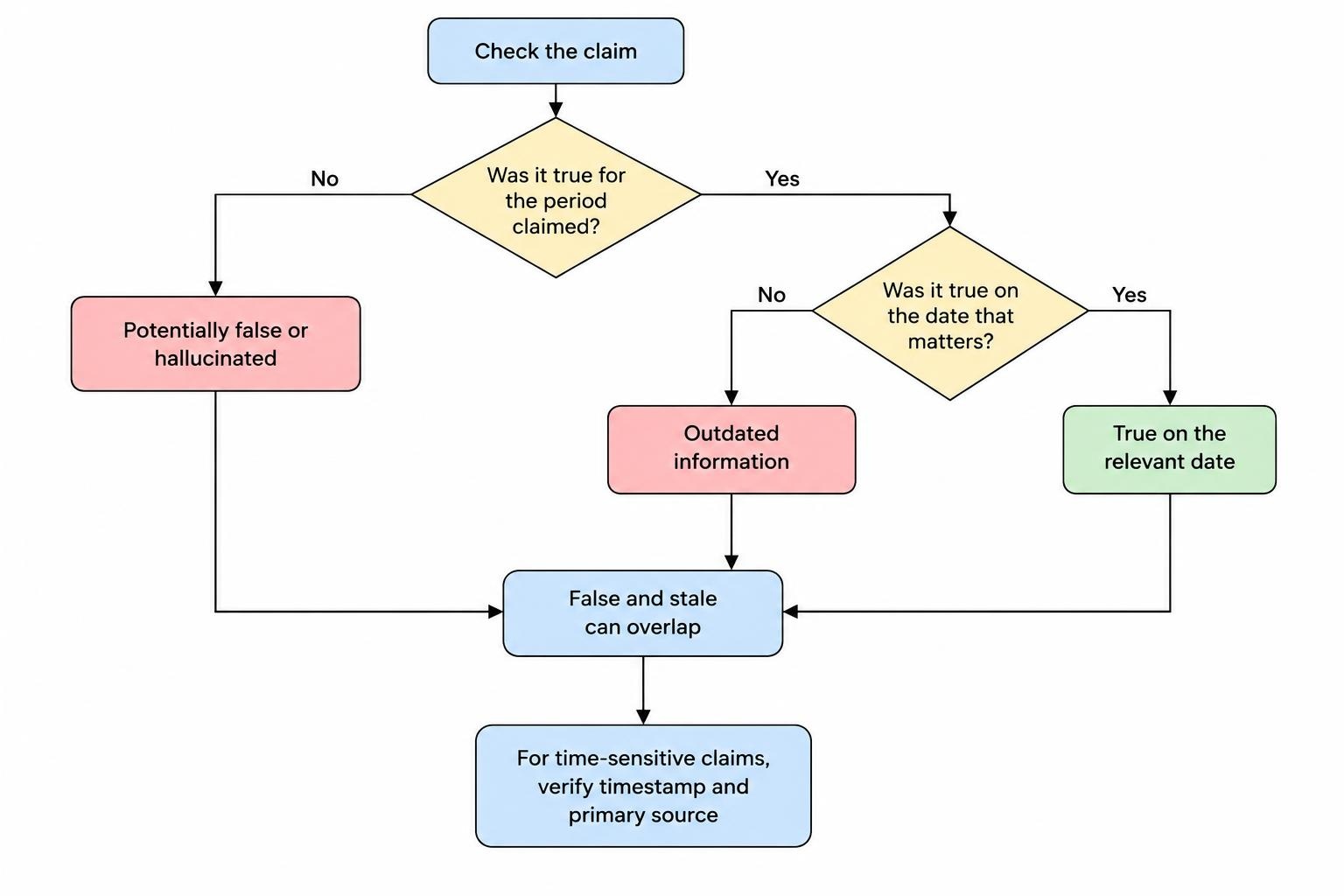
Outdated information is not always invented information. A model may accurately repeat a price, company executive, or policy that was correct at an earlier date. The answer becomes misleading when it is presented as current. A hallucination, by contrast, may be false even for the period it claims to describe. In practice, the two can overlap: the system may combine a genuine older fact with a made-up update or infer a present-day status from incomplete material.
Ask two questions for every time-sensitive claim: “Was this true?” and “Was it true on the date that matters?” For market prices, corporate actions, earnings, filings, and economic releases, confirm the relevant timestamp and data source. A date without a time zone may also be ambiguous when comparing releases across markets. Avoid relying on a chatbot’s apparent knowledge of “today”; unless it retrieves and shows current data, its answer may reflect old information or no live information at all.
Retrieval tools and web search can reduce the gap between a model’s stored knowledge and recent events, but they do not make every answer reliable. A system can retrieve an outdated page, select a weak source, confuse two documents, or summarize a current source incorrectly. Treat links and citations as leads to inspect, not as proof. For source discovery and interpretation, use a defined AI-assisted market research process that keeps the original record visible.
Why confident wording and citations can mislead
Fluency is a feature of the output, not a measure of its factual accuracy. A response may use exact numbers, formal language, and a step-by-step rationale while still resting on a false premise. NIST specifically warns that generated explanations and citations can themselves be fabricated, making people more likely to trust an incorrect answer. Asking the same model to “double-check” its work may catch some inconsistencies, but the second response is not independent evidence. It can repeat the first error or produce a different unsupported answer.
Financial research has particular demands: ticker symbols can overlap, figures depend on reporting periods, and prices change constantly. A 2023 empirical study tested language models on financial concepts, abbreviations, stock symbols, and historical price queries. Its results documented errors in those tasks and evaluated methods such as retrieval augmentation and tool use. The study is evidence that these failure modes can occur, not a scorecard for every current product or a guarantee that any one mitigation works in every workflow. Read the paper’s scope before applying its results to a present-day tool: the study of hallucinations in financial language-model tasks.
A practical source-verification process
Start by breaking an AI-generated answer into claims that can be checked separately. “The company raised guidance after strong quarterly results” contains several claims: the company issued guidance, the guidance changed, the results were strong by some defined measure, and the timing or relationship between these events is accurate. Verify each material statement rather than accepting the sentence as one package. If the output mixes facts, calculations, and opinions, label them separately in your notes.
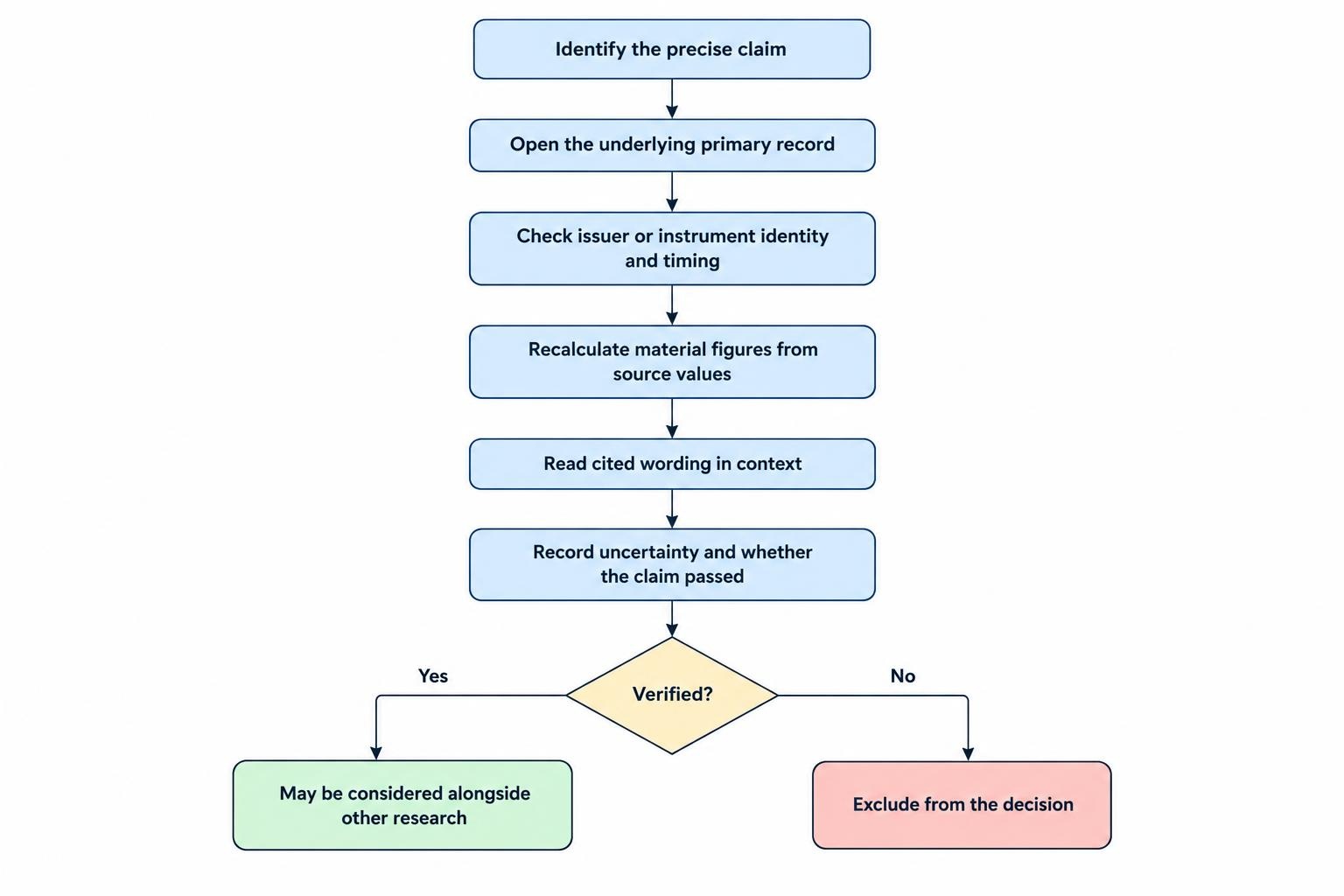
- Identify the claim. Record the company or asset, the precise statement, the date, and any number or quotation that could affect a decision.
- Open the underlying record. Prefer the issuer’s filing or release, an exchange notice, a regulator publication, or the original dataset over a chatbot summary or a repost.
- Check identity and timing. Match the ticker, issuer, document, reporting period, publication timestamp, and relevant market session.
- Recalculate material figures. Use the source values and a separate calculation method. Check units, currency, date ranges, and whether a figure is per share, total, annualized, or adjusted.
- Compare wording with context. Read enough of the source to catch caveats, definitions, exclusions, and statements that qualify the claim.
- Record what remains uncertain. Mark missing evidence or disputed interpretation. Do not turn an unverified explanation into a confirmed fact.
For market prices and trading volume, use a data source that supplies the relevant instrument, venue, interval, adjustment method, and timestamp. For company facts, check official filings and releases. For economic figures, use the issuing statistical agency or central bank. A search result snippet is not a substitute for the underlying record; it may be clipped, stale, or drawn from a page that has changed.
Keep a short audit trail: the AI output, the claim you checked, the record used, the date you accessed it, and whether the claim passed. This helps when an idea is reviewed later, especially if the source is updated or a trading decision is questioned. The same record-keeping habit can support a trading journal review, where a trader separates what was known at the time from what became clear later.
How to prompt for answers that are easier to check
A prompt cannot guarantee factual accuracy, but it can make unsupported details easier to notice. Ask the model to separate claims from interpretations, state when it lacks evidence, and identify the source document and relevant passage for each factual point. Provide a bounded question and dated source material when possible. For example: “Using only the attached quarterly filing, list the company’s reported revenue and operating income for the stated quarter. Give the page or section for each figure. If the filing does not contain a requested item, say so.” Then inspect the filing yourself.
Avoid prompts that reward confident completion, such as asking the system to explain a price move when the cause is unknown. That request encourages a tidy narrative even when the available evidence cannot establish causation. Ask instead for possible explanations, the evidence for and against each one, and what additional data would help distinguish them. A useful answer should preserve uncertainty, not erase it.
Do not treat a model’s confidence score, polished rationale, or agreement across repeated prompts as verification unless you know what the score measures and how the system was tested. Repeating a question can expose unstable output, but consistent answers can still share the same error. A separate source or an independent calculation is stronger evidence than asking the same system to reassure you.
When AI output should not drive a trade
Do not use an unverified chatbot answer as the sole basis for an order, position size, or risk limit. Be especially cautious with claims about breaking news, earnings surprises, regulatory action, halted securities, corporate actions, or precise live prices. A delay of minutes can matter for some strategies; a fabricated headline can matter even more. If the underlying source cannot be confirmed, leave the claim out of the decision process.
FINRA warns investors not to rely solely on AI-generated information for investment decisions or market predictions, noting that the output can draw on inaccurate, incomplete, misleading, false, or outdated information. Its guidance also recommends verifying underlying sources and reviewing more than one source. That is a practical baseline, not a claim that any fixed number of sources guarantees correctness. Read FINRA’s guidance on AI-generated investment information.
Marketing claims deserve the same skepticism as market analysis. A platform that says its AI identifies certain winners, predicts every move, or produces a high win rate should provide clear, checkable evidence, including definitions and test conditions. A made-up citation or unsupported performance figure is a warning sign, not a reason to proceed. Use a separate review of claims about AI trading results and backtests before treating promotional numbers as evidence.
Build verification into the trading workflow
Source checking works best before the analysis reaches an order decision. Set a rule that factual claims need a traceable source, calculations need reproducible inputs, and interpretations must be labeled as interpretations. Keep a human review step for decisions with material financial consequences. If a system cannot show where a claim came from, treat that claim as unverified instead of filling the gap with a plausible explanation.
Test the process on ordinary and difficult cases before relying on it. Include questions with similar ticker symbols, missing information, old documents, conflicting dates, and unsupported premises. Record where the model makes mistakes and whether the verification steps catch them. This checks the workflow, not just the model. A testing and validation plan for AI trading systems can help distinguish model output quality from the performance of a complete trading strategy.
For an individual trader, the operating rule is straightforward: use AI to organize questions, summarize material you can inspect, and generate hypotheses for further review. Confirm facts with the records that establish them. Recheck time-sensitive information at the point it matters. If a claim cannot be verified, do not let confident wording promote it into a trading signal.