AI trading bot scams sell certainty. The pitch may promise a bot that trades stocks, forex or crypto around the clock, claims a near perfect win rate, or says a proprietary model can produce steady income with little effort. Some offers sell software or signals; others ask you to deposit money into a platform supposedly managed by the bot. The technology changes, but the sales pressure and warning signs are familiar.
A real automated system can place orders according to rules, and machine learning can help analyze data. Neither makes profits certain or removes the risk of loss. Be especially careful when a seller ties an extraordinary return to secret AI, refuses to explain how the service works, or asks you to trust a dashboard instead of independently verifiable records. This guide covers the signs to check before paying, and what to do if you already sent money. For broader investing hazards, see the guide to AI trading risks and trader protection.
What an AI trading bot scam can look like
Some scams advertise a downloadable bot or a subscription to trading signals. Others present a managed investment: you send money to a website, and the operators claim their AI trades it for you. A polished website, technical vocabulary, a mobile app or a convincing support chat can make the offer feel established. None of those things proves that real trades are taking place, that the displayed account balance is genuine, or that customer funds are being handled as promised.
The U.S. Commodity Futures Trading Commission warns that fraudsters use interest in AI to market trading bots and signals with extreme or guaranteed returns. In one case described by the agency, a scheme displayed fake customer balances using demo trading accounts while little of the money was actually traded. The CFTC advisory on AI trading bots describes the warning signs and stresses that AI cannot predict the future or sudden market changes.
Some operators sell software that does not trade at all. Others may offer a functioning tool while making deceptive claims about its results, costs or risks. A product can also be risky without being a scam: a bot might place real orders and still lose money, behave differently from its backtest, or fail when market conditions change. The task is to assess both the seller’s conduct and the trading system’s evidence. A closer look at win rate, backtest and guaranteed-return claims can help separate measurable evidence from sales language.
Red flags in bot marketing
| Claim or behavior | Why it deserves scrutiny | What to check |
|---|---|---|
| Guaranteed profits or a fixed monthly return | Market returns are uncertain. A guarantee can disguise the risks or misrepresent what the seller controls. | Ask for a written explanation of losses, drawdowns, fees and the person or company responsible for the promise. |
| Near perfect win rates or enormous returns | A high win rate does not show how large losing trades are, whether results are real, or whether costs were included. | Request independently verifiable live results and a complete account of fees and losing periods. |
| “Secret” AI, proprietary algorithms or complicated jargon | Technical terms can make a weak offer hard to question without providing evidence of actual performance. | Ask what the system trades, how orders are placed, and what can cause it to lose money. |
| Pressure to act now or recruit friends | Urgency can stop you from checking the offer. Referral rewards can make recruitment central to the pitch. | Pause, review the offer independently, and check whether payment depends on bringing in others. |
| Payments by crypto or requests to pay extra to withdraw | Crypto payments can be difficult to reverse. A demand for a new “tax” or release fee may be an attempt to extract more money. | Do not send more funds to unlock a displayed balance. Contact your bank, payment provider or exchange promptly. |
Promises of high returns with little risk, vague investment details and pressure to commit are recognized warning signs in the Federal Trade Commission’s guide to investment scams. A risk disclosure does not cancel out a guarantee elsewhere in the sales pitch. Read the whole offer, including the terms, and pay attention to what the seller says in messages or group chats as well as on the main website.
Check who is behind the offer
Find the legal name of the company and the people operating it. Look for a real address, named management, clear customer support details and written terms that identify who holds the funds. Then search those names separately, along with words such as “complaint,” “fraud” and “withdrawal.” A new website, copied biographies or stock-photo executives do not prove fraud on their own, but they are reasons to slow down and check further. The CFTC recommends checking the identity of key people and the history of a trading website before trusting an AI trading offer.
Check registration through the regulator’s own database when the service claims to provide investment advice, manage money or trade a regulated product. The correct database depends on what the business does and where it operates. U.S. investors can use Investor.gov’s professional background search for information on securities professionals and firms. For futures, forex, commodity pools and other derivatives, the CFTC points to registration and disciplinary checks through the National Futures Association. Its registration and background check guidance explains where to look.
A registration entry is not proof that a bot will make money, and it does not guarantee that a particular offer is safe. Check that the name, website, contact details and account destination match the legitimate firm’s records. Scammers may impersonate a registered company or borrow a real person’s credentials. Do not rely on a registration number or regulator logo displayed only on the seller’s own site; look up the details through the regulator directly.
Test the performance claims, not the presentation
A screenshot of a profitable account is easy to produce and difficult to verify. It may show a demo account, selected trades, an edited balance or a platform the seller controls. Ask what period the results cover, whether they come from live trading, what the largest loss was, and whether the figures include spreads, commissions, subscriptions, financing and slippage. A backtest can help assess a strategy, but it cannot establish that the same results will continue in live markets.
Ask for a full record rather than a winning week or a chart with no scale. Results should include losing periods and describe how the system decides when to enter, exit and stop trading. If the seller refuses basic questions on the grounds that the model is secret, treat the performance claim as unverified. The article on overfitting and data leakage explains why impressive historical results can fail to reflect what a system would have known at the time.
Look for independent confirmation where available, but read what it actually verifies. A payment receipt proves a payment, not a profitable trading record. A software review may assess usability, not whether returns are genuine. Testimonials can be fabricated, selectively presented or written by people who earn referral fees. Be wary of marketing that treats customer stories, a “live” dashboard or a badge as a substitute for records that can be checked independently.
Understand where your money and trading access go
Before paying, establish whether you are buying software, signals, education or a managed investment. These are different services, with different costs and risks. Read the contract for recurring charges, cancellation terms, refund conditions, custody of funds and the process for closing an account. A seller that will not explain where deposits are held or how withdrawals work is asking you to take a risk you cannot properly assess. For a practical review of product features and claims, see how to evaluate an AI trading platform before paying.
Do not hand over the password to your brokerage, exchange or email account. If a legitimate tool connects to an account, review the requested permissions and use the narrowest access available. A tool that only analyzes data should not need permission to withdraw funds. Revoke access you no longer use, secure your email with a unique password and multifactor authentication, and never share a one-time login code with a salesperson or “account manager.” The guide to protecting broker API keys and trading permissions covers safeguards for automated connections.
Consider whether the seller’s fee structure creates pressure to trade often, upgrade, or recruit customers. Subscription costs and trading charges can erode results even when trades are real. Ask for the full cost in writing, including recurring fees and any charges for data or execution. The guide to AI trading software, data and execution costs explains how those expenses fit into a trading budget.
A recent example of how a fake bot pitch can work
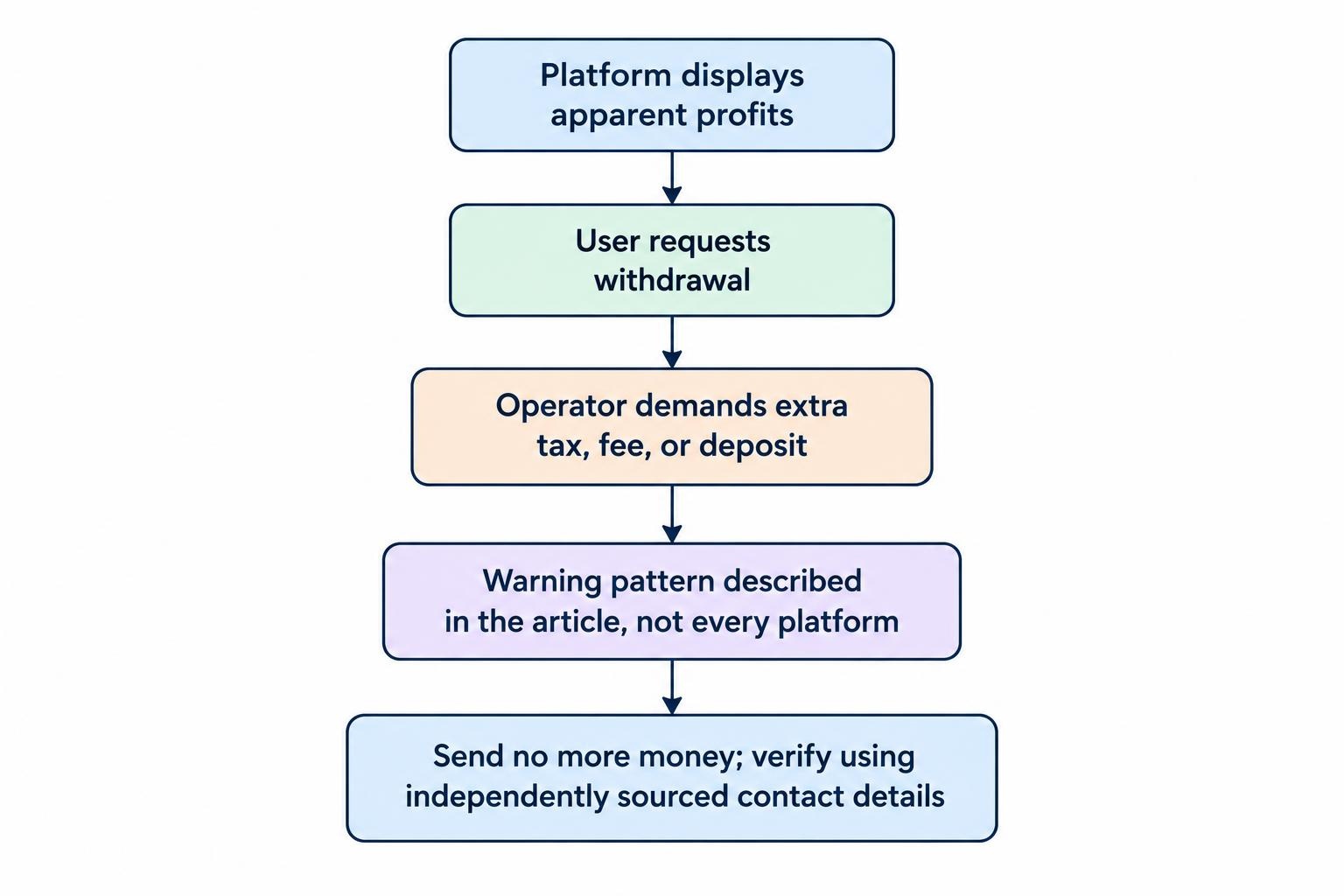
In a complaint filed on September 29, 2026, the SEC alleged that operators marketed a supposed AI bot program with guaranteed returns, displayed nonexistent profits in investor accounts and falsely claimed SEC regulation. The complaint also alleges that investors were told their accounts were locked and that extra payments were required to withdraw funds. These are allegations in a court filing, not a statement that every AI trading service is fraudulent. They do show why an account screen, a regulator-looking certificate and a withdrawal explanation should not be accepted as proof without independent verification. The SEC complaint describing the alleged AI trading bot scheme gives further detail.
Be alert when a platform displays fast-growing profits but makes withdrawals difficult. A demand for additional fees, taxes or deposits before a withdrawal is released is a serious warning sign. Do not pay just because the platform labels the charge official, urgent or refundable. Confirm the situation through contact details you find independently, not a phone number, link or chat account supplied by the person asking for money.
What to do before you pay
Put the decision on hold long enough to verify the seller and read the contract without someone coaching you through it. Save a copy of the offer, terms, performance materials and messages. Ask the seller to answer in writing: Who controls the funds? What happens when the system loses? What fees apply? How are results verified? Can you stop the service and withdraw without paying an additional release charge? Evasive answers, changing explanations or pressure to deposit while you are still checking are reasons to walk away.
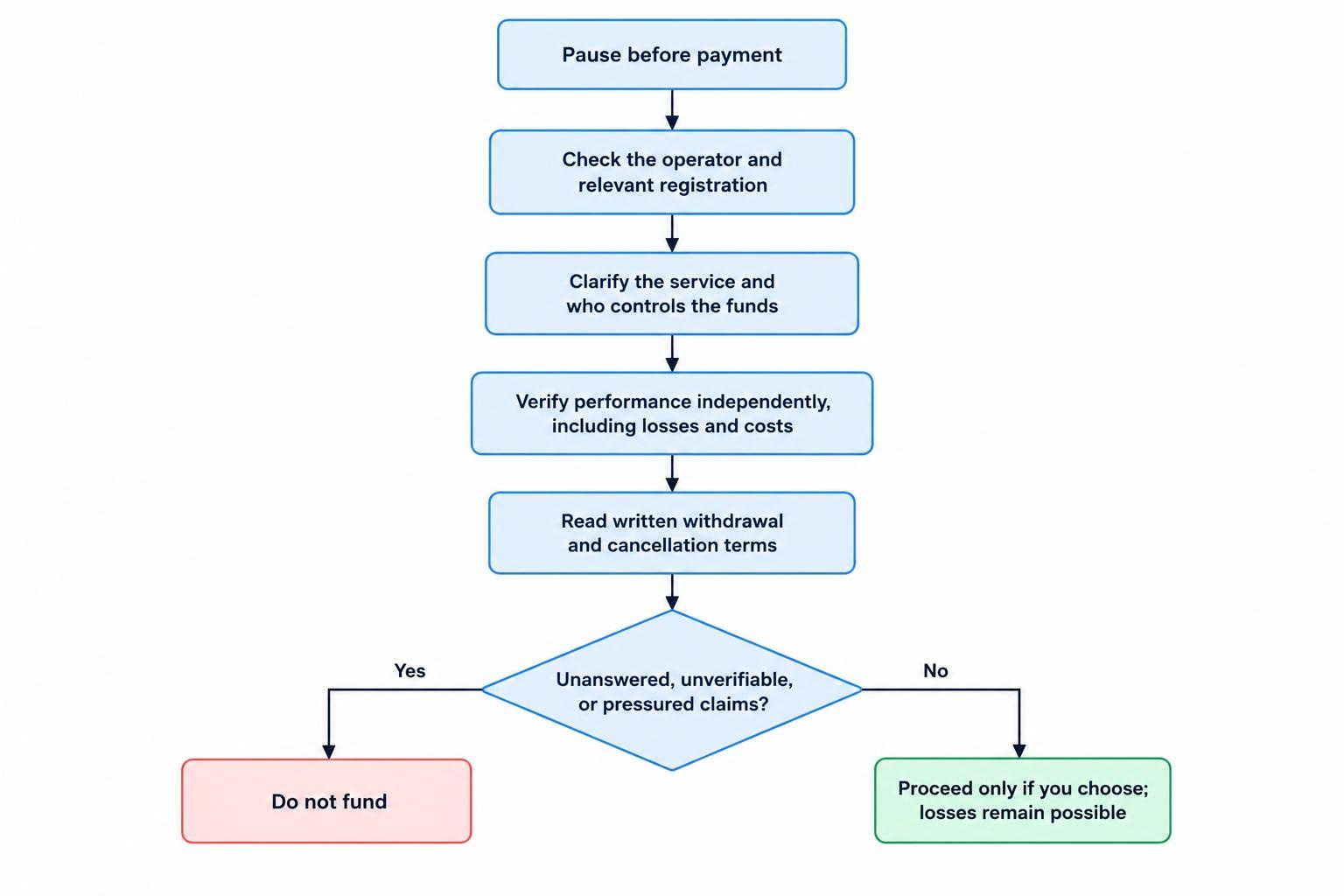
Do not start with money you cannot afford to lose, and do not treat a small successful withdrawal as proof of legitimacy. Some fraudulent schemes may allow early withdrawals or display returns to build confidence. If you decide to assess a legitimate tool, keep control of the account and permissions, and use a practice environment before considering live orders. Paper trading can test basic behavior, though it cannot prove that live execution or future results will match the simulation. The guide to moving from paper trading to live trading with risk limits covers that transition.
If you have already sent money
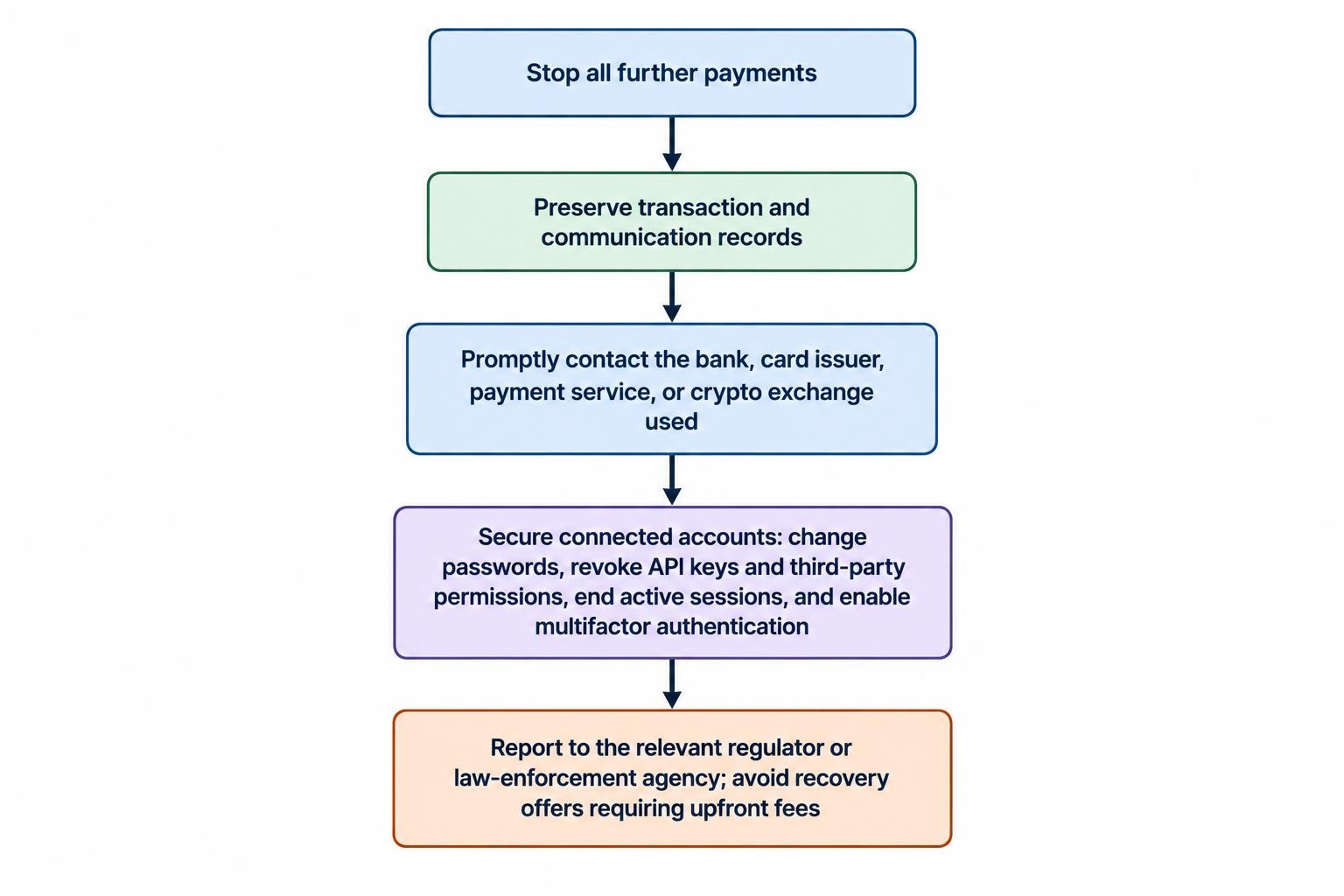
Stop sending funds, especially if someone says another payment is needed to release your balance or recover an earlier payment. Save transaction records, wallet addresses, emails, chat histories, account screenshots and the website address. Contact the bank, card issuer, payment service or crypto exchange used to make the transfer as soon as possible. Ask what steps are available to protect your account or dispute the payment; recovery is not guaranteed, and speed may matter.
Change passwords for any account you shared or connected, starting with email and financial accounts. Revoke API keys and other third-party permissions, sign out of active sessions and enable multifactor authentication. If the seller had identity or financial documents, monitor relevant accounts and consider contacting the appropriate institutions. Report the incident to the relevant regulator or law-enforcement agency in your jurisdiction. Be cautious of people who approach you offering to recover stolen funds for an upfront fee; that can be a second scam aimed at people who have already been targeted.
A credible trading tool should withstand ordinary questions about its operator, costs, risks and evidence. If the offer depends on guaranteed returns, opaque controls or a payment you cannot verify, do not fund it. More advice on misleading promotions appears in checking AI trading claims and verifying their sources.