Walk-forward testing evaluates a trading model on data that comes after the data used to build it. The process advances through time: train or update the model using information available at a given date, test it on a later period, move the date forward, and repeat. This creates a sequence of simulated decisions rather than one lucky split of historical data.
For an AI trading strategy, that distinction matters. A model can fit old prices, volatility, volume or news unusually well and still fail when conditions change. Walk-forward results show how the strategy performed across successive periods, under a defined retraining schedule. They do not prove that it will make money live. They can, however, reveal whether performance depends on one market phase, whether the model degrades between updates, and whether the research process has accidentally used information from the future.
What walk-forward testing measures
A walk-forward test imitates how a strategy could have been built and operated in real time. At each test date, the model may use only data that would have been available by then. It produces a forecast or trading decision for a later period. Once that period ends, its data can become part of the historical record available for a later model update, just as it would in live operation.
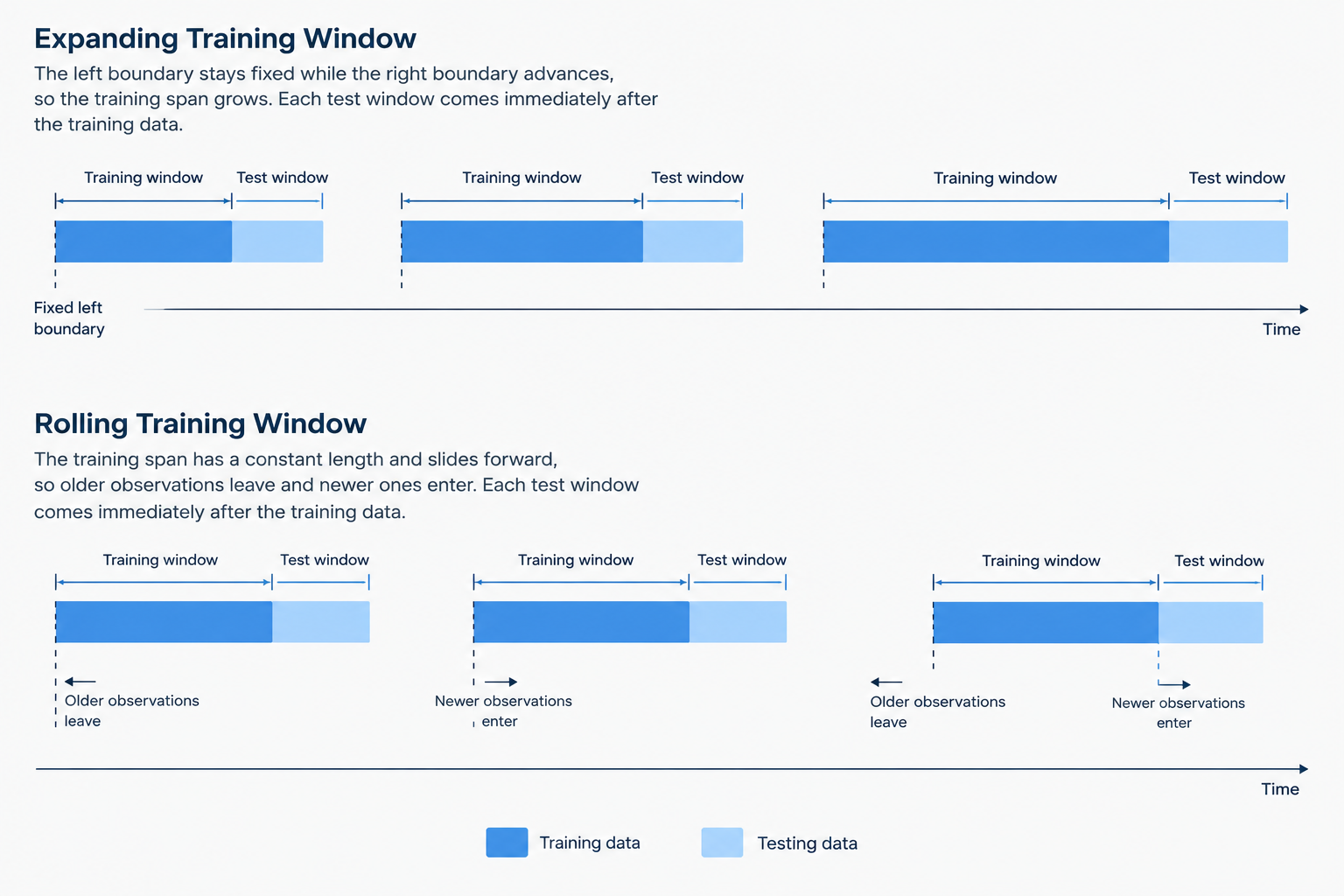
The test therefore has two parts: a training window, which supplies past observations for fitting or tuning, and a test window, which measures performance on later observations. The windows then move forward. Training can expand to include all available history, or roll forward over a fixed span. Test windows can be short or long, depending on how often the strategy would be evaluated, retrained or rebalanced.
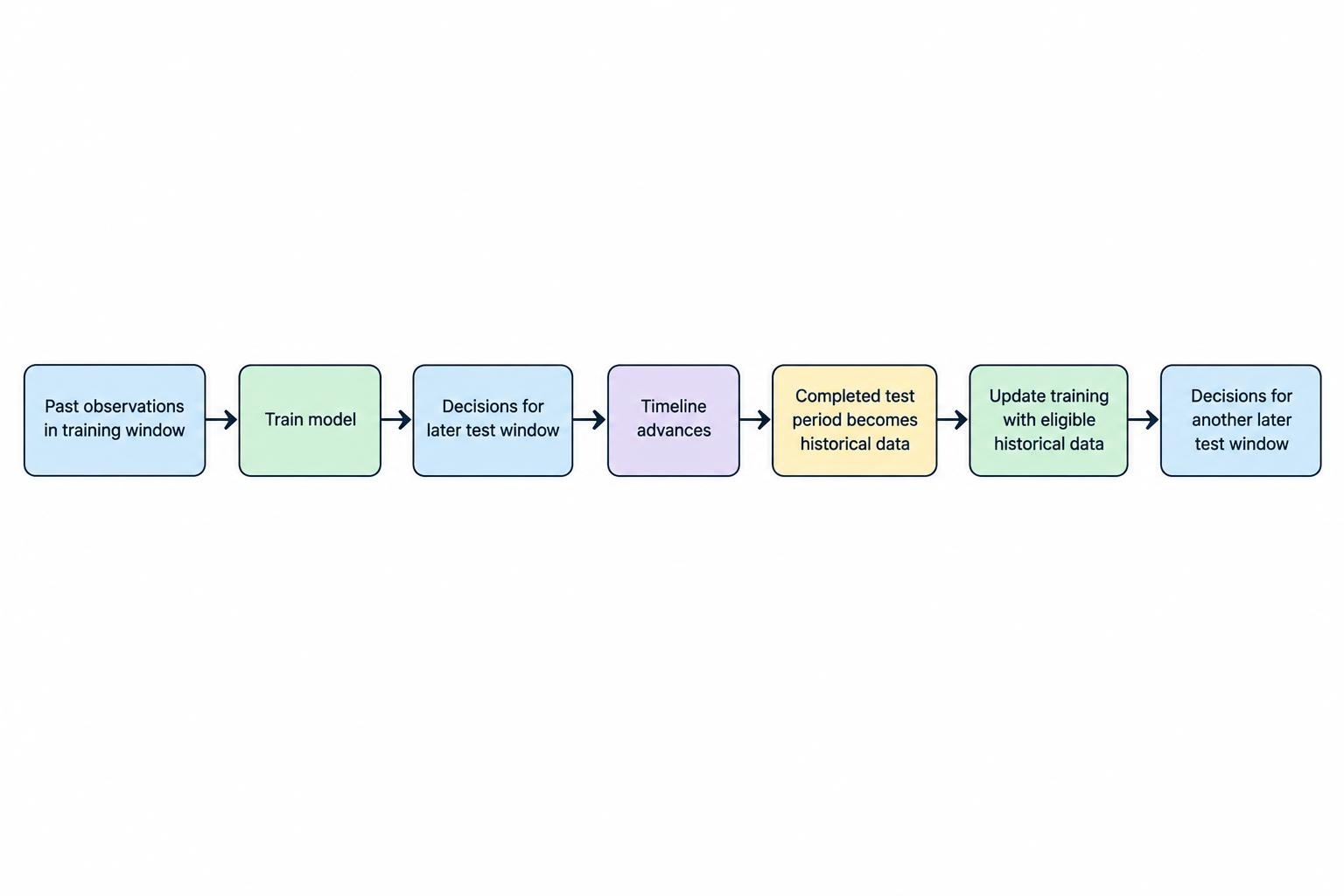
This approach differs from fitting a model once and testing it on one final block of data. A single holdout can be informative, but it may cover only one market condition. Walk-forward evaluation provides several chronological test periods, which helps show variation over time. The price of that extra view is more decisions to define and more chances to contaminate the evaluation if test results influence later research.
Walk-forward testing is one part of a broader process for testing and validating AI trading systems. It answers a practical question: if the model had been trained and updated according to this schedule, how would its decisions have performed on data it had not yet seen at each point in time?
A simple walk-forward example
Suppose a model uses daily market data and is retrained once a month. A researcher might fit it on the preceding three years of observations, generate signals for the next month, record those results, then move the training and test dates forward by one month. The next training set can include the newly completed month, because those observations would now be historical. The process repeats until the end of the available dataset.
The example is only a structure, not a recommended window size. A strategy that trades intraday, holds positions for weeks or retrains quarterly may need a different design. The training span should reflect the information the intended model would have at each update. The test span should reflect how long its forecasts or positions remain in use before the next planned update.
| Stage | What happens | What to record |
|---|---|---|
| Set the first training window | Fit the model using data available before the first test date. | Training dates, features, model version and settings. |
| Run the next period | Generate predictions and simulate trades for the following test window. | Signals, orders, fills, costs and portfolio results. |
| Advance the window | Move forward by the planned retraining or evaluation interval. | New dates and any changes permitted by the protocol. |
| Repeat to the end | Continue without using future information in earlier decisions. | Results for each window and the combined chronological record. |
Every date in the test period must occur after the data used to train the model for that period. That sounds obvious, but time leakage can enter through feature construction, revised historical datasets, labels that use future prices, or preprocessing fitted on the full dataset. A sound split cannot fix a feature that already contains information from beyond its decision date.
Expanding and rolling training windows
An expanding window starts with a fixed block of historical data and adds newer observations at each step. The model gets more training data over time. This can suit strategies that assume older observations remain useful, and it mimics a system that retains its full history. The cost is that very old data can dominate the fit even when market behavior has changed.
A rolling window keeps the training period at a fixed length. As the test date advances, the oldest observations fall out and recent ones enter. This can make the training sample more responsive to newer conditions, but it also discards information and may leave too little data for a complex model. A fixed duration is not automatically more adaptive; the useful window depends on the data, strategy and retraining schedule.
| Window design | Training data | Potential use | Main concern |
|---|---|---|---|
| Expanding | All eligible history up to the current date. | Models that benefit from a growing sample. | Old observations may no longer represent current conditions. |
| Rolling | A fixed recent span ending before the current date. | Models intended to adapt using recent data. | Shorter history can make estimates unstable. |
| Fixed initial fit | One historical training period, with no routine refitting. | Strategies designed to stay fixed for a known period. | Performance may weaken while the model remains unchanged. |
Compare window designs only within a documented research plan. Trying many spans, then reporting only the best-performing one, turns the test periods into part of the selection process. The apparent advantage may reflect repeated experimentation rather than a reliable feature of the strategy. Keep a record of all attempted choices, not just the winning configuration.
Choose the retraining schedule before testing
The test should reproduce the intended operating routine. If the planned system retrains each week, a monthly update schedule tests a different strategy. If parameters are adjusted after every disappointing test window, the evaluation no longer reflects a fixed protocol. Decide in advance when the model is allowed to retrain, which data it can use, and whether thresholds or risk limits may change.
Model retraining is only one part of the schedule. Some strategies update features daily but refit the model monthly. Others refit when a pre-defined data condition is met. Specify when the model receives new observations, when it calculates signals, when orders are simulated and how open positions are handled at the boundary between windows. A clear schedule also helps distinguish a model update from a discretionary decision to rescue a poor result.
For practical details on what counts as eligible input data, see the guide to preparing historical market data for AI research. Consistent timestamps, properly aligned prices and point-in-time records are part of the test design, not clerical cleanup. If a source later revises an economic release or corporate data, the test should use the version that would have been available at the simulated decision time.
Keep model selection separate from the test
A walk-forward test can be used for model selection, but then its results are no longer a neutral estimate of performance. If you compare dozens of feature sets, model types, thresholds and training spans across the same test windows, the winning result has benefited from repeated inspection. The more alternatives tried, the easier it becomes to find a historical pattern that will not persist.
A stronger design separates decisions into stages. Use training data to fit the model. Use a validation process to compare candidate settings and choose a configuration. Then measure that frozen choice on the next chronological test period. At a later scheduled retraining point, repeat the procedure using only data then available. Keep a final untouched period for an end-stage check if the amount of data permits. If you examine that final period and revise the strategy, it is no longer untouched.
Chronological splits matter because financial observations are ordered, and ordinary random splitting can train on later observations while evaluating earlier ones. The scikit-learn TimeSeriesSplit documentation describes a time-ordered splitter and its optional gap between training and test samples. That is a useful implementation reference, but a splitter alone does not guarantee that a trading experiment is leakage-free or faithful to real execution.
When labels cover a future interval, adjacent observations may have overlapping outcome periods. A label created from the return over the next ten sessions, for example, extends beyond the date of its input row. If training labels overlap the test interval, a simple gap may not be enough; the split should account for the full interval covered by each label. The right buffer depends on how features and labels are defined, rather than a universal number of bars.
Prevent leakage in each fold
Leakage occurs when the model, a preprocessing step or the researcher uses information that would not have been available at the forecast date. It can make a strategy look prescient. Common routes include normalizing data using the mean and standard deviation of the full dataset, selecting features after reviewing test-period performance, using corrected historical fundamentals without point-in-time records, or letting future prices influence a label that is treated as known at an earlier date.
Fit data transformations inside each training window. That includes scaling, imputation, feature selection and dimensionality reduction. Apply the fitted transformation to the following test window without recalculating it from test data. Store the dates and fit settings for each step so the process can be reproduced. For a fuller treatment of common traps, see overfitting, look-ahead bias and data leakage in trading models.
Also check the boundary between data collection and execution. A signal formed from a daily closing price cannot generally be filled at that same close unless the order could realistically have been submitted before the closing price was known. If a model calculates a signal after the close, the simulation should use a later executable price and account for the gap. Small timing errors repeated across many trades can materially distort results.
Some financial cross-validation designs use purging or embargo periods to handle overlapping label intervals and reduce information transfer across split boundaries. These are not automatic cures, nor do they replace a chronological simulation when the intended strategy learns from past data and trades forward. The research paper The Probability of Backtest Overfitting discusses how selecting among many backtests can undermine confidence in the chosen result.
Model the strategy, not just its predictions
Walk-forward evaluation should include the trading rules that turn predictions into positions. Specify the forecast horizon, entry threshold, exit rule, position sizing, maximum exposure and handling of conflicting signals. A model that predicts direction somewhat better than chance may still lose after costs or poor position sizing. A forecast metric alone cannot tell you what a trading account would have experienced.
Include commissions, spread, slippage, financing or borrow costs where relevant, and any other recurring expenses. Use assumptions that are plausible for the instruments and trading frequency under study. If real-time execution data are unavailable, report the assumptions and test a range of cost levels. A strategy that is profitable only when trades occur at idealized prices has not passed a practical test. The companion guide explains how to include fees, spreads, slippage and financing costs in a backtest.
Trading rules should account for portfolio state. A model may generate several correlated signals at once, exceed a position limit, or issue a new entry while an earlier position remains open. Simulate order timing, partial fills where material, position reconciliation and the handling of missing or rejected orders. Keep the results from the forecast model separate from the results of the execution assumptions, so a good prediction score does not obscure an unrealistic trading simulation.
Report performance with more than a win rate or a single headline return. Track drawdowns, volatility, turnover, exposure, the distribution of trade returns and performance after costs. Show results by test window as well as for the combined sequence. Guidance on measuring trading performance beyond win rate can help prevent a high proportion of small wins from hiding a few large losses.
Read results window by window
A combined return can conceal how the strategy behaved. One long bull-market window may account for most of the gains, while later periods are flat or negative. Report the dates and number of observations in every test window, and inspect the range of returns, costs and drawdowns across them. A strategy with one standout period and several weak ones needs a different interpretation from a strategy whose results are more evenly distributed.
Look for dependence on market conditions. A trend strategy may behave differently in a range, while a short-horizon model may be affected by volatility spikes or changes in liquidity. Breakdowns by regime can help explain performance, but they also create more comparisons. Treat such analysis as diagnostic unless the regimes and hypotheses were defined in advance. If a regime filter is adjusted after seeing which windows performed poorly, test the revised strategy on fresh data.
Compare the model against simple alternatives, such as a no-position baseline, a relevant buy-and-hold benchmark, or a transparent rule-based strategy with similar exposure and trading frequency. A model that beats cash but trails a suitable passive benchmark may not justify its complexity. The test should use a comparison that matches the strategy’s market, risk and holding period; the guide to comparing AI strategies with relevant benchmarks covers that choice.
Do not treat every test window as an independent sample. Returns often cluster in time, and windows may share market conditions or, under some designs, positions held across a boundary. Report the number of windows, their dates and how positions carry forward. Avoid presenting a precise-looking average as proof that the next period will match it. Historical performance is a record of the tested setup, not a promise about future results.
Common walk-forward design errors
- Choosing the best schedule after trying many. Training lengths, update frequency, features and thresholds can all be tuned. Keep the trial log and reserve genuinely unseen data for any final assessment.
- Letting test results influence later design. Repeatedly changing rules in response to test windows gradually turns those windows into training material for the researcher.
- Using a gap without checking label timing. A fixed gap can be inadequate when outcomes span several days or feature records arrive late.
- Assuming each fold is a separate live trial. Later folds may use earlier test observations as training data. That can accurately simulate scheduled retraining, but it does not make the full sequence an untouched holdout after the results have been reviewed.
- Ignoring execution and costs. Predictions do not become tradable returns without order timing, fill assumptions, position limits and expenses.
- Reporting only the aggregate. A single cumulative figure can hide regime dependence, long periods of losses or one unusually favorable window.
When walk-forward testing is not enough
Walk-forward testing cannot recreate every live condition. Historical data may omit market impact, queue position, outages, changing fees or the delay between signal generation and order execution. Some risks are hard to reconstruct from bar data alone. A test is only as realistic as its records and assumptions.
It also cannot erase research selection bias. Each time you inspect a result and change the strategy, you create another experiment. A long sequence of walk-forward windows does not solve that problem if the same windows guided dozens of revisions. The number and nature of trials matter, and a clean protocol should record them alongside model settings.
After historical tests, a paper-trading stage can check data handling, signal timing and operational behavior without risking capital. It does not establish that future live fills or returns will match the simulation. The guide to paper trading an AI system explains what simulated operation can and cannot verify.
Performance may also change after deployment because market conditions, data quality, participant behavior or the system itself changes. Monitor predictions, positions, costs and execution against expected ranges. Set rules for investigation, pausing and retraining before a problem occurs; do not assume that a scheduled refit will fix every decline. See model drift and performance decay for ways to frame that monitoring.
A practical walk-forward protocol
- Define the strategy. Record the instruments, decision times, forecast horizon, trading rules, risk limits and intended execution method.
- Freeze the data rules. Specify the sources, timestamps, point-in-time requirements, missing-data treatment and feature availability.
- Choose the windows. Set expanding or rolling training, test duration, update frequency and any gap needed for label overlap.
- Separate fitting and selection. Keep transformations and model fitting inside each training period. Use an explicit validation method for tuning, not the test window.
- Simulate orders and costs. Apply realistic timing, spread, fees, slippage, financing and position constraints.
- Save fold-level records. Store each window’s dates, model version, parameters, signals, trades, costs and results.
- Review the entire sequence. Examine individual windows, drawdowns, turnover and benchmarks, while recording every design choice prompted by the results.
- Protect a final check. If enough history remains, reserve a later period for evaluation after the strategy design is fixed. Do not revise the system and continue describing that same period as untouched.
A useful walk-forward test is a reproducible operating simulation. It states what the model knew, when it knew it, how it was updated and how the resulting orders were priced. When the process is documented, weak periods become evidence to investigate rather than inconvenient rows to delete, and strong periods can be judged against the same rules.