A financial trading model should be tested on data it did not use to learn, tune, select features, or choose a strategy. That sounds straightforward until a dataset contains overlapping trade outcomes, revised economic data, indicators calculated using future values, or hundreds of attempts at improving a backtest. A clean split is not just a row number. It is a record of what information was available at each simulated decision, and when.
Training, validation, and test sets serve different jobs. The training set teaches the model. The validation set helps choose its settings and compare candidate versions. The test set provides a final check on the choices already made. If information from the test period influences development, it no longer functions as an independent test. The strategy may still perform well, but the reported result has become less convincing.
This guide explains how to divide financial time series, handle common leakage risks, and read the results without treating a single test score as proof of future performance. It sits within the broader process of testing AI trading systems, but focuses on one part of that process: making sure that model development and evaluation do not borrow answers from the future.
What each data set is for
| Data set | Purpose | Permitted use |
|---|---|---|
| Training | Fit model parameters and learn patterns | Model fitting, plus preprocessing fitted only on this data |
| Validation | Compare model versions and settings | Choosing features, thresholds, architecture, and other development decisions |
| Test | Estimate performance on data reserved from development | Final evaluation after choices are frozen |
In a basic chronological split, earlier observations go to training, a later period goes to validation, and the most recent reserved period goes to testing. For example, a research dataset could use its first 60% of observations for training, the next 20% for validation, and its final 20% for testing. Those percentages are a teaching example, not a standard. The right lengths depend on how much history exists, how often the strategy trades, how long its holding period is, and whether the test window includes enough market conditions to be informative.
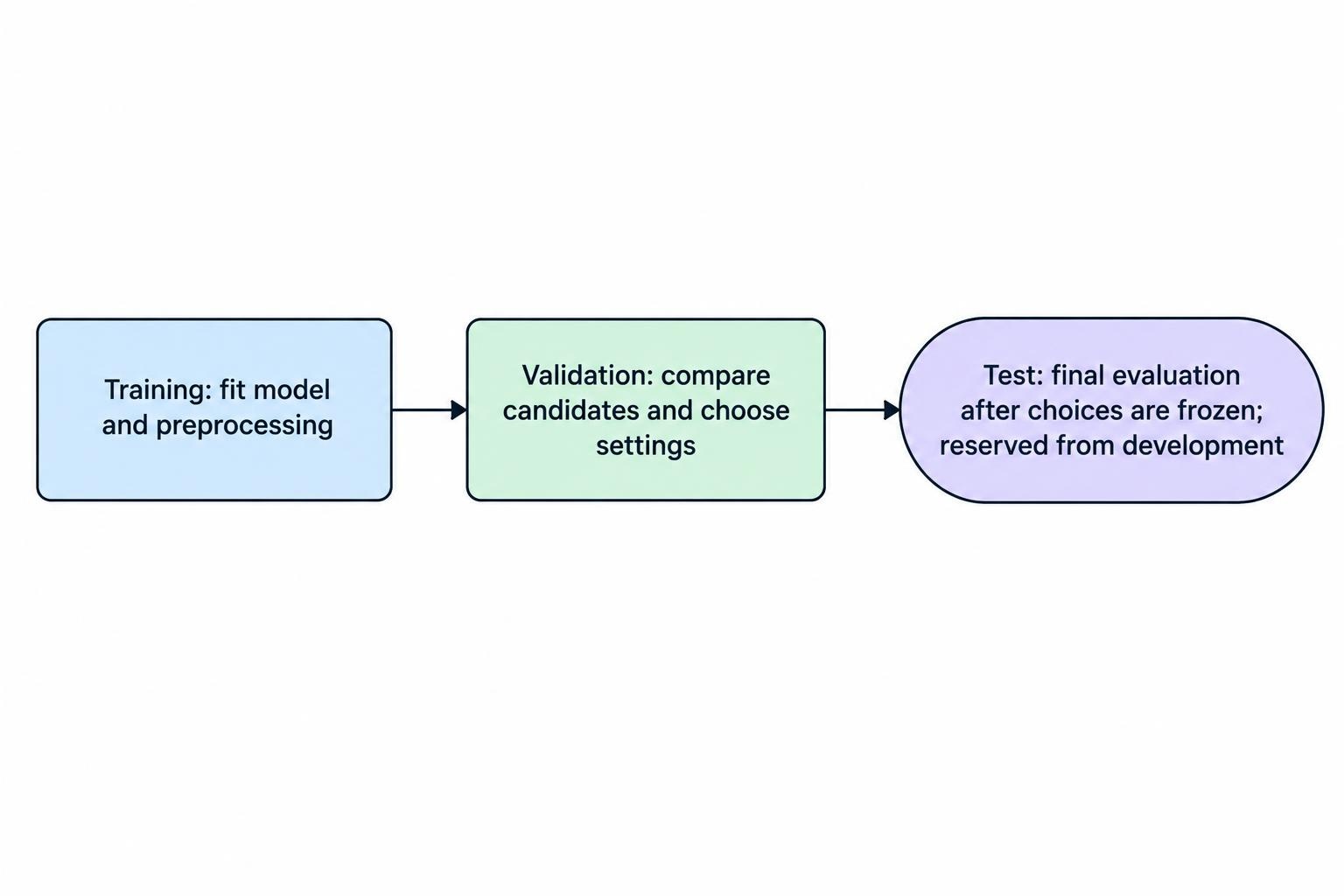
Set the dates before fitting the model. Then record them. Changing the split after seeing disappointing test results turns the test period into part of the development process: each new attempt gives the researcher another chance to adjust the strategy to that period. A test set can be revisited for investigation, but the revised model needs a fresh, untouched evaluation period before its results can be described as independent.
Why random splitting is usually a poor default
Financial observations have an order. A model evaluated on a random sample of dates may be trained on observations that occur after some of its test dates. That can answer a different question from the one most traders care about: how would a system built with information available at the time have performed on later data? The random split can also place closely related observations on both sides of the boundary, making the test score look more persuasive than a genuine forward-in-time evaluation.
A time-ordered split avoids training on later rows than the test period. The scikit-learn TimeSeriesSplit documentation describes this approach for observations recorded at fixed intervals and notes that shuffling is inappropriate for its time-series cross-validator. Its optional gap parameter can exclude samples between the end of the training set and the beginning of the test set. The gap is not a universal fix, though: it must match the timing and overlap of the labels being predicted.
Chronological order alone cannot guarantee a clean evaluation. A feature might be calculated using the full dataset, a company’s historic membership in an index could be replaced with today’s membership list, or a news item could be assigned to the wrong publication time. The research on information leakage in financial machine learning discusses how selection, preprocessing, feature construction, timestamp alignment, and validation can each introduce information that would not have been available at the simulated decision time.
Choose boundaries that match the trading question
Before choosing a split, write down what the model is meant to do. A model that is retrained every week using the latest observations has a different evaluation setup from one fitted once and left unchanged for a year. A strategy with a one-day forecast horizon has different label timing from a strategy that predicts a return over the next month. The split should reproduce the intended use as closely as the available history permits.
For many retail trading studies, the first useful arrangement is a chronological holdout: fit on the earliest period, select settings on a later period, then evaluate once on the final reserved period. This arrangement is simple to inspect and explain. It also has a weakness: one test window may reflect an unusually favorable or unfavorable patch of market history. A result from that window is a sample, not a promise that later markets will behave the same way.
A rolling evaluation can provide more than one forward test. The researcher trains using information available at a chosen date, tests on the next block, moves forward, and repeats the process. In an expanding window, each new training set keeps the earlier observations and adds newer ones. In a rolling window, older observations eventually drop out, keeping the training history at a fixed length. Use an expanding window when older data remain relevant; use a rolling window when the planned live process intentionally limits how far back it learns.
Each test block must remain in the future relative to its training data if the purpose is to estimate forward deployment. If the model will be retrained between blocks, mimic that schedule. Fit on the available history, produce predictions for the next block without using its outcomes, then move the simulated date forward and refit only if that matches the intended live process. This is often called walk-forward evaluation; more detail belongs in walk-forward testing and out-of-sample strategy evaluation.
Account for label horizons and overlapping outcomes
Each row needs a clear timestamp for the decision and a clear interval for the outcome. Suppose a model uses information available at Monday’s close to predict the return over the next five trading sessions. That target includes information from several dates after Monday. If training labels near the test boundary extend into the test period, their outcomes overlap the test window, even though their decision dates appear earlier.
One response is to remove training observations whose label periods overlap the test interval. This is often called purging. A buffer after the test block, sometimes called an embargo, can also be used in validation designs where nearby observations may remain dependent or share information through label construction. The exact procedure depends on the target and evaluation design; a fixed number of discarded rows is not automatically enough. Check the date range of each label, not just the date printed beside its feature row.
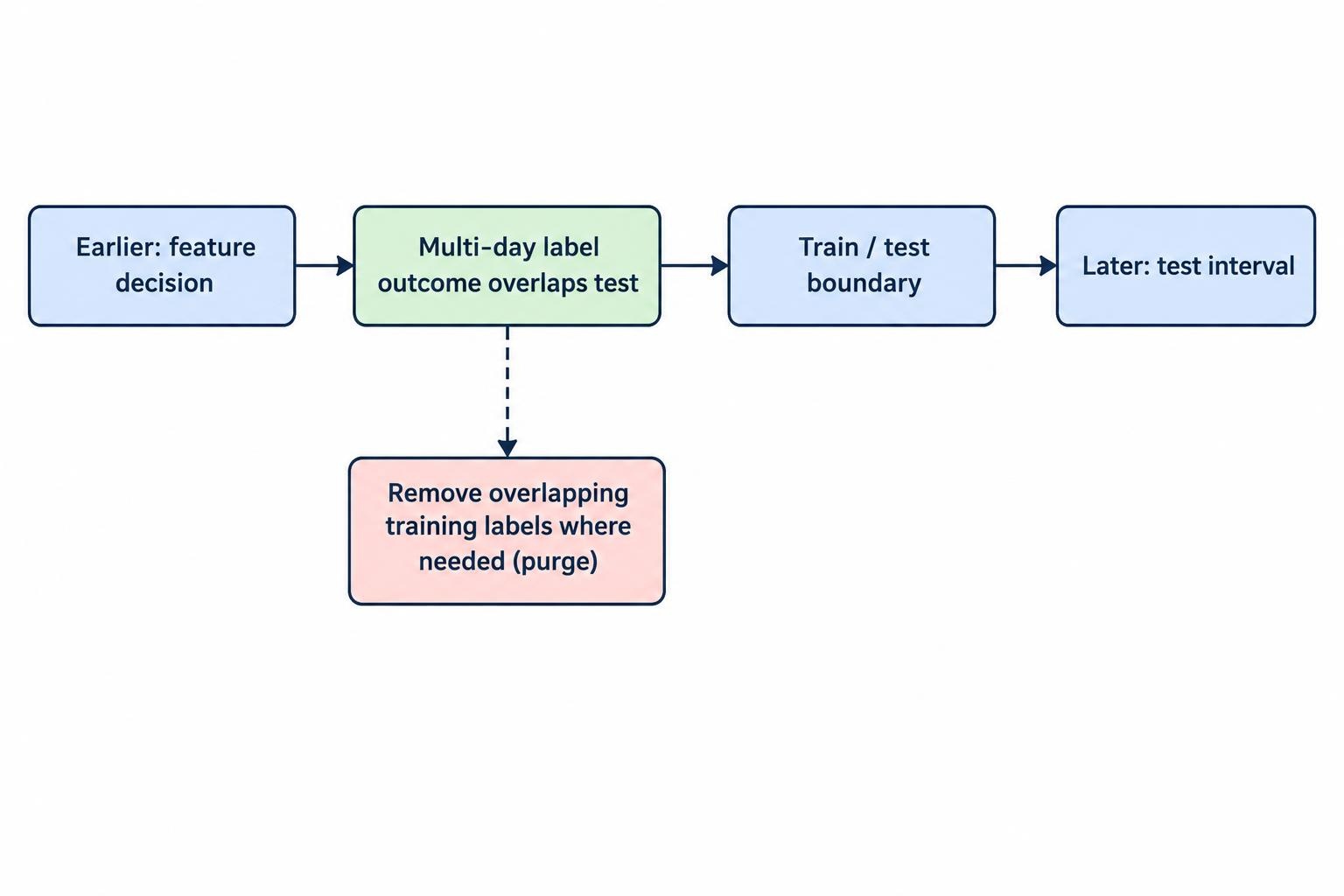
This matters when the target is a multi-day return, a barrier-based outcome, or a trade whose exit depends on a future price threshold. If an event begins before the split and resolves after it, the label reaches across the boundary. The training process must not use that resolved outcome to fit a model that is being evaluated on the same future interval. A careful historical market data preparation process should preserve decision times, outcome intervals, and the availability date of each input.
Fit preprocessing on training data only
Splitting raw rows is only the start. Many data-processing steps estimate values from the dataset: standardization uses means and standard deviations, imputation may use typical values, feature selection compares predictors with outcomes, and dimensionality reduction estimates combinations of features. If those steps are fitted before the split, the training pipeline has already learned something from validation or test data.
Instead, fit each learned transformation on the training portion, then apply the fitted transformation to validation and test data. During walk-forward evaluation, repeat that process using only the history available at each simulated retraining date. This includes clipping thresholds, scaling ranges, feature-selection rules, and any data-driven denoising method. A transformation that uses future rows can leak information even when the model itself is trained on the correct dates.
Feature availability needs the same attention. A daily bar may not be complete until the session closes; an earnings figure may refer to a quarter that ended weeks before the report became public. If a feature uses the value before it was actually known, the test gives the model an impossible advantage. Store or derive a timestamp for when the information became usable, then align features to the decision time rather than relying on the reporting period alone.
For a broader review of mistakes that can distort results, see overfitting, look-ahead bias, and data leakage in trading models. A split can be correctly ordered and still fail if the features, labels, or transformations reveal future information.
Keep model selection away from the final test set
Validation is where development decisions belong. A researcher may use it to compare candidate models, choose a training window, set a classification threshold, or decide which features to keep. The trouble begins when every new idea is judged on the final test set. After enough rounds of inspection and adjustment, choices become tuned to quirks in that period, even if no formal model fitting used its labels.
Keep a record of the alternatives tried: model families, features, thresholds, time windows, and strategy rules. The number of experiments matters because the best score among many attempts can be unusually high by chance. Research on the probability of backtest overfitting examines how selecting the strongest in-sample strategy from a set of alternatives can lead to weaker out-of-sample ranking. A holdout is useful, but it does not erase the effects of repeated experimentation.
If the final test period has already influenced development, label it honestly as used data. Freeze the revised pipeline and reserve a later period for another evaluation, or use a separate live or paper-trading phase to gather new evidence. Avoid repeatedly shifting the boundary backward until the result looks better. That is a new model-selection decision, not a repair to the original test.
Nested validation for repeated tuning
When the model needs substantial tuning, nested evaluation can separate two kinds of selection. Within each outer training period, inner chronological splits compare settings and choose a candidate. The selected process is then evaluated on the next outer test block, which was not used for those inner choices. Repeating this across several outer periods estimates how the full selection procedure performs, not merely how a preselected model performs.
Nested validation requires more data and computation than a single split. It can also be misapplied: if the researcher reviews outer test results and then changes the development process, those results have informed a new round of choices. The outer blocks are no longer untouched for that revised process. Reserve a final holdout beyond the nested evaluation when the available history allows it, and keep the researcher’s decisions inside the validation process.
Not every project needs a large nested scheme. A simple chronological training, validation, and test arrangement can be appropriate when the model has few adjustable choices and the test period is kept sealed. The important point is to identify how decisions were made, then make sure the reported evaluation period did not guide those decisions.
Read the result in context
Training performance shows how well the model fits data it has already seen. Validation performance helps compare candidates. Test performance estimates how the frozen candidate behaved on a reserved period. A gap between training and validation or test performance may indicate overfitting, but it can also reflect a shift in market behavior, data quality, or trading conditions. The score alone does not identify the cause.
Report the test dates, number of observations and trades, target horizon, retraining schedule, and whether labels overlap across boundaries. Then evaluate the strategy after realistic costs. Spreads, fees, slippage, financing, and execution assumptions can change the practical meaning of model predictions; see how to include trading costs in backtests. Also look beyond hit rate: a model can correctly predict direction often and still lose money if its losses are larger than its gains.
Compare the model with a simple rule or a relevant benchmark using the same dates and cost assumptions. If the model was selected from many candidates, disclose that search process rather than presenting the winner as though it were the only idea tested. The related guide to comparing an AI strategy with simple rules and benchmarks covers that comparison. For performance measures, include risk and return behavior that fits the strategy, rather than leaning on one favorable statistic; measuring trading performance beyond win rate discusses suitable comparisons.
A practical split checklist
- Define the decision timestamp, target horizon, and intended retraining schedule.
- Sort observations by the time information became available, not only by the date it describes.
- Assign earlier periods to training, later periods to validation, and a reserved final period to testing.
- Check whether any target interval crosses a split boundary; remove overlapping training labels where needed.
- Fit scaling, imputation, feature selection, and other learned preprocessing on training data only.
- Use validation for model and strategy choices, and record how many alternatives were tested.
- Freeze the full process before evaluating the final test period.
- Report the dates and assumptions, then check performance across forward periods and after trading costs.
Paper trading can help assess whether the data feed, signal timing, and execution assumptions behave as expected outside the historical pipeline. It does not prove that a model will stay profitable, and simulated fills may differ from live fills. Use it as another evaluation stage, not as a substitute for a clean test; the guide to what paper trading can establish explains the distinction.
Even a well-constructed test describes a particular historical sample. Market behavior, data quality, and model performance can change after deployment. Track live predictions and realized results, and define in advance what would trigger a review or retraining decision. Model drift and performance decay covers how to monitor that change without treating every losing trade as proof that the model has failed.