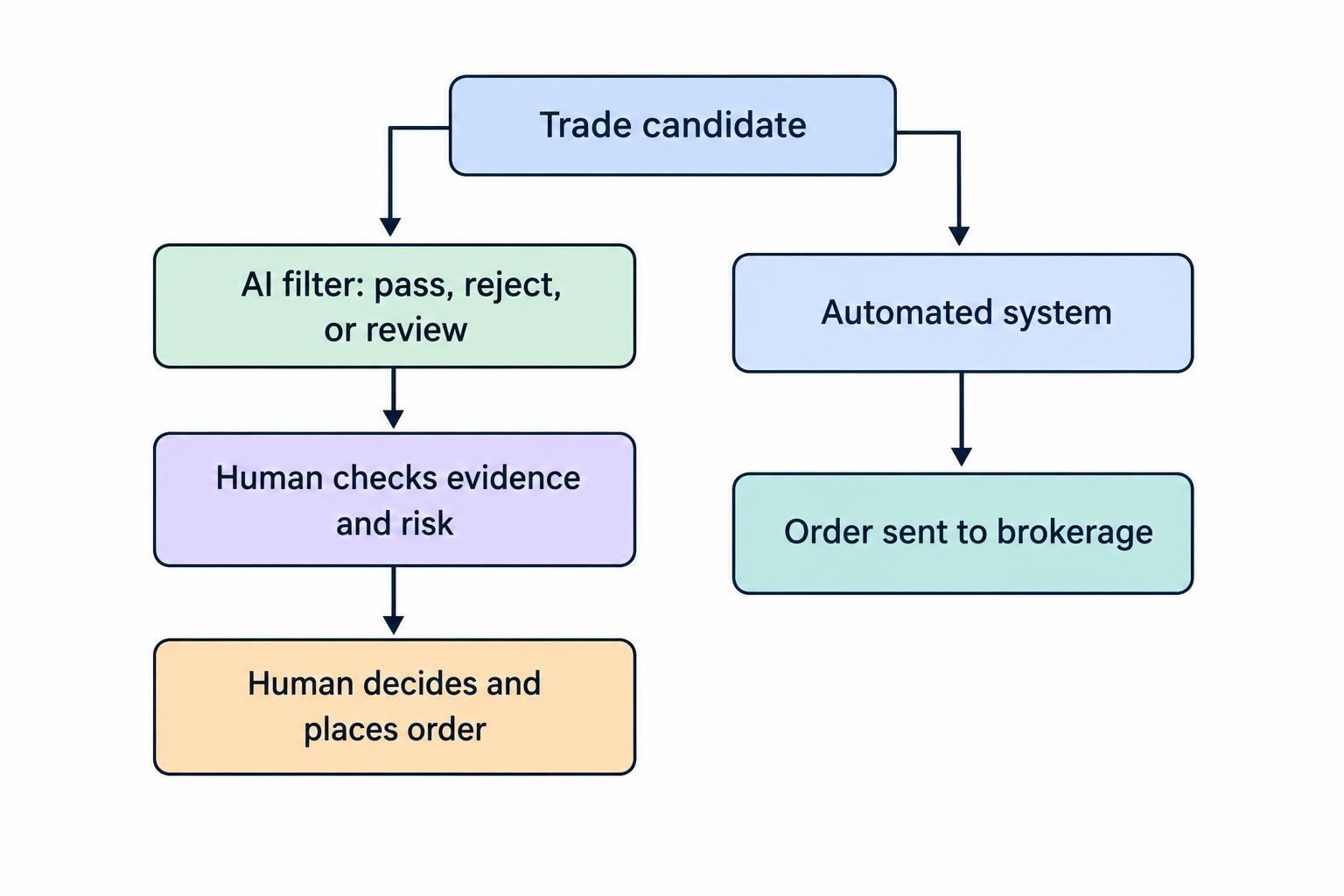
AI can help a trader sort a large set of possible trades, flag conditions that deserve attention, or rule out setups that fail predefined checks. That is different from letting a model decide what to buy and send orders automatically. Used as a filter, AI can reduce the number of ideas a person reviews while leaving the final decision, order placement and risk controls under human control.
The distinction matters because a model’s output is only as useful as its data, assumptions and validation. A high score is not a promise of profit, and a low score is not proof that a trade cannot work. The practical aim is narrower: use an AI signal to help decide which candidates merit review, then apply a tested process before risking money. That approach fits within a broader set of AI trading strategies, but it does not remove the need to understand the strategy being filtered.
What an AI trade filter does
A trade filter evaluates a candidate against one or more conditions, then returns a result such as pass, reject, or review. The candidate might be a ticker flagged by a basic screen, a trend-following setup, or a trade idea generated by a separate system. The AI layer can rank candidates, estimate a probability, classify market conditions, or detect that required information is missing. It should not be treated as a signal that automatically means “buy” or “sell.”
A simple example: a trader’s rules identify stocks that have broken above a recent range. An AI filter then checks whether the move has occurred during unusually high volatility, whether the price is close to a major scheduled announcement, or whether similar setups have tended to fail under comparable conditions in the trader’s historical sample. The output can prompt a closer review or remove a candidate from the list. The trader still checks the evidence, confirms the intended entry and exit rules, and decides whether the risk fits the account.
This is different from handing the whole process to a bot. A filter can reject a trade, but it should not silently change the strategy, invent missing inputs, or override position limits. If a system can place orders, alter risk settings, or act without a human approval step, it has moved beyond filtering into automated execution. FINRA describes auto-trading services as third parties sending trading instructions directly to brokerage accounts, and warns investors to monitor account activity and examine claims about the service’s technology. Its guidance on risks from unregistered auto-trading services is relevant when a filter is bundled with an execution service.
Why filter instead of automate every decision?
Filtering keeps a person in the loop at the point where context, ambiguity and consequences matter. A model may sort thousands of records quickly, but a trader can still reject a result because the data is stale, the market has changed, or the trade conflicts with an account-level risk limit. This division of work can be useful when automation is good at consistency and scanning, while the person remains responsible for interpreting uncertain results and controlling exposure.
It also makes errors easier to contain. If an AI model labels a setup as promising, but no order is sent until a trader checks the chart, costs and position size, the model’s mistake does not immediately become a live trade. That safeguard is not perfect: a person can become overconfident in a score, approve trades too quickly, or mistake an impressive interface for reliable evidence. Human review only helps when the reviewer has clear criteria and permission to say no.
A filter can be especially useful when a trader already has a defined method but faces too many candidates to inspect with equal care. It can prioritize review rather than create trade ideas from scratch. For example, a trend system might generate ten possible entries; a separate model could rank them by volatility, liquidity or fit with a chosen market regime. A trader can then examine the highest-priority candidates, while retaining the option to reject all of them. The model’s ranking is a sorting aid, not a reason to take a trade.
Choose what the filter is meant to screen
Start with one narrow job. “Find winning trades” is too vague to test. A useful filter question is concrete: does this candidate meet a defined liquidity threshold? Is volatility outside the range in which the underlying strategy was tested? Does the current setup match a particular trend pattern? Is the expected return estimate high enough to warrant manual review? Each question calls for different inputs and a different way to judge the output.
Define the result categories before examining performance. A filter might return pass, reject, or uncertain. The uncertain category matters: a model that must produce a confident answer for every case can turn bad or incomplete inputs into false certainty. Set rules for missing, conflicting or stale data, and decide what happens when a result falls near a threshold. In many workflows, “send for review” is safer than forcing a pass or fail.
Pick features that have a plausible connection to the filter’s job. Price, volume, volatility and market context may be relevant, but piling in every available indicator can make a system harder to inspect and easier to overfit. A guide to choosing features for a trading model can help frame which inputs belong in a test and why. Keep a record of each feature’s definition, source and calculation, so a change in the data pipeline does not quietly change what the model sees.
Set a decision boundary before looking at results
A model often produces a score or probability rather than a clean answer. The threshold that converts this number into a pass, reject or review decision is the filter’s decision boundary. Choose it using a method that is part of the testing plan, not by repeatedly adjusting it until the historical results look attractive. A threshold that performs well only on the data used to select it may be fitting noise.
Be clear about what a probability means. If a model says a setup has a 60% chance of success, the relevant definition of “success” must be specified: reaching a price target before a stop, finishing positive after a set period, or something else. Those are different outcomes. A probability also needs calibration: among many cases assigned a similar probability, the observed frequency should be reasonably consistent with that estimate. For a filter that ranks candidates, rank quality may matter more than probability calibration, but the test should still match the intended use.
Choosing whether the model predicts price, return, direction or a probability affects how its output should be interpreted. A filter built to predict the direction of the next price move does not directly answer whether a trade has enough expected value after costs. Keep the model’s target aligned with the decision you plan to make, as explained in this guide to prediction targets for trading models.
Test the filter without giving it an unfair advantage
Historical tests are vulnerable to leakage. If information from the future slips into the model’s inputs or the process used to select its threshold, results can look far better than live performance. The same danger arises when a trader tests many versions, keeps the best one and treats the winner as if it had been specified in advance. Research comparing backtests with later performance across trading algorithms found evidence that repeated backtesting can widen the gap between in-sample and out-of-sample results. The study, “All That Glitters Is Not Gold”, supports caution about selecting a filter based solely on the strongest historical chart.
Separate the data used to develop the filter from data reserved for evaluation. Do not use the final test period to select features, tune thresholds or decide which version to keep. For market data, the order of observations matters; random shuffling can put later information into training when the aim is to test performance on a future period. A proper training, validation and test split for financial time series preserves that time order and helps limit leakage.
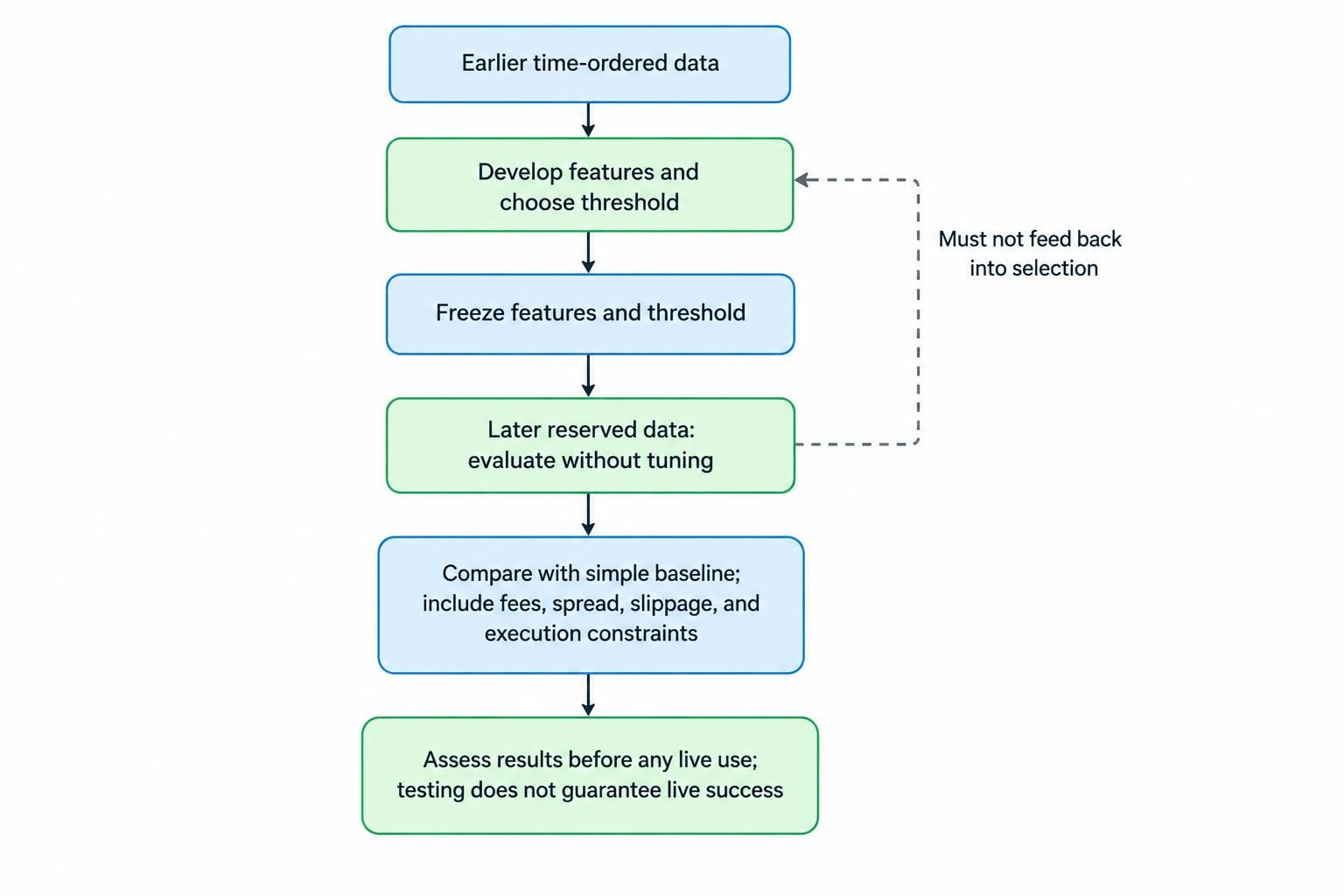
Compare the filter with a sensible baseline. If a simple rule screens candidates just as well, the AI layer may add complexity without improving the decision. Test the complete process, including fees, spread, slippage and any constraints on execution. Track how often the filter rejects candidates that would have met the strategy’s success definition, as well as how often it passes candidates that fail. A filter can reduce the number of trades yet still damage performance if it discards too many of the better setups.
Keep market conditions and costs in view
A filter can behave differently in trends, ranges, sharp volatility changes or thin markets. A score that worked in one environment may not transfer to another, especially if the model learned a pattern tied to a particular period. It can help to label the conditions in which the filter has been tested and define circumstances that trigger extra review. A discussion of market regime detection can help distinguish a change in conditions from ordinary variation in a model’s results.
Costs can also change which candidates deserve attention. A small predicted edge may not survive the spread, commissions, slippage or financing charges associated with the trade. If the filter ranks setups by estimated opportunity but ignores the cost of acting on them, its ranking may be misleading. Include realistic assumptions in testing and review how sensitive the result is to worse execution than the historical average.
Do not let the filter override portfolio exposure. Several candidates may share the same sector, asset, currency or underlying market risk. Each trade can pass a signal check while the combined positions create a concentration the trader did not intend. Set account-level limits outside the model, and check total exposure before placing an order. A trade filter is not a substitute for position sizing or risk controls.
Use a review process that can reject the model
Before using a filter live, write down what a reviewer must verify: whether the input data is current, whether the setup meets the strategy’s rules, what invalidates the trade, and how much capital can be risked. Record the model output alongside the human decision and the reason for any override. Reviewing those records helps identify whether the filter adds useful information or simply encourages faster approval of ideas the trader already favored.
Monitor the filter after launch. Compare its live results with the conditions seen during testing, check for changes in data quality, and note whether its rejection rate or candidate ranking shifts. Define in advance when to pause the tool, such as repeated missing inputs, a broken data feed, or performance outside a preselected tolerance. Retraining should be a considered change, not an automatic response to a short losing streak. New data can improve a model, but it can also invite another round of fitting to recent noise.
Keep a paper or shadow phase before allowing the filter to influence live decisions. In shadow use, the model produces its normal output, but the trader records what it would have screened out without relying on it to place orders. This reveals operational problems, such as delayed data or unclear alerts, while limiting the consequences of a bad recommendation. A paper trading test can help assess what simulation establishes and what it cannot establish about live execution.
Put limits on human approval
Human oversight is not a rubber stamp. A reviewer should be able to inspect the reasons for a score, identify missing evidence and reject a candidate without pressure to meet a trading quota. Keep approval separate from the model’s ranking where practical: the model can put a candidate at the top of a list, but it should not change risk limits or send an order merely because the score crossed a threshold.
Use a consistent review checklist, especially when several people share the process. Record the version of the model, the data timestamp, the candidate, the result and the final action. If the explanation is vague, the input is suspect, or the model’s output cannot be reproduced, treat that as a reason to pause and investigate. FINRA warns that AI-generated information can be inaccurate or outdated and advises investors to verify underlying sources rather than rely solely on generated information. Its investor guidance on AI and investment fraud also cautions against claims that AI can guarantee returns.
When a filter is a poor fit
An AI filter may be unnecessary if a small, stable set of candidates can be checked quickly with transparent rules. It is a poor fit when the trader cannot explain what it screens, lacks reliable data, or has too little historical information to test the intended use. It is also a poor fit when the output is treated as a verdict rather than one input to a decision. A model can help focus attention; it cannot remove market risk, guarantee that a setup is valid, or make an unsuitable trade appropriate.
The strongest use case is modest: let AI sort or flag candidates under a defined process, keep uncertainty visible, test the filter against a fair benchmark, and make a person responsible for final approval. If the model adds little beyond a simple rule, remove it. If it is useful, keep its authority narrow and its behavior observable.