Financial headlines, company announcements and social posts arrive faster than a retail trader can read them. AI can sort that stream, identify which companies or themes it concerns, and estimate whether the language is positive, negative or uncertain. The result is a news sentiment signal: a structured measure of tone or attention that can help a trader decide what deserves a closer look.
That signal is not a forecast by itself. A positive headline may describe an event the market already expected; a negative post may be inaccurate, or refer to a different company with a similar name. News analysis is most useful as a filter for research and risk, not as an automatic instruction to buy or sell. It needs reliable data, a clear time horizon and a test that includes trading costs. Retail traders considering this approach should understand what the model is measuring, what it misses and how to check its output against the original information.
What AI news sentiment analysis measures
Sentiment analysis applies language processing to text and assigns a label or score. A basic model may classify a passage as positive, negative or neutral. A finance focused system may also estimate relevance to a company, identify an event such as an earnings release, or separate a change in outlook from routine reporting. Some tools summarize articles or group coverage of the same event, which can reduce duplicate reading.
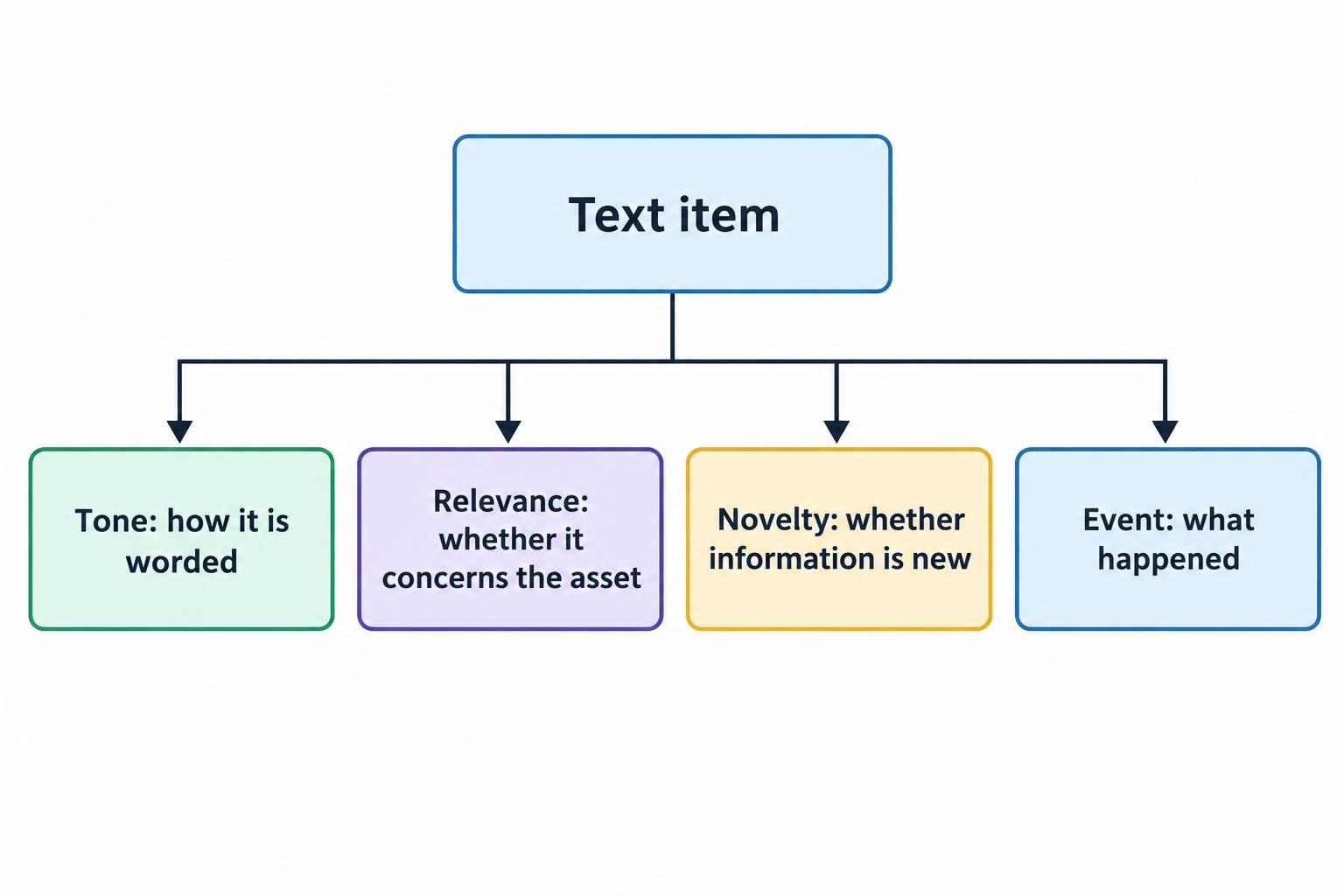
These outputs answer different questions. Tone asks how the text is expressed. Relevance asks whether it concerns the instrument under review. Novelty asks whether the information is new compared with prior coverage. Event classification asks what happened. A headline can be strongly negative in tone but have little bearing on the asset being traded. Conversely, a neutral sounding announcement may describe a major change in guidance. A single green or red score conceals these distinctions, so traders should check what a tool actually calculates before treating its signal as meaningful.
News analysis and social sentiment analysis also use different kinds of text. News sources may have editorial standards and timestamps, but reports can repeat the same underlying announcement. Social posts can surface a developing theme quickly, yet include jokes, rumors, promotional content and coordinated activity. FINRA notes that social sentiment tools can use posts, messages and other online material, and warns that their data may be stale, incomplete or misleading. A system that combines both feeds should show which source produced a signal, rather than blending them into an unexplained number.
Where AI can help a retail trader
The clearest use is triage. A trader can monitor a chosen list of companies, funds or markets and receive alerts when new text mentions an earnings surprise, a regulatory decision or a material change in company guidance. The system can group several reports about one event, flag a shift in tone and link back to the underlying material. This is more useful than a sentiment score alone because the trader can inspect what triggered the alert and decide whether it matters to the strategy.
A second use is organizing research. AI may extract named companies, dates, reported figures and stated causes from a batch of articles, then present them in a consistent format. A trader could compare coverage before and after an announcement or distinguish company specific news from broad market commentary. For a wider discussion of how AI tools fit into market research, see the guide to using AI assistants to research markets and check trading ideas.
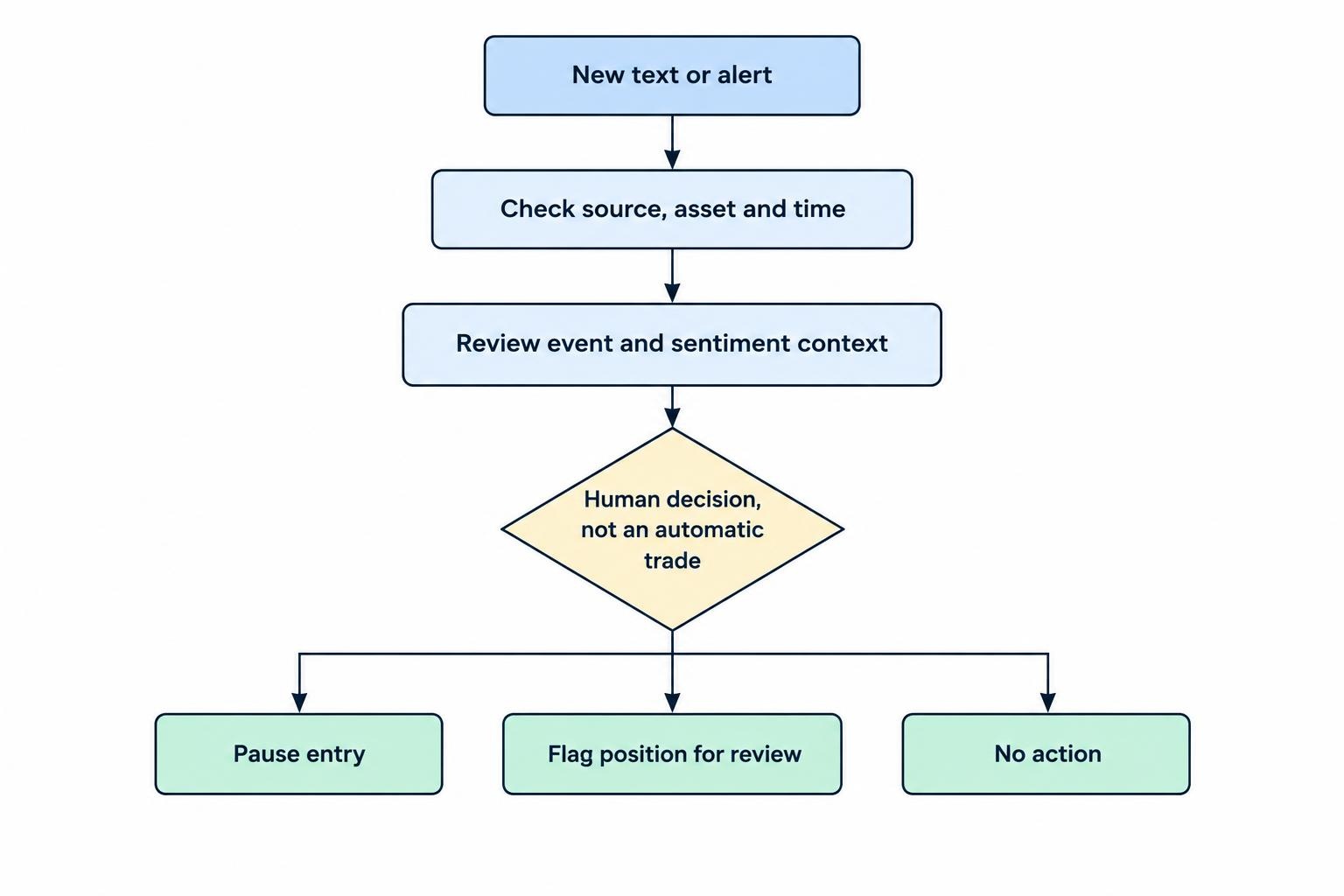
News sentiment can also act as a trade filter. A rule based system might pause new entries around a high impact announcement, flag a position when coverage changes sharply, or ask for human review when a price move coincides with a burst of unusual news. That is a narrower and easier to test use than asking an AI system to read headlines and place trades without review. Traders building a repeatable process can connect the signal to a broader AI assisted trading workflow from research to review.
How to read a sentiment signal
A useful sentiment output needs context. Start with the text itself: is it a news article, a company filing, a short post or a summary generated by another model? Check the timestamp and confirm whether it refers to the asset in question. Then examine the classification. Does “negative” mean the wording is negative, the reported event is adverse, or the model estimates a bearish market reaction? Those are not interchangeable.
Consider a fictional company that reports higher revenue but cuts its forecast. A simple tone classifier may label the article positive because it contains words such as “growth” and “record.” An event aware model may identify the lower forecast as a negative change. Neither output tells the trader how much the market has already priced in, whether the report matches analyst expectations or whether the share price has already reacted. The model can point to the issue; the trader still has to interpret its importance.
Sentiment is often displayed as a score between two extremes, with zero representing neutral tone. The number can look precise without being a probability or a measure of expected return. A score of 0.8 does not necessarily mean an 80 percent chance that the price will rise. Before using a score in a rule, find out how it is scaled, what text it covers, whether it is calibrated and how missing or conflicting reports are handled.
News tone is not the same as a trading edge
Research has found links between news tone and asset prices, but those results do not establish that a retail trader can earn reliable profits from a commercial sentiment score. A Federal Reserve study using more than 900,000 news stories found that daily news predicted returns over a short period in its sample, while weekly news showed a different horizon. An IMF working paper using international news coverage also reported relationships between sentiment and equity returns, with results that differed between local and global news. These studies concern particular datasets, periods and methods. They are evidence that text can contain information, not a promise that any present day tool captures it profitably.
Timing is a major obstacle. If a headline is published after a price move, a model that reacts quickly may still be late. If several outlets repeat the same report, the volume of articles can make a signal appear stronger without adding new facts. A strategy must therefore distinguish first publication from later copies, record when the data became available and avoid using information that would not have been accessible at the simulated decision time.
Market reaction also depends on expectations and context. An apparently positive earnings report may disappoint if traders expected more. A negative headline may have little effect if the information was already public. Sentiment can be more useful as one input alongside price, volume, volatility and the event itself than as a standalone direction call. The article on choosing features for a trading model covers how other data fields can be considered alongside text signals.
Choosing news and social data
Before comparing AI models, inspect the input feed. Useful details include source names, publication timestamps, update history, asset identifiers, licensing terms and whether the feed preserves the original text. Check how the provider handles duplicate stories, corrections and articles that mention several companies. If the data is delayed, that delay should be visible. A polished dashboard cannot make a stale feed current.
News wires, company disclosures and general media do not offer identical coverage. Social data adds a different set of limitations: posts may be anonymous, promotional or deliberately misleading, and a spike in discussion may reflect attention rather than informed opinion. FINRA and the SEC’s Office of Investor Education and Advocacy warn that social sentiment data can be inaccurate or stale, and that posts may be used to manipulate prices. Their investor bulletin on social sentiment investing tools recommends checking the tool’s methods and not relying on social sentiment alone.
Language adds another complication. Sarcasm, idioms, slang and financial shorthand can change a sentence’s meaning. A post saying a company’s results were “sick” may be praise or criticism, depending on context. A machine may also confuse a company name with an ordinary word, misread a negation or miss that a quoted phrase is being rejected. FINRA’s 2025 report on social media influenced investing notes that sentiment tools can struggle with sarcasm, misleading information and contextual language. Performance in one language or asset class should not be assumed to transfer to another.
Testing a news sentiment strategy
A backtest should reproduce what the trader could have known at each decision point. That means using publication and availability times, not just the date printed on an article, and accounting for later corrections where possible. If the strategy relies on a sentiment score, save the score produced at the time. Re-running a newer model on old text can create a misleading test if the updated model would not have been available then.
Define the signal before looking at the results. Specify which sources count, how articles are assigned to an asset, how duplicate coverage is treated, how a score becomes an entry or exit condition, and how long the signal remains active. Then compare the model based approach with a simple baseline, such as the same strategy without sentiment. A rule that looks profitable only after many thresholds have been adjusted to fit the test period may be overfit. The guide to overfitting, look ahead bias and data leakage explains why these errors can make simulated results look stronger than they are.
Include realistic spreads, commissions, slippage and delays in the test. News driven signals can arrive during fast price moves, when the assumed execution price may be unavailable. Check performance across different market conditions and separate genuinely unseen data from the period used to design the rule. A single win rate is not enough: examine drawdowns, average trade outcomes, exposure and the number of signals. The guide to including trading costs in backtests covers expenses that can erase a small apparent edge.
A practical review process
For each alert, a trader can follow a short review sequence: open the original report, verify the asset and timestamp, identify the event, compare it with prior expectations, then check price and market conditions. If the signal cannot be traced back to credible text, it should not be treated as evidence. The system should preserve links and excerpts so that a reviewer can see whether the summary omitted a qualification or turned uncertainty into certainty.
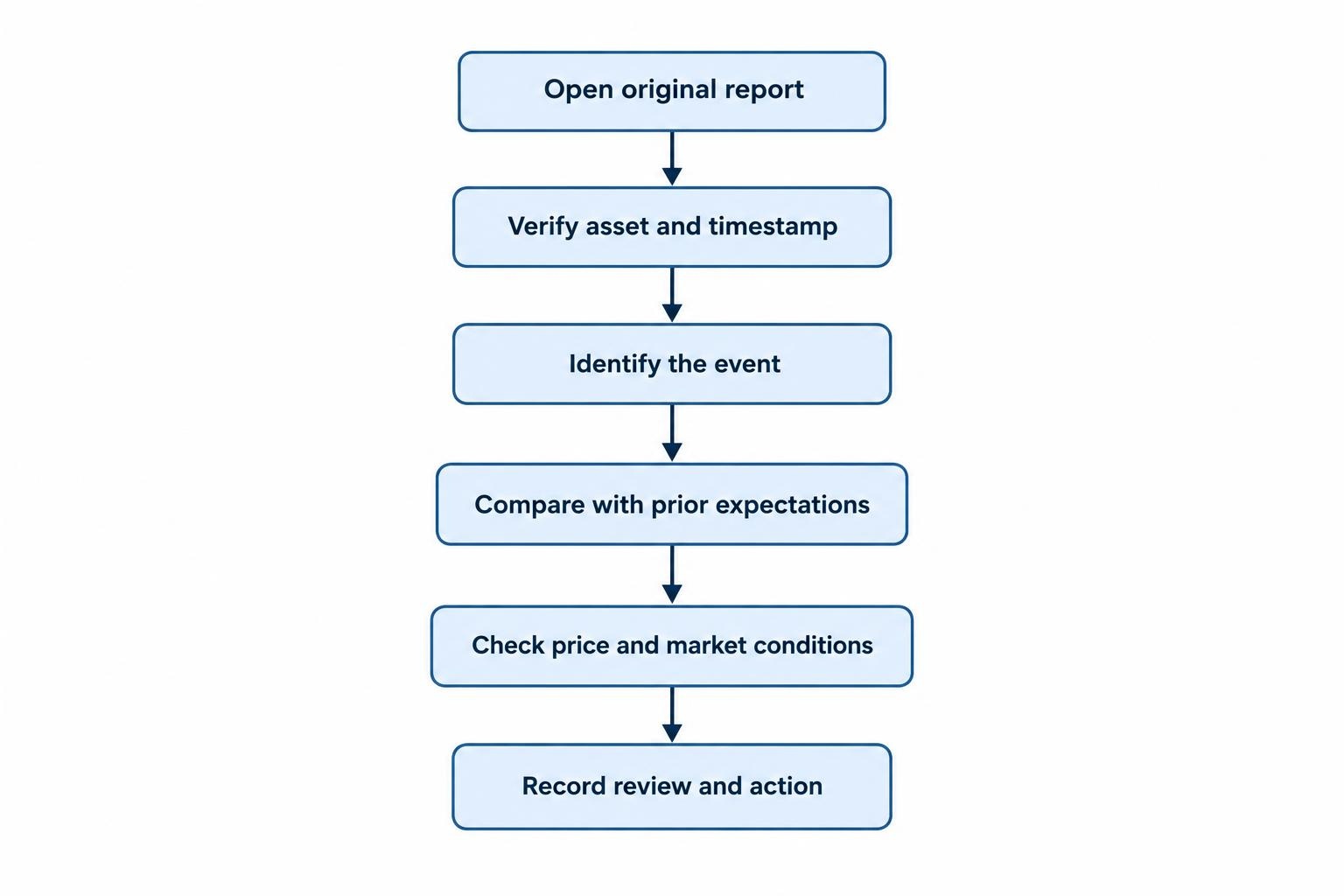
Keep an audit record of the source, the text received, the model or tool version, its output and the action taken. Track false positives as well as useful alerts. If a model routinely mistakes opinion for fact or reacts to repeated stories, adjust the data filters or stop using that feed. Traders concerned about fabricated summaries and unsupported claims can refer to AI hallucinations, outdated information and source verification.
Social media requires particular restraint. A sudden wave of bullish posts may be a reason to investigate unusual activity, not a reason to chase a price. FINRA’s report on social media influenced investing describes risks including misinformation, undisclosed conflicts and coordinated campaigns. Automated sentiment can count or classify that content without establishing that it is true. Treat an unexplained spike as a prompt to verify, and avoid allowing an unverified signal to trigger an order on its own.
Common failure points
- Confusing tone with direction. Positive wording does not guarantee a positive price reaction, and negative wording does not settle what the market will do.
- Ignoring timing. A delayed article or repeated headline may arrive after the useful move has passed.
- Trusting the score without the text. A label can hide a misread entity, a negation or an important caveat.
- Counting attention as information. More posts can signal a crowded conversation, not stronger evidence about value.
- Testing on cleaned historical data only. Real time feeds contain delays, corrections, duplicates and outages.
- Automating before validating. A tool should demonstrate a clear, repeatable role before it is connected to order execution.
When AI news analysis is worth using
AI news analysis may suit traders who already have a defined process and need help sorting a large volume of text. Its strongest practical role is often modest: locate relevant items, group repeated coverage, flag an event for review or provide a second check against a written rule. That can save reading time without pretending to know the future.
Before paying for a platform, ask what sources it uses, how quickly data arrives, whether it identifies duplicate and corrected reports, and how its score is validated. Check whether the tool exposes the original text and explains its categories. A product that offers a crisp buy or sell label but cannot show its inputs deserves skepticism. The guide to evaluating an AI trading platform before paying provides a broader checklist for that decision.
Use sentiment as one piece of evidence, with a defined purpose and a way to measure whether it adds value. If it cannot improve a research or risk process under realistic testing, the score is decoration. The market does not owe a model an edge simply because it can read the headline faster.