AI assistants can help retail traders collect market information, compare competing explanations, and turn a vague trading idea into questions that can be tested. They are most useful as research support: they can organize material, summarize documents, explain terminology, and flag assumptions for review. They cannot reliably tell you what a market will do next, and a fluent answer is not proof that its facts or reasoning are sound.
A practical approach is to give the assistant a narrow task, provide or identify the material it should use, and check important claims against the original data or documents. Use the result to improve your research process, not as a substitute for market data, judgment, or a tested trading plan. This distinction matters whether you are using a general chatbot, a specialist research tool, or one of the AI trading tools and platforms marketed to retail traders.
What an AI assistant can do in market research
An assistant can make it easier to work through a defined research question. It might summarize a company filing, extract dates from an economic calendar you provide, compare two explanations for a price move, or turn a set of notes into a checklist. It can also help you identify what you do not yet know. If you are considering a trade because a company announced a new product, for example, ask what information would be needed to assess the announcement’s possible relevance: the company’s own description, expected launch date, financial impact, and any response from competitors. The answer is a research plan, not a verdict on the stock.
These tasks are different from forecasting a price. A summary can be checked against its source; a forecast needs a defined target, time horizon, data set, and evaluation method. “Will this stock go up?” is too broad to test usefully. “What conditions would support or weaken a bullish view over the next five trading sessions?” is more concrete, but the assistant still cannot establish that the view has an edge. For model-based forecasts, a trader needs separate methods for testing the data and results, such as those covered in testing and validating AI trading systems.
| Research task | Useful role for an assistant | What the trader must verify |
|---|---|---|
| Summarize a document | Condense sections and list the main claims | Figures, dates, quotations, and omitted qualifications in the original |
| Compare explanations | Lay out evidence for more than one interpretation | Whether each claim is supported by reliable, current material |
| Review a trade idea | Find assumptions, missing information, and possible failure conditions | Whether the setup matches the trader’s rules and market data |
| Analyze a journal | Group notes and suggest questions about recurring decisions | Whether the pattern is real, meaningful, and present in the underlying records |
| Generate a forecast | Help define a target or outline hypotheses | Whether the forecast can be tested without biased data or assumptions |
Start with a question that can be checked
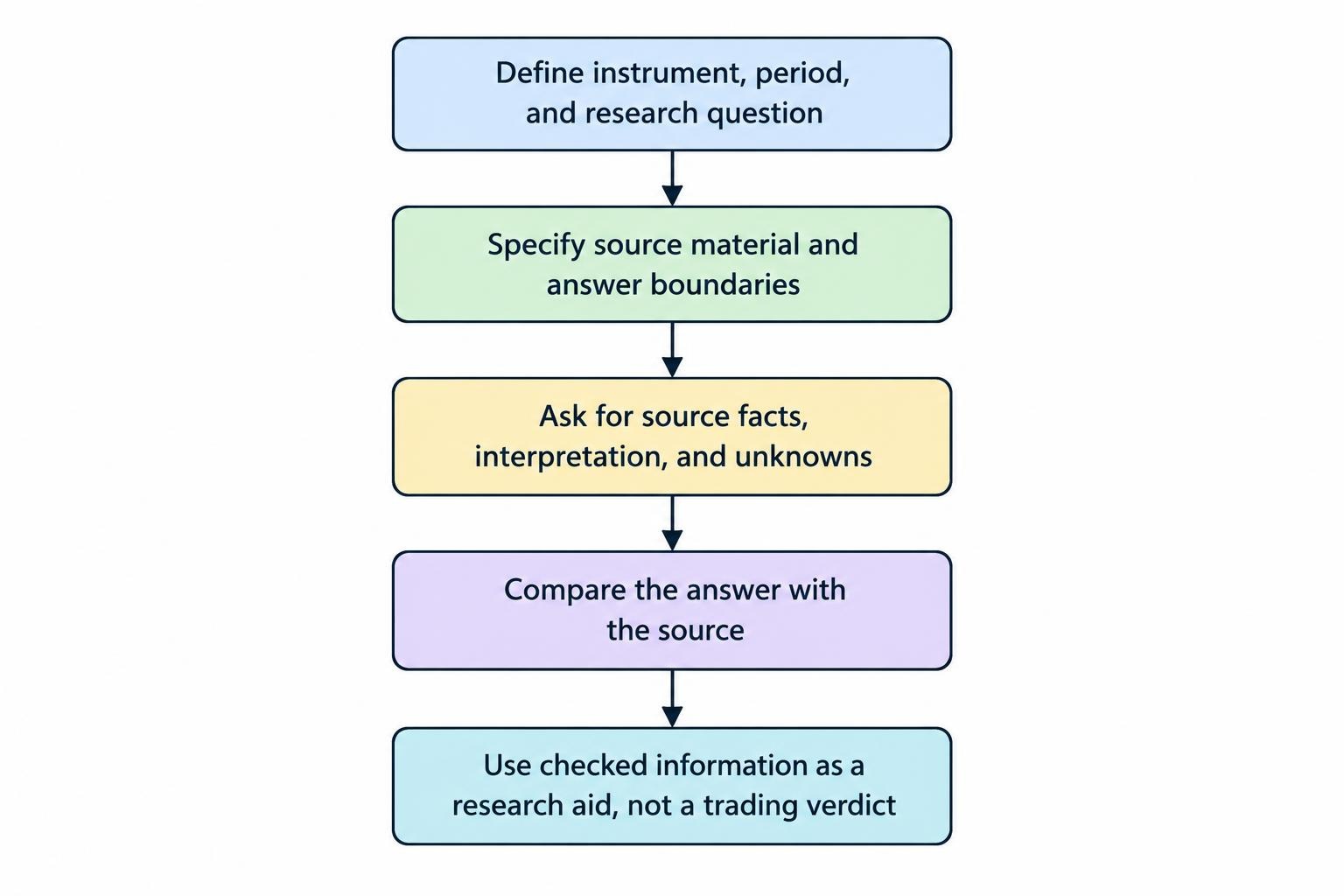
Prompts work better when they define the instrument, time period, task, and boundaries. “Analyze the market” invites a broad answer that may mix time frames or invent context. A more useful request might be: “Using only the attached quarterly report, list the company’s stated revenue guidance and the risks it names. Quote the page or section for each item. If a detail is not in the document, say so.” That prompt makes the source and the expected output clear. It also gives you a straightforward way to check the answer: open the cited sections and compare them with the summary.
For an idea review, ask for analysis rather than approval. You might request a list of assumptions behind a bullish thesis, the evidence that would weaken it, and the information needed before deciding whether to trade. Require the assistant to separate facts in the supplied material from interpretation and unanswered questions. Avoid wording that nudges it toward a preferred outcome, such as “Explain why this is a great buy.” A chatbot may follow the framing of a question and produce a persuasive case even when important counterevidence is missing.
Useful prompts can also put limits on the answer. Ask the assistant not to use information outside the provided documents; to label unsupported points; to distinguish confirmed facts from estimates; or to return a table with a source reference for each factual claim. These instructions do not guarantee accuracy. They make errors easier to spot. If a document, source link, or figure cannot be checked, treat the related answer as unverified rather than filling in the gap with a plausible-sounding explanation.
Use current sources for market-moving information
Market research is time-sensitive. A company’s earnings, a central bank announcement, or a change in guidance can make an older summary misleading. If your tool has web search, check whether the answer links to original material and whether the source date fits the question. Follow links to filings, company announcements, government releases, exchange notices, or other primary records where appropriate. A search result or AI-generated summary is a pointer to evidence, not the evidence itself. Even when a source is linked, open it and confirm that it supports the claim.
For news analysis, define the event and the time window. Ask the assistant to separate the announcement itself from commentary about it, note the publication dates, and flag conflicting reports. That can help prevent a recycled article or an older event from being presented as breaking news. It is also useful to distinguish an event from its market effect: a report may confirm that a company made an announcement, but it does not prove how traders will respond or whether the price has already reflected it. For a more focused look at this use case, see AI news analysis and sentiment signals.
When using search-enabled assistants, review the original sources rather than relying on the generated citations alone. OpenAI’s guidance notes that search citations and results can be incomplete, outdated, or incorrect, and advises checking that a cited source actually supports the answer. That is a sensible standard for market research with any tool. A citation can lead to a relevant page while still failing to substantiate the precise number, date, or interpretation in the response. The ChatGPT search guidance on reviewing sources describes this verification step.
Check every important claim against its source
AI assistants can produce inaccurate information, including fabricated citations, quotations, or studies. A polished answer can therefore contain a false detail in the middle of otherwise correct material. OpenAI’s guidance on model limitations recommends treating important answers critically and checking quotes, data, technical details, and references against reliable sources. For a trader, that means verifying claims that could change a decision: earnings figures, dates, corporate actions, economic releases, regulatory statements, and the wording of a company’s guidance.
Use a claim-by-claim check instead of trying to verify a whole answer by impression. For each important statement, ask: What is the original source? Does it say exactly this? Is the date current for the question? Has a figure been confused with a forecast, an estimate, or a prior period? Does the answer leave out a qualification that changes the meaning? If the source does not support the statement, remove it from the working analysis until you can verify it elsewhere. OpenAI’s guidance on ChatGPT accuracy and verification also warns that confidence in the wording is not a reliable measure of correctness.
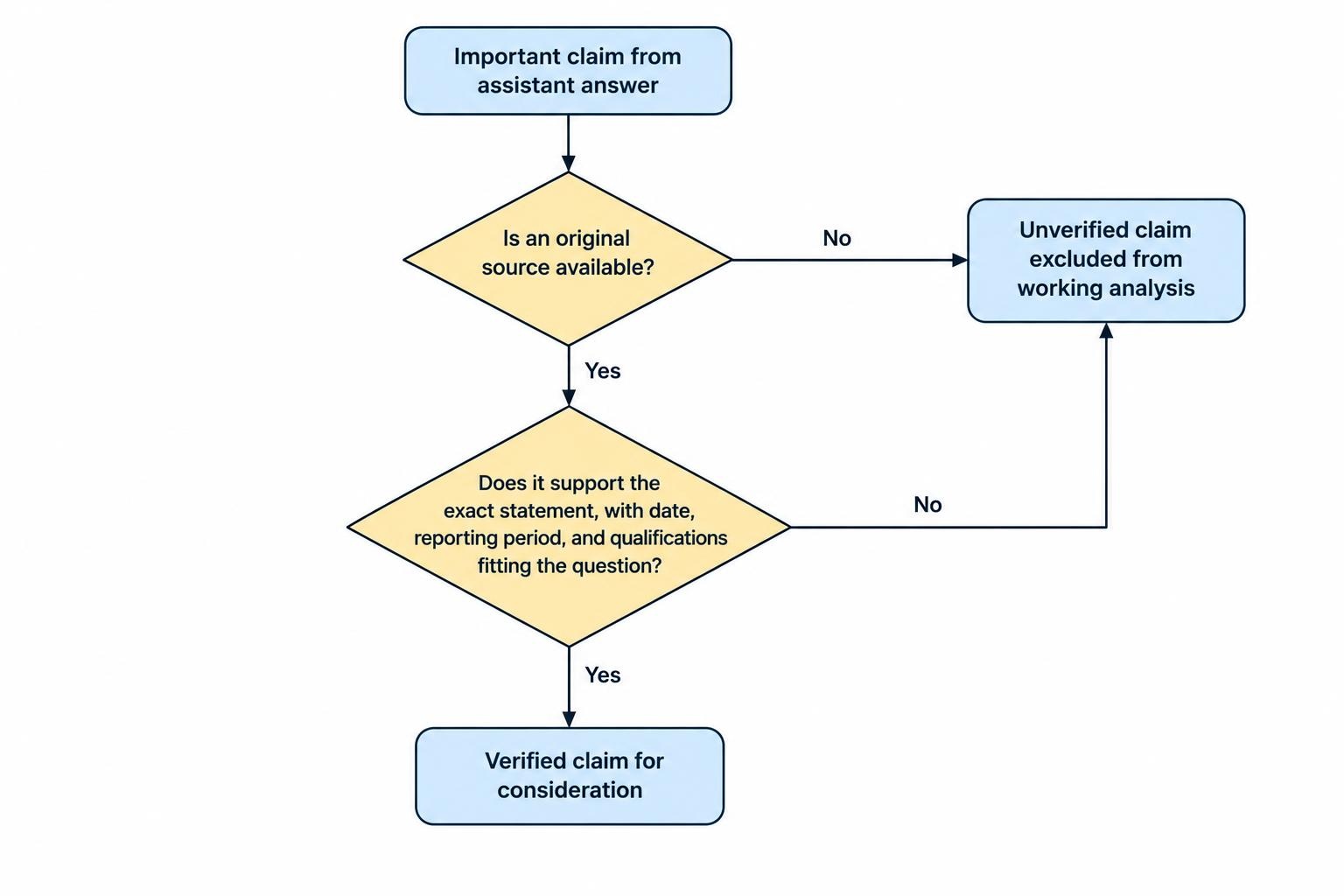
For a company filing, check the section the assistant cites and read the surrounding text. A sentence about revenue may refer to a different reporting period than the one you assumed, or a risk statement may be conditional rather than a prediction. For a news item, compare the publication time with the event time and check whether the report is original or repeats another outlet’s account. For a chart-based observation, compare the assistant’s description with the actual chart and data interval. Do not accept a pattern simply because the label sounds familiar; the dates, price series, and chosen time frame all matter. A separate guide to AI chart analysis, context, and limitations can help keep visual pattern claims in perspective.
Ask for competing explanations, not a prediction
A useful research assistant should help expose the weak points in an idea, not just make it sound convincing. Ask it to list a plausible alternative explanation for the same evidence, identify what information would distinguish the two explanations, and state what would invalidate the original thesis. If a stock rises after an earnings release, possible explanations might involve the reported results, forward guidance, market expectations, or broader market movement. Those are hypotheses to investigate, not conclusions to accept without checking the release and price data.
You can make the exercise more disciplined by asking the assistant to classify each point as a verified fact from a named source, an interpretation, or an open question. Then review the facts independently and decide whether the interpretations follow from them. If the answer produces only evidence supporting your initial view, prompt it to search for the strongest counterargument or provide the opposing case yourself and ask it to compare both sides. The aim is not to get a chatbot to choose a winner. It is to reduce the chance that your research overlooks a material assumption.
Keep analysis and execution separate. A market-research assistant may help you organize a thesis, but that does not mean it should place orders or change risk limits. The connection between research, a trader’s rules, and review is described in an AI-assisted trading workflow. If you want a tool to assess a setup, specify what it may review and what decisions remain yours. A plain-language output is not a risk control.
Analyze trading journals without mistaking a pattern for proof
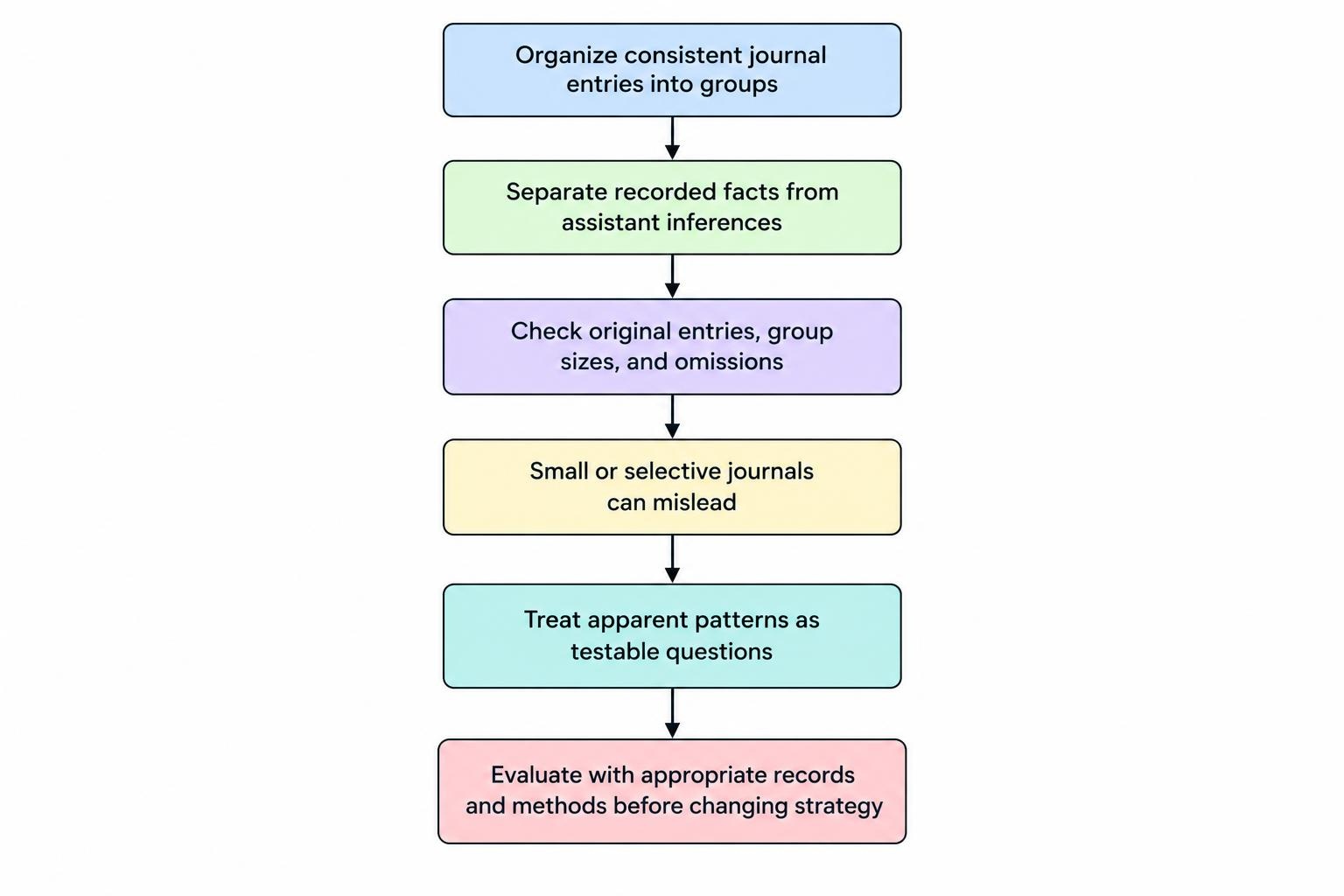
An assistant can help sort journal entries by strategy, instrument, time of day, setup, or reason for exit. It might also group notes that mention missed entries or early exits, then suggest questions to investigate. This can save time when records are consistent and clear. The result is only as useful as the data provided: entries with missing dates, inconsistent labels, or hindsight-heavy descriptions can produce tidy but misleading patterns. Before asking for analysis, remove information you do not need to share and standardize the fields you want compared.
Ask the assistant to report the number of entries in each group and to distinguish what the journal literally records from what it infers. If it says a strategy performs better on certain days, check the original entries, the size of each group, and whether trading costs or open positions were captured. A pattern in a small or selectively recorded journal may be a prompt for more testing, not a reason to alter a live strategy. You can use the result to form a testable question, then assess it with the appropriate records and method. The dedicated guide to using AI to analyze a trading journal covers that review task in more detail.
Protect private and account information
Market research prompts can reveal more than intended. Before uploading broker statements, journal exports, or account screenshots, check what personal or account details they contain and whether the tool is appropriate for that material. Remove names, account numbers, addresses, access tokens, and other unnecessary identifiers. Never paste a password, API key, recovery code, or authentication detail into a chatbot. A research assistant does not need those secrets to summarize a public filing or review a trade thesis.
Also check the service’s privacy and data controls before supplying nonpublic information. Policies and settings vary between products, so do not assume that a conversation is private or that submitted data will be handled in the way you expect. Public market information is usually enough for broad research questions. When private records are genuinely needed, share the smallest useful excerpt and remove identifiers first. For more on reducing exposure, read guidance on protecting financial data when using AI assistants.
Keep the assistant out of the decision seat
AI-generated information can be inaccurate, incomplete, misleading, outdated, or made up. A joint investor alert from the SEC’s Office of Investor Education and Advocacy, NASAA, and FINRA warns investors not to rely solely on AI-generated information for investment decisions or stock-price predictions, and recommends checking underlying sources and reviewing multiple sources. That warning applies even when a response seems coherent. A chatbot does not know your financial circumstances, risk tolerance, or full portfolio just because you describe a trade in a prompt.
Use the assistant to improve the quality of questions, organize evidence, and identify gaps. Verify claims independently, apply your own trading rules, and record why a decision was made. Do not treat a confident answer as a signal, a source link as proof, or a generated price forecast as evidence of an edge. The joint SEC, NASAA, and FINRA investor alert on AI and investment fraud also describes how AI claims can be used to promote misleading investment opportunities, including promises of guaranteed returns. Any tool or service making that sort of promise warrants careful scrutiny.