An AI-assisted trading workflow is a repeatable process for turning a market question into a decision, then checking whether that decision was sound. AI may help organise research, prepare data, generate code, compare scenarios or review a trading journal. It should not be treated as a source of guaranteed signals. A useful workflow keeps the reasoning, data, tests and final decision visible, so a plausible sounding answer cannot quietly become an unchecked trade.
The workflow below is designed for a retail trader who remains responsible for decisions and execution. It applies whether AI is a chat assistant, a machine learning model or a feature inside trading software. The tool changes; the need to define the question, test the result and manage risk does not. For a broader introduction to AI trading for retail traders, start with the role these tools can play before choosing a particular use case.
Start with a decision, not a tool
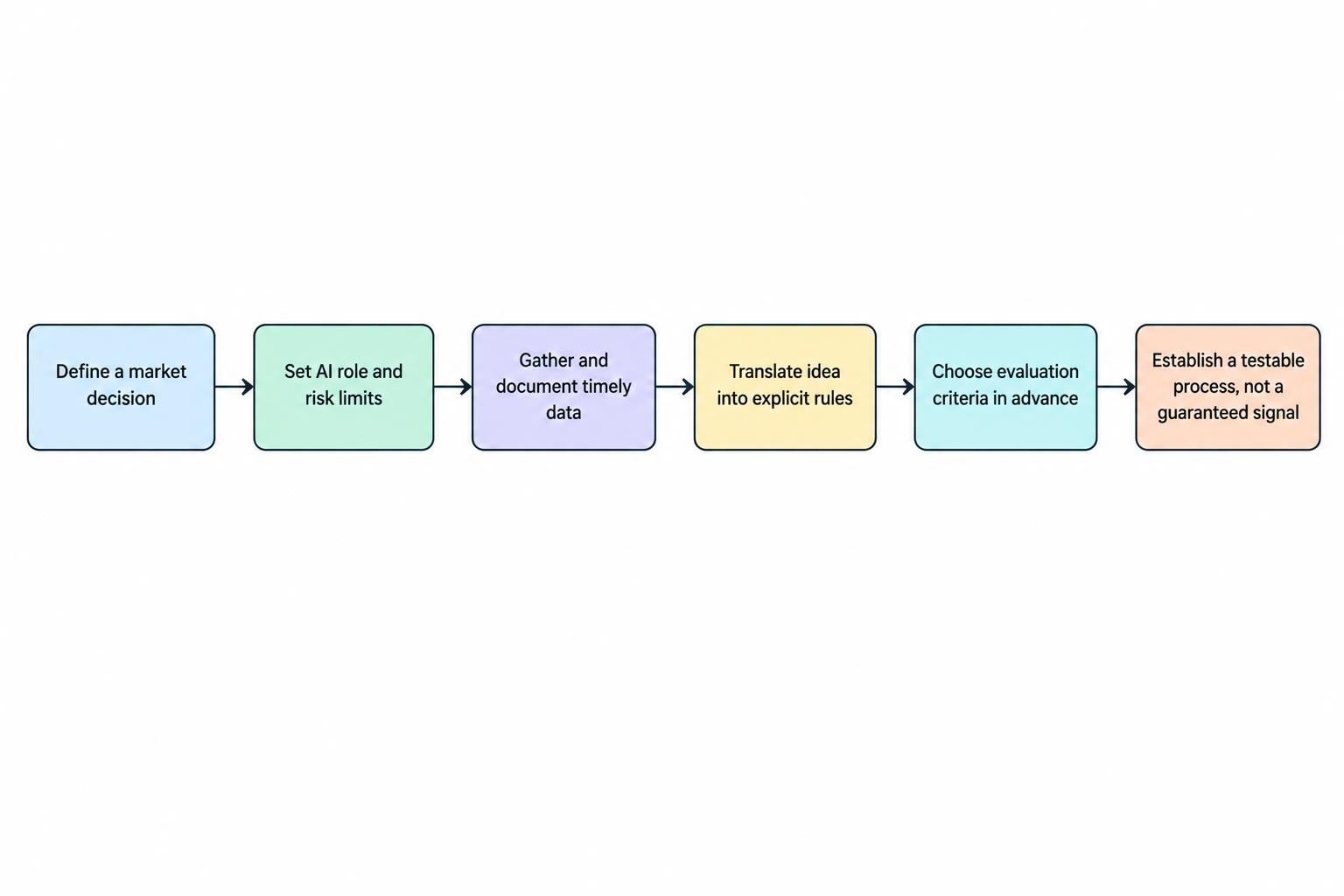
Write down the trading decision you want to improve before opening an AI tool. “Find profitable trades” is too vague to test. A useful question identifies an instrument or market, a time horizon, a possible decision and the evidence that could change it. For example: “Can a trend filter help me avoid taking long entries when daily volatility is unusually high?” That question is narrow enough to investigate. It also allows an unhelpful answer: the filter may add complexity without improving the process.
Define the decision boundary as well. Is AI helping you screen markets, summarise a report, label a chart, test a rule or prepare a trade review? Each task has a different standard of proof. A summary can be checked against its source document. A model that generates a trade signal needs a defined target and a test that respects when information became available. For practical research tasks, see how AI assistants can support market research and idea checks. Keep the use narrow at first; adding extra tasks makes it harder to tell what the tool actually contributed.
Set the rules and limits before analysis
Before collecting data, set basic operating limits: the markets you will study, the time period, the intended holding period and the maximum risk allowed per trade or across the account. Decide what AI may do and what requires your approval. A research assistant might extract earnings dates or summarise a central bank release. It should not silently turn a summary into an order. A coding assistant might propose a backtest, but the trader still needs to inspect what the code measures and what it leaves out.
Also decide what counts as a useful result. A high win rate on its own may be misleading if average losses are much larger than average gains. A promising historical return may disappear once realistic fees and execution assumptions are included. Choose a small set of criteria before running tests, such as net performance after costs, drawdown, number of trades and stability across separate periods. This reduces the temptation to keep changing the scorecard until one version looks impressive. It is easier to defend a plain rule chosen in advance than a complicated one discovered after dozens of experiments.
Gather data with its timing intact
Every research step depends on the data behind it. Record the market, instrument, source, date range, time zone, bar interval and any cleaning or adjustment applied. Check for missing observations, duplicate rows, stale prices and changes in instrument definitions. Corporate actions, contract rolls and trading hours can all affect a historical series. The goal is not to make the dataset look tidy at any cost; it is to understand what each value represents and whether it could have been known at the moment of the simulated decision.
That last point matters. If a signal uses a closing price, a trade cannot usually be assumed to fill at that same close unless the execution method makes that possible. If an indicator is calculated with future data by accident, the backtest has been given information no trader had at the time. Build a record of data handling and decision timing before fitting a model. The guide to preparing historical market data for AI research covers data quality in more detail.
AI can help inspect a dataset or draft a cleaning routine, but generated code deserves review. Ask it to explain each transformation and identify what rows it removes. Then compare a small sample of the output with the original source. Keep the raw files unchanged and save the processed version separately. If a model uses economic releases, news or company reports, record when each item was published and when the data vendor made it available. A value labelled with a date is not necessarily a value that was available at the start of that date.
Turn the idea into a testable process
Translate the trading idea into explicit rules before evaluating results. Specify the input, the calculation, the decision threshold, the order timing and the exit condition. “Buy when momentum is strong” leaves too much room for interpretation. A testable rule states how momentum is measured, what value qualifies, and when the order is assumed to be placed. If AI proposes a condition, rewrite it in plain language and check that you could apply it consistently without the model.
Choose inputs for a reason, not because an AI tool has listed a long menu of indicators. Each extra feature adds another choice that can make the result fit the past by chance. The supplied guide to choosing features for a trading model can help separate potentially useful inputs from decorative ones. Keep a versioned record of the rule, data, prompt or code, model settings and date of each test. If the idea changes, log the change rather than overwriting the earlier version.
For language models, use them to structure a question or identify missing assumptions, not to certify a market claim. Give the assistant the relevant source material when possible, ask it to distinguish facts from interpretation, and verify important dates or figures in the original document. FINRA’s 2026 oversight report describes hallucinations as inaccurate or misleading outputs presented as fact, and advises member firms to test accuracy and monitor outputs. It addresses firms, not retail traders, but the risk is directly relevant when a trader relies on generated summaries or analysis. See the FINRA 2026 Annual Regulatory Oversight Report section on generative AI.
Validate without giving the model tomorrow’s data
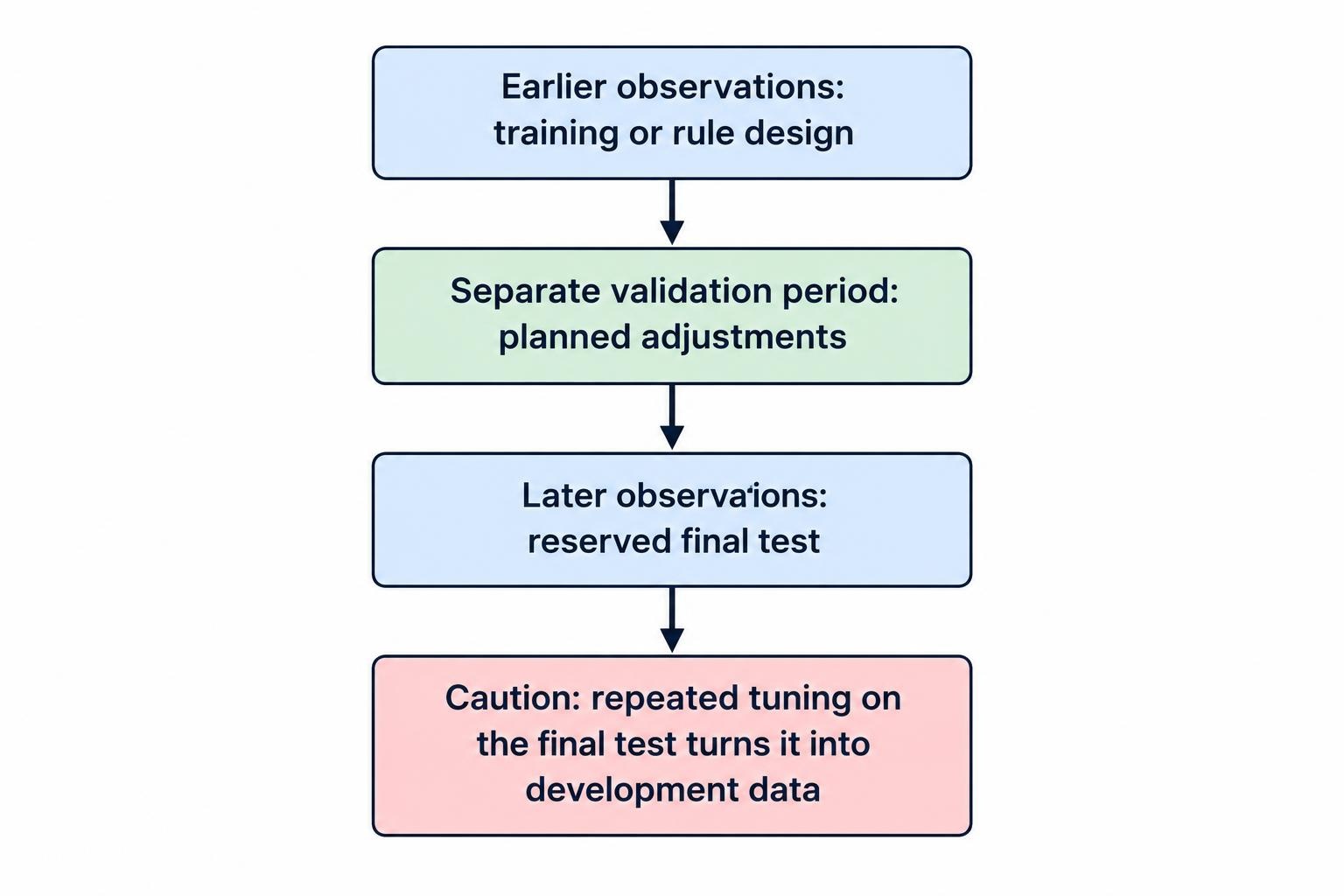
Separate model development from evaluation in chronological order. Train or design the rule using earlier data, make any adjustments on a separate validation period, then reserve later observations for a final test. Do not repeatedly inspect the final test and tune the model to improve its score; after that, the test period has become part of development. The explanation of training, validation and test sets for financial time series covers common ways to structure these periods.
Repeated experimentation is a risk in its own right. If a trader tries enough combinations of indicators, thresholds and holding periods, some will look good on historical data by chance. Research on backtest overfitting in financial markets describes how selecting among many variations on the same dataset can produce strategies that perform poorly on new data. Keep a log of every meaningful trial, including unsuccessful ones. Report the number of versions tested, not only the final winner.
Use a testing method that reflects the intended use. A rolling or walk-forward test repeatedly fits the process on an earlier window and evaluates it on the next period, then moves forward. This can reveal whether results depend on one convenient market phase. It does not guarantee future success; a walk-forward setup can still be overfit if a trader keeps changing the method in response to results. Test the final process on another period or market only when that test is part of the original plan, and be wary of claiming broad usefulness from a narrow sample.
Include costs and real execution limits
A strategy is not ready for review until its simulated trades include plausible costs. Account for commissions, spread, slippage and, where relevant, financing or borrowing charges. Model fills conservatively, especially if the strategy trades often, uses less liquid instruments or depends on entering at a particular price. A signal that looks profitable before costs may have little room for error once each trade is executed. See how to include trading costs in a backtest before comparing model variants.
Execution assumptions should match the actual account and order process as closely as practical. Consider whether a limit order would have filled, whether a stop could slip during a fast market, and what happens if a quote is missing or delayed. A backtest cannot reproduce every live condition, but making assumptions explicit lets you test how sensitive the result is to them. If a small increase in spread or a modest delay erases the edge, that fragility is part of the result, not an inconvenient footnote.
Review the result as a set of evidence
Do not reduce the evaluation to one headline number. Review net return alongside drawdown, average gain and loss, trade count, turnover and performance across distinct periods. Check whether a few unusually strong trades account for most of the total. Inspect losing periods and ask whether they reflect an expected weakness, a data issue or a logic error. A high win rate can coexist with poor overall results; a lower win rate may still be viable if gains and losses are managed differently. The guide to measuring trading performance beyond win rate explains why more than one measure is needed.
Compare the AI-assisted rule with a simple baseline that uses the same data and cost assumptions. The baseline might be a straightforward fixed rule or a passive reference appropriate to the market and time period. The purpose is not to prove that the AI is superior; it is to see whether the added model complexity changes anything useful. If a simple rule performs similarly, is easier to explain and is less sensitive to small changes, the complex version may not justify its maintenance burden.
Keep a decision log alongside the performance record. Note what the model suggested, what the trader chose, why any recommendation was rejected, and what information was available at the time. This helps separate a model error from a process error, such as ignoring a planned limit or changing the rules after a loss. If AI produces a written analysis, retain the prompt, response and source documents when practical. A saved answer is not proof that the answer was correct, but it makes later review more useful.
Move from testing to a controlled trial
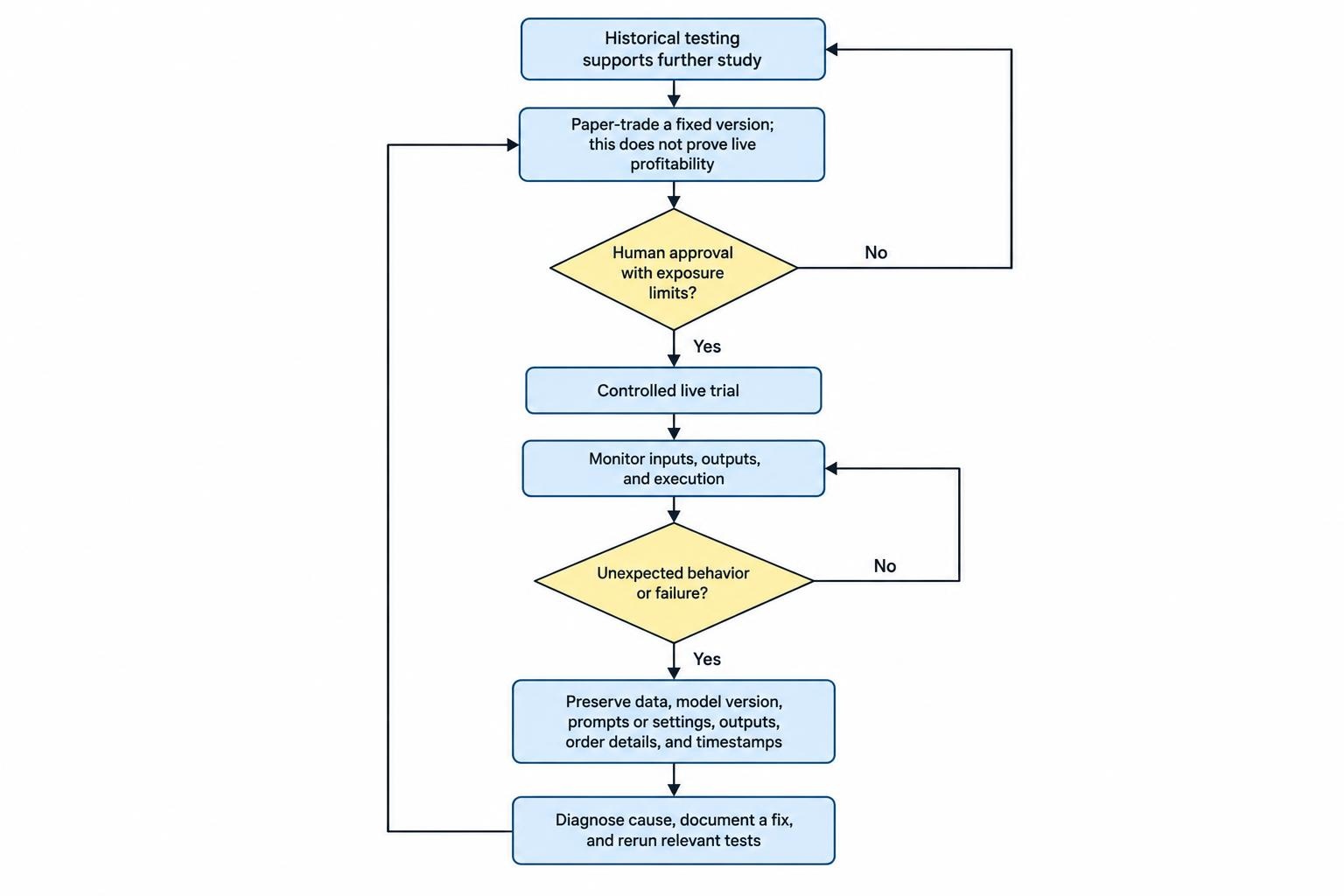
When historical tests support further study, paper trade the fixed process before considering live use. Paper trading can show whether alerts arrive on time, data fields map correctly, and the trader can follow the rules in ordinary market conditions. It cannot establish that simulated fills match live fills or that future performance will resemble the test. Avoid tuning the system every time a paper trade disappoints; changes create a new version that needs its own evaluation.
Set written conditions for continuing, pausing or stopping the trial. These can include an unexpected data outage, a sharp deviation from expected behavior, a breach of risk limits or a material change to the model or data feed. Decide in advance who can approve changes and how the previous version can be restored. The article on what paper trading can establish about an AI system discusses the gap between simulated results and live trading.
If the workflow can send orders, begin with the smallest practical scope and keep human approval in the loop. Use limits on order size and exposure, and verify that the system cannot place duplicate orders after a connection failure. Keep credentials and trading permissions restricted to what the system actually needs. A research assistant with access to account or personal data also raises privacy concerns; avoid pasting sensitive information into a service unless its data handling terms are understood. Automation deserves its own controls, separate from whether the signal looks promising.
Monitor changes and investigate failures
After a process enters use, compare its live inputs and decisions with the conditions it was tested on. Record data gaps, delayed updates, unexpected outputs, rejected orders and changes in market behavior. Establish review intervals rather than retraining or changing thresholds whenever results wobble. Frequent adjustment can turn monitoring into another round of fitting the past. The guide to model drift and performance decay covers signs that a model’s behavior may be changing.
When something goes wrong, preserve the evidence before changing the system: data snapshots, model version, settings, relevant prompts, output, order details and timestamps. Reproduce the event if possible, then classify the cause. Was the input wrong, was the model response unsupported, did the code mis-handle a value, or did execution differ from the assumption? Fix the cause, document the change and rerun the relevant tests. A quiet patch with no record makes the next failure harder to diagnose.
A practical daily sequence
A workable routine can be short. Review the market question and risk limits, confirm that required data has arrived, check any AI-generated claims against original material, then record the signal and the reason for acting or standing aside. After the session, reconcile intended decisions with actual orders and note exceptions. On a scheduled review date, compare results with the original evaluation criteria and decide whether to continue, pause or investigate. The sequence should be written down, not held together by memory on a busy trading day.
Keep the workflow proportional to the task. A language model summarising a public report needs source checks and clear boundaries; a predictive strategy needs a stricter data, validation and execution process. Across both, the standard is the same: know what the tool received, what it produced, what you did with the output and what evidence could change your decision. AI can shorten parts of the work. It cannot remove the need to check whether the work is sound.