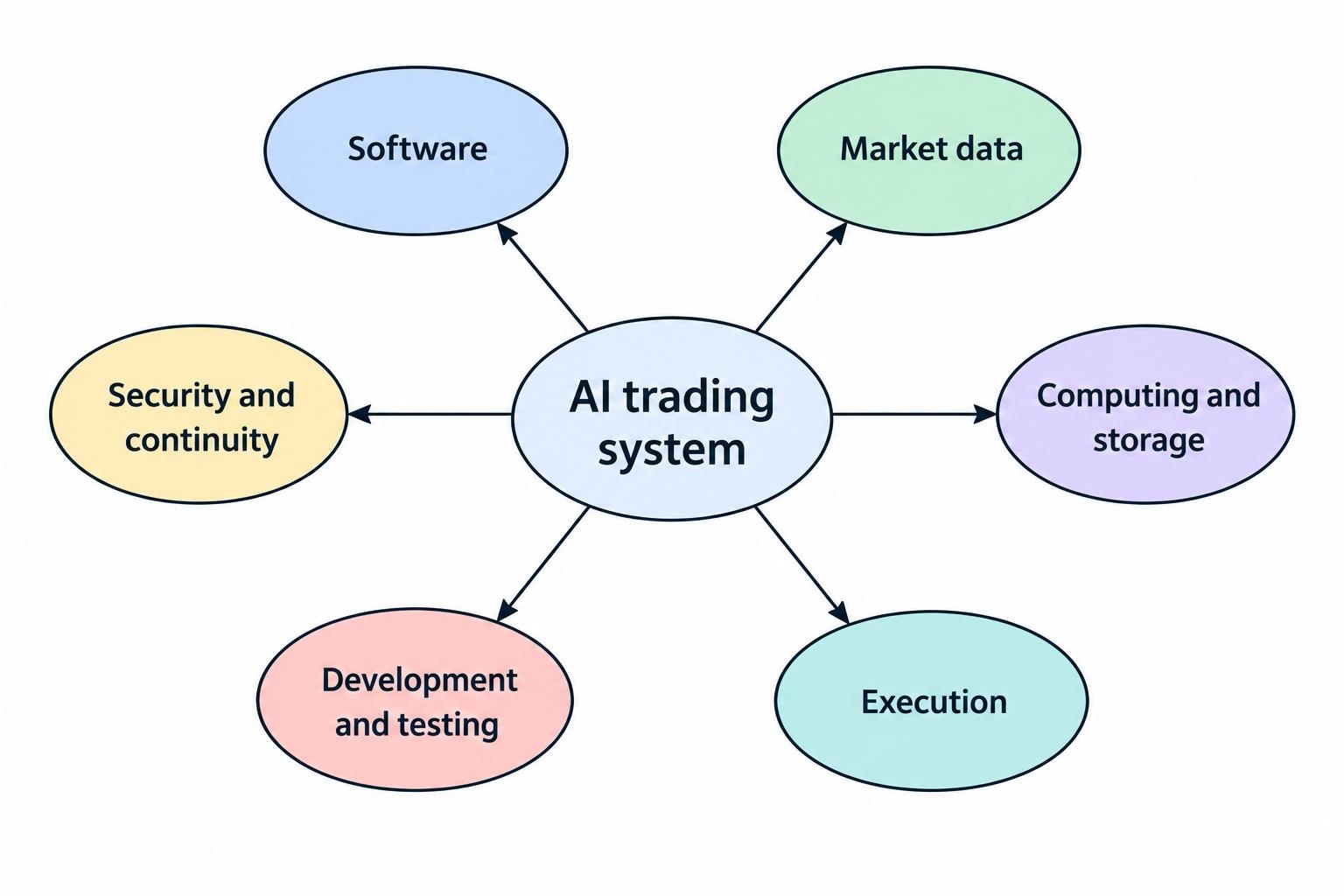
The cost of AI trading is not the price of a model or app alone. A realistic budget includes software, market data, computing, storage, testing and the cost of placing trades. Some expenses are fixed monthly subscriptions; others grow with data usage, account activity or the number of markets covered. A low-cost setup can still be expensive if it trades often, needs paid real-time data or uses infrastructure that runs around the clock.
Start by deciding what the system will do. A tool that summarizes daily market news has different costs from a model that processes tick data and routes orders automatically. The right comparison is the full cost of a working system against its intended use, not a vendor’s headline subscription price. This guide breaks down the main expense categories and gives you a way to estimate them before committing to a platform or live trading.
What counts as the cost of AI trading?
Separate operating expenses from trading costs. Operating expenses pay for the tools and infrastructure used to research, test or run the system. Trading costs arise when orders are placed: commissions and fees, the spread, slippage and, where relevant, financing or borrow costs. A strategy may have no monthly software charge and still be costly to run. The reverse is also true: an expensive research platform does not mean each trade is expensive.
For a broader view of how AI fits into a retail trading process, see AI trading for retail traders. The table below is a budgeting map, not a universal price list. Actual charges depend on the market, provider, data rights, usage and trading frequency.
| Cost category | What may be charged | What makes it grow |
|---|---|---|
| Software | AI assistant, charting package, strategy builder or hosted bot | Premium features, usage limits, number of accounts or users |
| Market data | Real-time or delayed quotes, historical data, exchange or vendor fees | Market coverage, data speed, licensing status and intended use |
| Computing and storage | Cloud server, database, backups, network transfer or local hardware | Run time, processing demand, retained data and reliability needs |
| Development and testing | Data cleaning, model experiments, backtesting and monitoring | More markets, more frequent retraining and larger datasets |
| Execution | Commissions, exchange or regulatory charges, spread, slippage and financing | Trade size, order type, turnover and time held |
| Security and continuity | Credential management, alerts, backups and a second system for recovery | Reliability requirements and the cost of downtime or an execution error |
Software and platform fees
AI trading software may be sold as a subscription, charged by usage, bundled with a data service or included in a broader trading platform. Check what the fee actually buys. A lower tier might restrict the number of alerts, models, symbols, historical bars or monthly requests. A platform may advertise AI features while charging separately for live data, automation or a connection to an execution venue.
Compare the plan’s limits with the workflow you intend to run. A model that reviews a watchlist once a day may fit within a basic plan; a process that sends frequent requests or scans many instruments may not. Check overage charges, cancellation terms, export options and whether you can retrieve your work if you leave. A paid plan is not automatically better, and a free plan is not costless if it consumes time or lacks the records needed to test a strategy. Use a structured platform evaluation before paying for features you may not use.
Software choice also affects technical costs. A no-code tool can reduce setup and maintenance work, but it may limit control over data, testing or execution. Building with Python can avoid some subscription fees while adding development time, hosting and maintenance. The trade-off is explained in no-code AI trading tools versus Python. Count your own hours as a cost even if no invoice arrives. Time spent fixing an unreliable pipeline is time the system’s budget should reflect.
Market data can be a larger expense than the model
Data costs vary according to the asset class, exchange, delay, depth and license. A free quote feed may be enough for rough research, but it may not match the timing or detail needed for an intraday strategy. Tick data, order book depth and long histories can carry separate fees, and a platform’s data price may not include the right to use that data in every application.
Exchange rules can also distinguish between personal and professional use, display and non-display use, or different types of access. NYSE’s market data subscriber policy, for example, says that a person receiving data through an organization’s account may be classified as a professional subscriber even when using it personally. CME’s January 2026 market data fee list separates fees by data and use categories. These are exchange-specific policies, not a universal rule or a quote for your account. Confirm classification and charges with the data provider before building a budget around an advertised retail rate.
Data quality can create costs without appearing as a line item. Missing timestamps, inconsistent symbols, corporate actions and gaps between sources may require cleanup or cause invalid test results. Check whether the feed supplies adjusted prices, the relevant session hours and the historical coverage your model needs. If a strategy relies on a data field that was not available at the time of each historical trade, the backtest may contain look-ahead bias, not a genuine edge. The practical issues are covered in preparing historical market data for AI trading research.
Computing, storage and network costs
Many retail projects do not need a large server. A local computer can handle research and scheduled analysis; a small hosted instance may be more convenient for a process that must run while the computer is off. Costs depend on processor and memory requirements, operating hours, storage, backups and data transfer. Cloud services can bill these parts separately. AWS, for example, lists additional charges for some services used alongside EC2, including storage and monitoring, so the instance rate alone may not describe the full bill.
Estimate usage before selecting infrastructure. Record how many hours the system must run, how much historical data it stores, how often it writes logs and whether it needs a database or backup copy. Shut down research machines when idle, set billing alerts and review usage after the first month. AWS EC2 on-demand pricing is one example of usage-based compute pricing; other providers have their own rates and billing rules. Avoid paying for high availability or processing capacity that the system does not need, but do not cut backup and monitoring costs where a failure could leave orders unmanaged.
There is also a difference between a model that analyzes data and one that runs continuously. A language model or hosted AI service might charge by requests or tokens, while a locally run model shifts spending toward hardware and power. The best option depends on frequency, data sensitivity and the work involved in keeping it running. Include setup time and routine maintenance rather than comparing only the monthly bill. A system that is cheap to host but takes hours each week to repair may be poor value.
Execution costs: the part that can hide in performance
Trading costs include more than a stated commission. Depending on the instrument and account, there may be exchange, regulatory, clearing or platform charges. The spread is the difference between the prices available to buy and sell. Slippage is the difference between the expected execution price and the actual fill. Financing, overnight charges or stock borrow fees may apply to some positions.
These costs are especially relevant for strategies with frequent trading or small expected gains per trade. An AI signal can look profitable before costs and fail after realistic spreads, fees and slippage are included. The backtesting guide to fees, spreads, slippage and financing explains how to account for them in testing. The SEC notes that execution venue and timing can affect the price an investor receives, not just the commission charged. Its investor guide to trade execution describes those execution factors for securities trading.
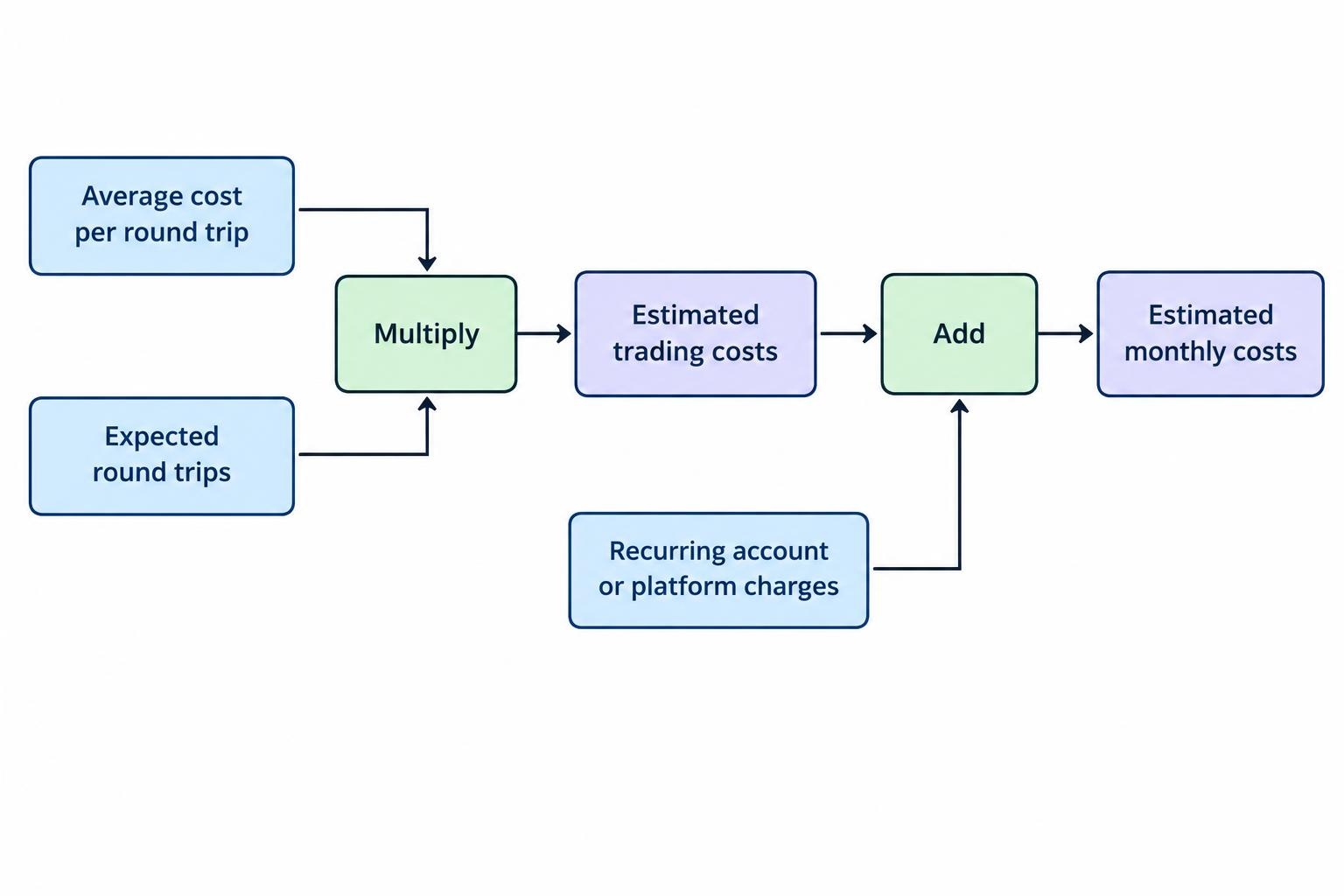
Estimate costs per completed trade and per month. For a simple first pass, multiply the average round-trip cost by the expected number of round trips, then add any recurring account or platform charges. Use actual fills from a paper-trading period or account records when available, rather than assuming every order fills at the quote. A strategy that trades more often than expected can incur a much larger bill even if the average cost per trade seems small.
Testing and maintenance belong in the budget
Testing takes data, computing and time. You may need to clean a dataset, run multiple tests, compare the model with a simple benchmark and repeat the process on out-of-sample data. Keep those expenses separate from the cost of live trading; otherwise it is easy to treat research spending as though it were a recurring operating fee. Still, excluding testing entirely produces a misleading estimate of what it takes to build a system responsibly.
After launch, the model needs review. Data formats change, platforms update, credentials expire and trading performance can drift. Monitoring can be a small recurring expense, but it also takes attention. An automated system should have a way to detect failed data updates, duplicate orders or unexpected position sizes, and a process for pausing it when something breaks. Budget for these controls as part of the workflow, not as optional extras. The article on trading limits and human oversight covers operational safeguards.
Include a transition period if you plan to move from simulation to live orders. Paper trading can reveal workflow problems, but simulated fills do not establish that live trades will have the same costs or execution quality. Set a risk limit for any live trial and monitor fills against the assumptions used in the backtest. A system’s software bill may stay flat while its real-world operating costs change with market conditions.
A practical monthly cost worksheet
Use a spreadsheet with one row per expense. Record the provider, billing unit, expected use, estimated monthly amount and whether the charge is fixed or variable. Add a notes column for assumptions such as data delay, number of symbols, run hours and estimated trades. When an amount is unknown, mark it for confirmation instead of treating it as zero. Check the provider’s current fee schedule and terms, since prices and data policies can change.
| Budget line | Estimate method |
|---|---|
| Software and AI usage | Subscription plus expected usage or overage charges |
| Market data | Feed, exchange access and any required data license |
| Compute and storage | Expected run time, storage, backups and network transfer |
| Trading costs | Estimated round-trip cost multiplied by expected trades |
| Testing and upkeep | Data preparation, monitoring and routine maintenance time |
| Contingency | Allowance for variable usage or unexpected operational needs |
Build three estimates: a minimum viable setup, a realistic expected month and a higher-use month. The minimum should still include the data and checks required to test the strategy properly. The higher-use estimate should account for more trades, a larger data request or longer compute time. This range makes it easier to see whether costs remain manageable if your initial assumptions are wrong.
How to keep the budget under control
Begin with the smallest setup that can answer a clear research question. Use delayed or lower-frequency data if the strategy does not need immediate updates. Limit the number of instruments, store only the data you need and run expensive model jobs on a schedule rather than continuously. Before adding a paid service, identify which cost or limitation it addresses. If the benefit cannot be measured, wait.
Track actual costs alongside performance. Include subscription charges, data, computing and execution expenses in monthly reviews, and distinguish recurring charges from one-time development work. A trading journal can help connect strategy decisions with actual results; the guide to using AI to analyse a trading journal covers that review process. If total cost per trade rises, find out whether the cause is higher turnover, execution quality, data pricing or infrastructure usage before changing the model.
Finally, assess cost against risk and expected benefit, not against a claim of easy savings. A model that reduces research time may have value even if it does not execute trades. A more expensive data feed may be warranted for a strategy that depends on precise timing, but it does not guarantee better results. Keep estimates grounded in current invoices, actual usage and realistic fills. That is a much firmer basis for deciding whether an AI trading system is affordable than a platform’s starting price.