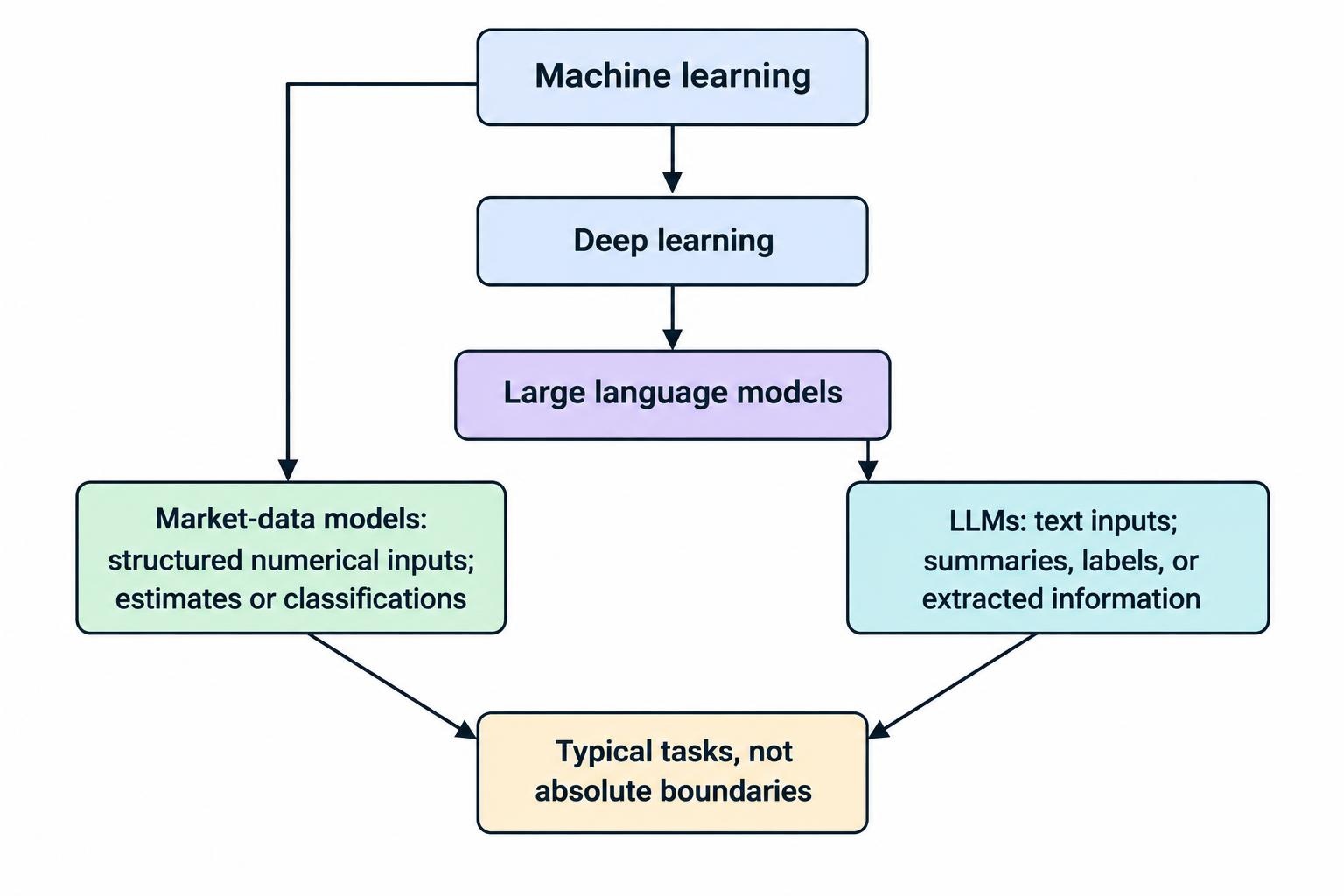
Machine learning and large language models are often discussed as separate ways to use AI in trading. That comparison is misleading. A large language model (LLM) is a kind of machine learning model, usually built with deep learning. The practical distinction is what the model learns from, what it is designed to output, and how you test its results.
A model trained on historical prices might estimate volatility or classify market conditions. An LLM trained on text might label the tone of an earnings announcement or extract figures from a filing. Either could support a trading process, but neither should be treated as a reliable price oracle. For retail traders, the useful question is not which label sounds more advanced. It is which tool handles a defined task, with data and testing suited to that task. This distinction also helps place the wider field of AI trading for retail traders in practical terms.
Machine learning and LLMs: how the terms fit together
Machine learning is a broad family of methods that learn patterns from data. A model is trained on examples, then uses what it learned to produce an estimate, classification, ranking or other output. The data might be numbers, text, images, or a mixture. Deep learning is a branch of machine learning based on neural networks with many processing layers. LLMs are deep learning models trained to process or generate language at scale.
So an LLM is machine learning; it is not an alternative to machine learning. In trading discussions, people often use “machine learning” to mean a model built for a narrow task, such as predicting next-period volatility from market data. They use “LLM” to mean a language model that can interpret or generate text, often through a chat interface. That shorthand is convenient, but it can obscure important differences: an LLM may be specialized for classification rather than chat, and a machine learning model may itself process language.
| Term | Typical input | Typical output | Possible trading use |
|---|---|---|---|
| Traditional machine learning | Prices, volume, indicators or other structured data | Score, category, estimate or ranking | Rank candidates or estimate a condition such as elevated volatility |
| Deep learning | Structured data, sequences, text, or other complex inputs | Prediction or representation used for a task | Model patterns in time series or process financial text |
| Large language model | Text, and sometimes other supported input types | Generated text, answers, labels or extracted information | Summarize a filing, classify a news item or extract named figures |
| Financial language model | Financial text used for training or task adaptation | Text classification or other language task output | Classify sentiment or identify finance related topics in documents |
The categories overlap. An LLM can be fine tuned for one financial task, while a deep learning model can be built to analyze price sequences. The difference between AI, algorithmic and automated trading is another useful distinction: a strategy can be algorithmic without using AI, and a model can produce analysis without placing orders automatically.
What a market data model does
A trading model built around numerical data usually receives structured inputs: recent returns, volume, volatility estimates, spreads, technical features or other measurements. During training, it learns a relationship between those inputs and a defined target. The target might be the next day’s return category, the chance that volatility exceeds a threshold, or whether a rule based setup historically reached a stated exit condition.
That target must be precise. “Predict the market” is not a useful specification. “Estimate whether the next five sessions’ realized volatility will exceed a defined threshold” is testable. The model can then be assessed on observations it did not train on, with trading costs and the intended decision process represented as accurately as possible. Choosing appropriate inputs is part of the work; a feature is useful only if it is available at the time of the decision and contributes out of sample. A separate guide to choosing features for a trading model covers that issue in more detail.
Not every market data model is sophisticated. A logistic regression or decision tree can be machine learning, and a simple rule can be a strong benchmark. More complex neural networks may model nonlinear relationships, but complexity does not guarantee better forecasts or better trading results. Financial data is noisy, market behavior changes, and a model can fit historical quirks that fail to repeat. For a fuller account of this distinction, see what AI can and cannot do for retail traders.
What an LLM does with financial information
An LLM works with language. Depending on its design and setup, it can generate a summary, classify a passage, extract requested fields, or answer questions about supplied text. A trader could use one to turn a long earnings release into a structured note containing revenue guidance, management’s stated risks, and dates mentioned in the document. The result can speed up reading, but the model may omit a qualification, misread a number, or state an unsupported detail with a confident tone.
Some LLMs are designed mainly to represent or classify text rather than hold a conversation. FinBERT, for example, is a BERT based model adapted to financial texts. A published study tested it on researcher labeled analyst report sentences and found stronger sentiment classification results than several comparison methods in that sample. That finding supports a narrow point: domain adapted language models can help classify financial text. It does not show that FinBERT predicts profitable trades, works equally well on every news source, or will keep its measured performance on new data. See the FinBERT study of financial text classification for the task and evaluation details.
The original Transformer architecture helped make modern language models practical by using attention mechanisms to process relationships across a sequence of text. Its initial research evaluated machine translation and other language tasks, not trading performance. That distinction matters: strong language ability is evidence about language tasks, not proof of an edge in the market. The Transformer research paper describes the architecture’s original purpose and tests.
Where the approaches differ in a trading workflow
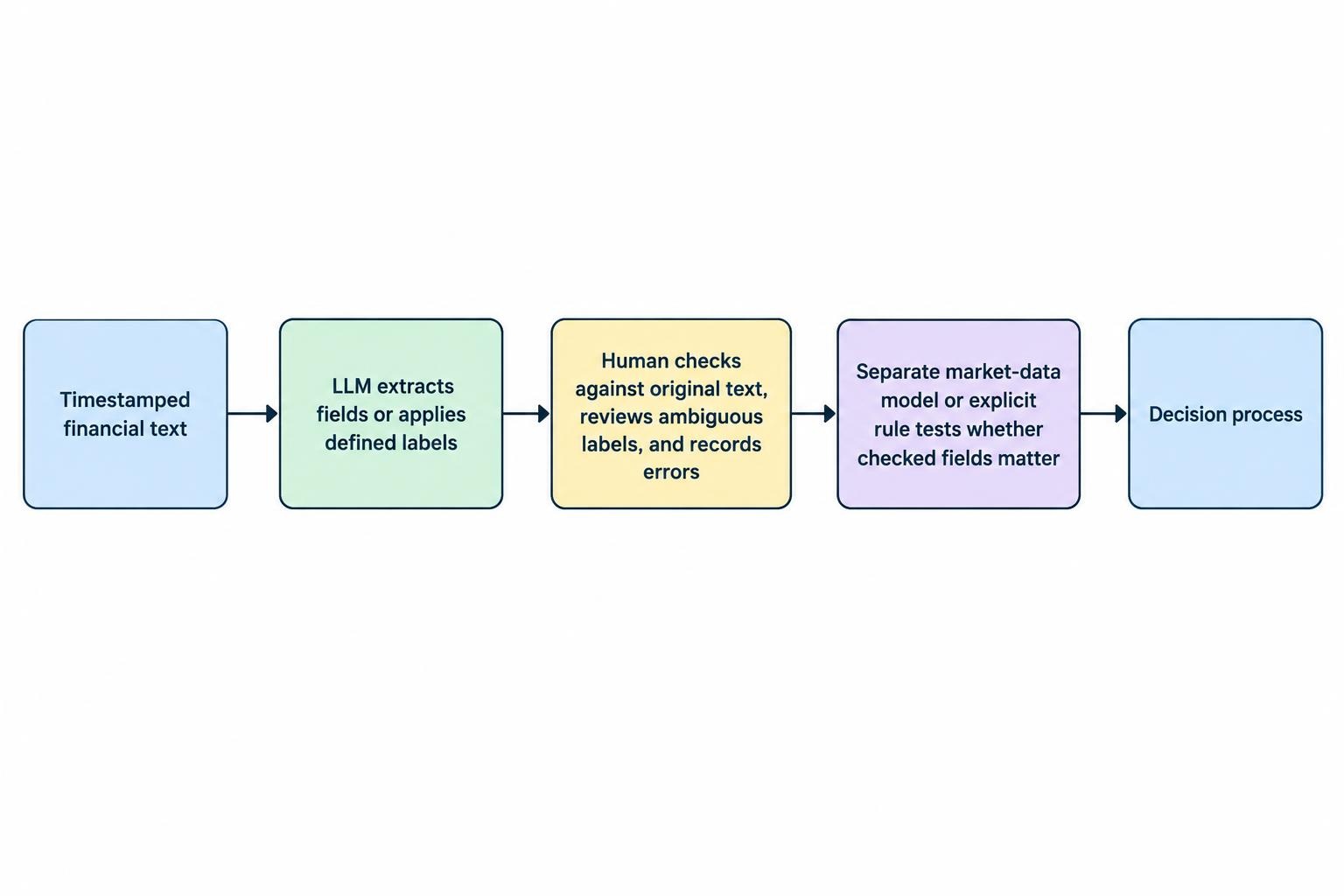
The clearest division is by job. Use a market data model when the question is numerical and measurable, such as estimating volatility from observations available before a trade. Use an LLM when the task begins with unstructured language, such as extracting an earnings date or separating company guidance from analyst commentary. Some workflows use both: an LLM can convert a document into carefully checked fields, and a separate model can test whether those fields add value to a defined strategy.
That handoff needs care. If an LLM labels “positive news” without a consistent definition, two similar announcements might receive different labels. If it extracts a reported figure but misses whether the figure is quarterly or annual, the downstream model inherits a bad input. A trader should keep the original text, record the model’s output, define the categories before testing, and inspect a sample of errors. Treat LLM output as a measurement that needs validation, not as a fact simply because it is neatly formatted.
Historical timing is another fault line. Financial releases are revised, and a backtest must use only the information that was actually available at each simulated decision point. A Federal Reserve study of LLM recall found errors involving revised historical values and data that had not yet been released on the date being assessed. The study concerns macroeconomic knowledge, not every model or trading strategy, but it illustrates why remembered information should not substitute for timestamped records. A sound process starts with historical market data prepared for research and checks the timing of each input. ([federalreserve.gov](https://www.federalreserve.gov/econres/feds/total-recall-evaluating-the-macroeconomic-knowledge-of-large-language-models.htm))
How to test an LLM signal or a machine learning model
Both types of system need a test that matches their intended use. For a numerical model, define the prediction target, the forecast horizon and the decision rule. For an LLM, define what counts as a correct extraction or classification, how ambiguous examples are handled, and which version of the model and prompt produced the result. If the LLM output is converted into a trade signal, test the complete chain, including data timing, signal generation, position sizing and costs.
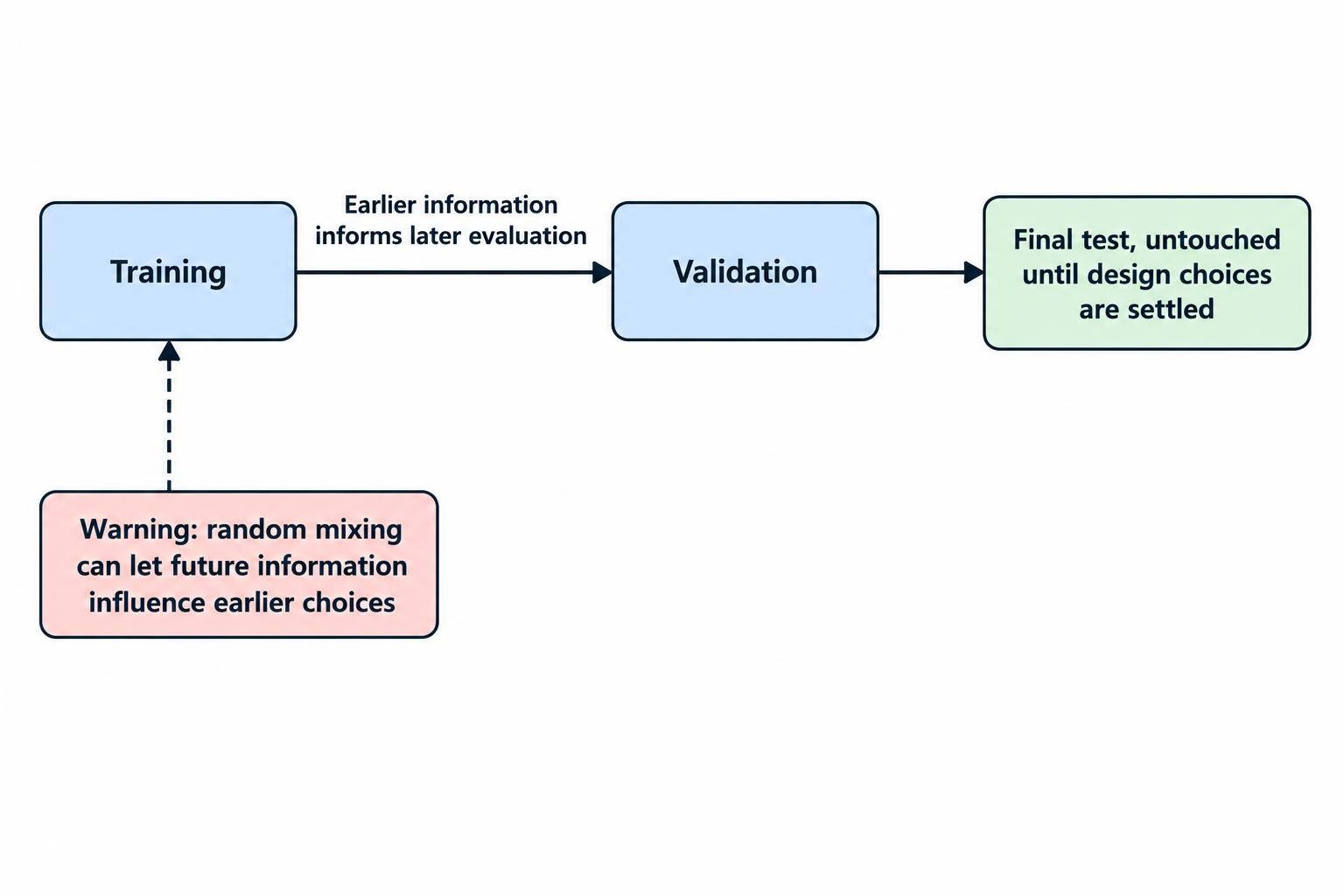
Separate training, validation and test data in chronological order when the task involves time. Randomly mixing dates can let information from later periods influence model choices for earlier ones. Keep a final test set untouched until design choices are settled, then evaluate across more than one period or market condition. A result from one backtest is a measurement under those test conditions, not a forecast of future returns. The guides to time series training and test sets and overfitting and data leakage explain common ways historical results can be overstated.
For an LLM, benchmark accuracy alone may not capture the cost of mistakes. Suppose a model labels market news as positive or negative. A false positive on a routine update may be harmless if a human reviews it; a missed warning about an unexpected filing may carry more weight in the workflow. Measure error types that matter to the intended decision, and check results on different sources, writing styles and time periods. If the model changes, rerun the evaluation rather than assuming the new version behaves the same.
Finally, compare the system with a simple alternative. That could be a no trade rule, a basic keyword filter, a plain statistical model or the existing strategy without the AI feature. If the more complex setup does not improve a relevant out of sample measure after costs, it has not earned a place in the process. For strategy level testing, review how to test and validate AI trading systems.
Choosing between them for a retail trading task
Start with the input and output, not the model label. If the input is a chart or a price series and the desired output is a defined numerical estimate, a market data model or a simpler statistical method may fit the task. If the input is a filing, news report or earnings transcript and the desired output is a summary or structured label, a language model may save time. If the task combines text and market data, keep the text processing step separate at first so its errors can be inspected.
- Use an LLM for text work: summarizing documents, extracting named details, or classifying passages under a clear label scheme.
- Use a market data model for numerical targets: estimating a defined outcome from inputs with known timestamps.
- Use neither as a shortcut around testing: check data quality, timing, costs, and performance against a simple benchmark.
In practice, an LLM may help a trader read and organize information, while a separate model or explicit rules determine whether a tested condition is present. That division makes errors easier to trace and reduces the temptation to treat fluent output as a trade instruction. A documented AI assisted trading workflow can specify where each tool fits, what a human must verify, and what evidence is required before a signal affects a decision.