AI trading, algorithmic trading and automated trading describe overlapping parts of a trading system, not three competing categories. An algorithm is a set of instructions. Automation lets software carry out tasks with less human input. Artificial intelligence (AI) refers to methods that can learn from data, generate outputs or identify patterns. A single system may use all three: an AI model estimates the chance of a price move, an algorithm turns that estimate into a trade rule, and automated software submits and manages the order.
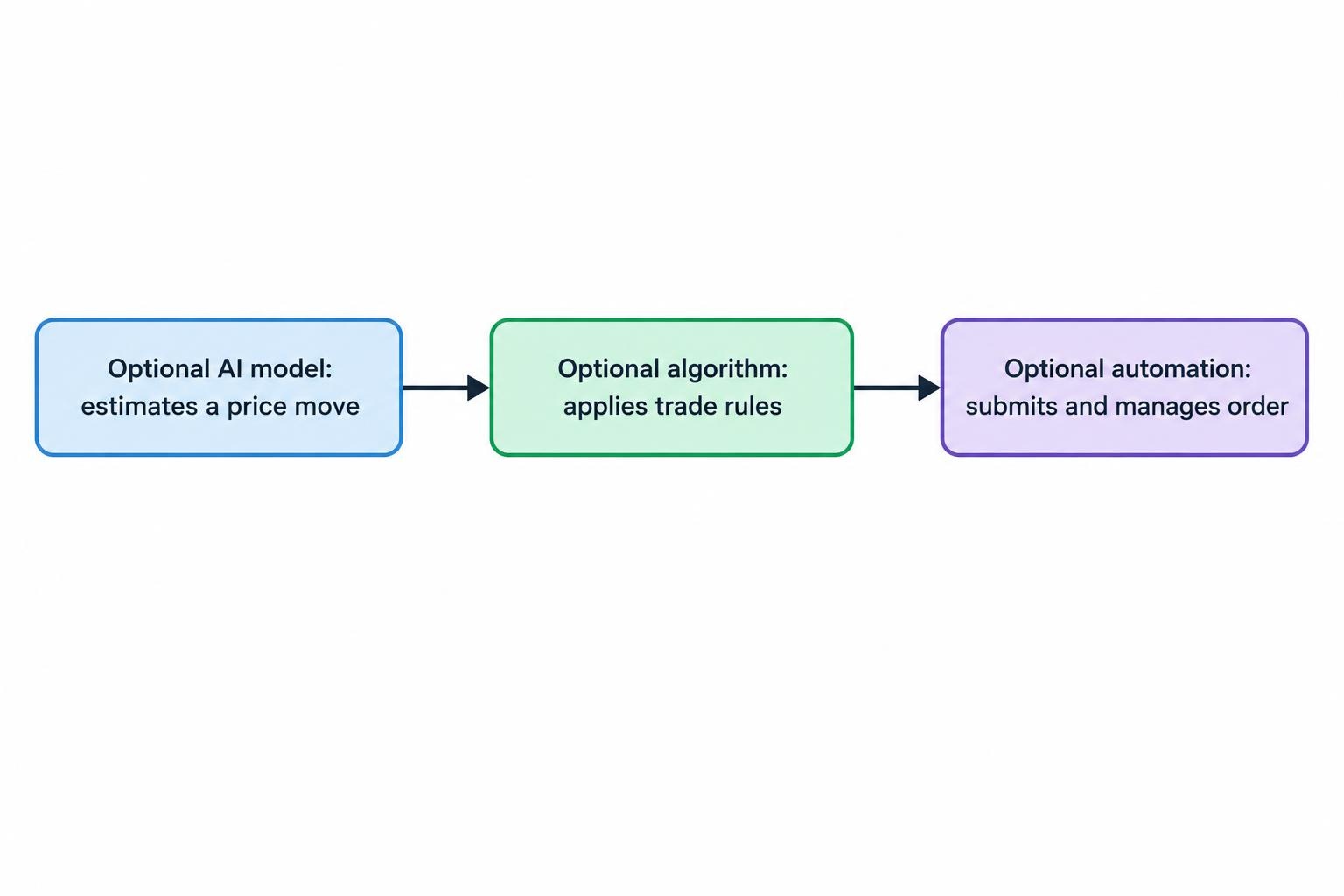
The distinction matters because product labels are often vague. A tool that summarizes market news may use AI without trading. A basic script can trade automatically without AI. And a rule based strategy can be algorithmic even if a person reviews every signal before placing an order. To assess a tool, ask what it does at each step: analyze information, make a decision, generate an order, or send and manage that order. That gives a more useful answer than the label on its sales page.
What each term means
| Term | What it describes | Example |
|---|---|---|
| AI trading | Trading research or decisions that use AI methods. | A model classifies market conditions as trending or ranging. |
| Algorithmic trading | Trading decisions or order parameters produced by programmed rules. | A rule buys when a moving average crosses above another and sells when a stop is reached. |
| Automated trading | Software carrying out one or more trading tasks with reduced manual input. | A system sends an order when a user approved signal appears. |
These are practical definitions, not universal legal labels. Their precise meaning can vary by market and regulation. In a U.S. futures market concept release, the Commodity Futures Trading Commission described automated trading systems as software and related computer systems used to automate a trading strategy, including order generation and execution. That framing helps show why algorithmic and automated trading overlap: algorithms supply instructions, while automation puts some or all of those instructions into action. The CFTC’s discussion of automated trading environments and systems is about market structure, not a complete classification guide for every retail product.
AI is a method, not an execution mode
AI describes how a system analyzes information or produces an output. It does not say whether a person must approve the result, whether software can place orders, or how much of the process is automated. A trader might ask an AI assistant to summarize earnings news, then make an independent decision and place an order manually. That is AI assisted research, not necessarily automated trading.
AI can also sit inside an algorithmic strategy. A model might estimate the probability that a market will rise over the next hour. A separate rule could act only when that estimate exceeds a chosen threshold and other conditions are met. The model produces an input; the rules determine how that input affects a trade. The difference between machine learning models and language models matters here, since a text generating assistant and a model trained to classify price data do not perform the same job. The article on machine learning and large language models in trading covers that distinction.
Some AI systems generate recommendations or alerts but never connect to an account. Others may feed signals into software that creates orders. Whether that final step is manual or automatic changes the system’s role, not whether its analysis uses AI. AI can be present at the research stage, the signal stage, or both. It can also be absent entirely from an automated strategy.
Algorithmic trading does not require AI
An algorithm is a procedure for solving a problem or carrying out a task. In trading, it may specify when to enter or exit, how much to trade, or how to divide a large order into smaller ones. The instructions can be simple and fixed. A rule such as “buy if price closes above yesterday’s high, provided a risk limit is not breached” is algorithmic even if it uses no machine learning.
A person can still supervise an algorithmic strategy. For example, a trader may review an alert, approve the trade and enter it manually. The signal comes from programmed rules, so the analysis is algorithmic; the final action remains under human control. In other systems, software may choose order details or manage an order after submission with little intervention. Regulatory definitions can focus on those order functions, so terms used in a trading product’s marketing do not necessarily match a regulator’s legal test.
Automation can be narrow or end to end
Automation describes which tasks software performs, not how clever the software is. It might send a price alert, calculate a position size, place a stop order or manage an open position. A fully automated setup may also monitor market data, apply trade rules, submit and amend orders, and record results. Each added step can reduce manual work, but it also creates more places where a faulty rule, bad data or a connection problem can cause trouble.
Automation does not automatically mean the system makes its own market judgment. A trader might select a strategy and set its rules, while the platform handles order placement when the conditions are met. Conversely, an AI assistant may produce detailed analysis while leaving every trade decision and order to the user. Reviewing the capabilities and limitations of AI for retail traders helps separate model output from the actions a trading platform can actually take.
How the terms fit together
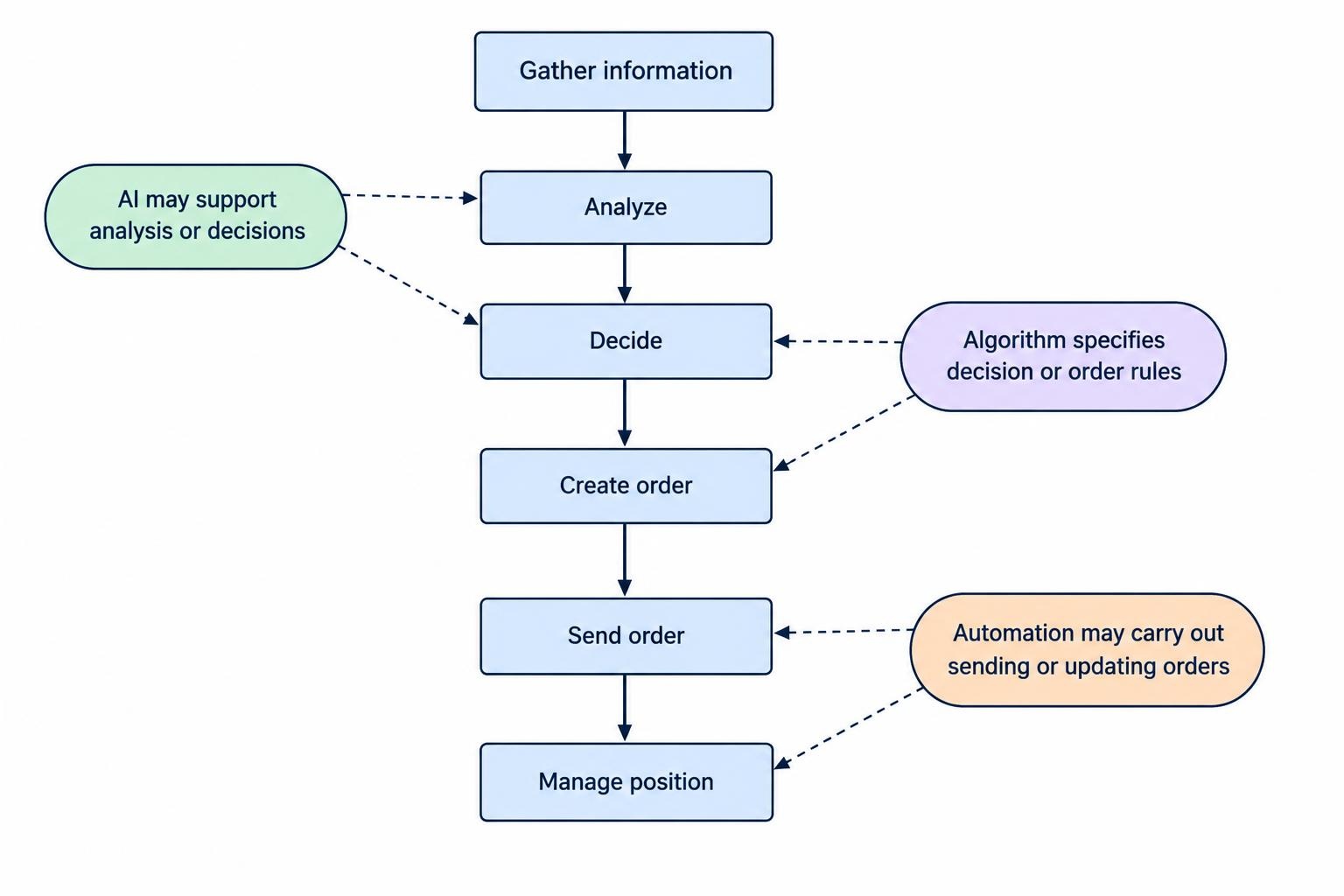
It helps to break a trading process into stages: gather information, analyze it, decide whether to trade, create an order, send it, and manage the position. AI may contribute to analysis or decision support. An algorithm expresses a procedure for making a decision or setting an order. Automation performs tasks such as sending or updating that order. A system can use one, two, or all three.
| Setup | AI? | Algorithmic? | Automated? |
|---|---|---|---|
| An AI assistant summarizes a company report; a trader decides and places a trade. | Yes | Not necessarily | No, not for execution |
| A fixed rule generates an alert; a trader reviews it and enters the order. | No | Yes | Partly, for the alert |
| A programmed strategy sends orders when set conditions occur. | Not necessarily | Yes | Yes |
| A model estimates a signal, a rule checks it, and software submits the order. | Yes | Yes | Yes |
The table uses everyday descriptions, not legal classifications. A system’s exact status can depend on what it does, the market where it operates and the relevant rules. For most retail traders, though, the practical questions are simpler: what information does it use, what decides whether a trade happens, and who or what can send the order?
Examples from a retail workflow
Research only: A trader asks an AI assistant to organize recent company announcements and identify questions to investigate. The trader checks the underlying documents, forms a view and places any trade manually. AI helps with research; the trading decision and execution are not automated. This can still require care: a fluent answer may misstate a date or overlook a detail, so claims that matter need verification.
Rules with human approval: A script scans a watchlist and flags shares that meet set price and volume conditions. The trader reviews the chart, checks the risk and submits an order. This is algorithmic screening, with partial automation. It does not become AI trading just because the script processes a large amount of data.
AI signal with automatic orders: A machine learning model evaluates market data, a separate set of rules decides whether its output meets the entry threshold, and a connected program submits an order. This combines AI, algorithmic logic and automated execution. It also needs testing that accounts for out of sample performance and trading costs; a convincing historical result is not proof that the system will work in live markets. The guide to testing and validating AI trading systems explains why those checks matter.
Questions to ask before using a trading tool
Start by identifying the tool’s actual function. Does it provide research, produce a signal, calculate an order, or send orders to a trading account? Marketing phrases such as “AI powered” do not answer that. Check whether a human must approve each trade, what happens if the service loses its data connection, and whether the software can amend or cancel open orders.
Then look at how the model or rules are tested and monitored. Ask what data the system uses, whether historical tests include fees and slippage, and how it handles unexpected inputs. If it can place orders, review its trading permissions and set limits that match your tolerance for loss. A defined review process matters too: a strategy can behave differently when market conditions change, even if its code has not changed. For a practical step by step approach, see how to build an AI assisted trading workflow.
Finally, treat promises of effortless or guaranteed returns as a warning, not evidence of quality. The CFTC notes that promoters have used AI claims to market trading schemes with unrealistic or guaranteed returns, and warns that AI cannot predict the future or sudden market changes. Its advisory on AI trading bots outlines common claims to question. The central distinction remains practical: AI describes a method, an algorithm describes instructions, and automation describes tasks software carries out. A tool may combine them, but each needs to be evaluated on its own role.