Artificial intelligence can help a retail trader sort information, test rules and handle repetitive analysis. It cannot see the future, guarantee a profitable trade or remove the need to manage risk. Those boundaries matter because “AI trading” can describe very different things: a machine learning model estimating returns, a language model summarizing company news, or software that sends orders to a brokerage account.
For an individual trader, the most practical question is not whether AI is powerful. It is which task the tool can perform reliably, what evidence supports that claim, and what can go wrong when its output is used to make a trade. AI can make some parts of research faster. A fast mistake, though, is still a mistake.
What AI can do for retail traders
AI systems can process information at scale. Depending on the tool, they may sort a watchlist against defined criteria, classify news by topic, flag unusual price or volume activity, summarize a filing, or identify patterns in a trading journal. A model can also help a trader turn a vague idea into testable rules, then write or review code for a historical test. These jobs can reduce manual work, but the output still needs checks: a summary can miss a qualification, a data feed can be delayed, and a pattern can be meaningless outside the sample where it appeared.
Language models are particularly useful for working with text. A trader might ask one to extract dates, figures and stated risks from an earnings release, then compare that list with the original document. A separate model could classify news headlines for later analysis. Such tools can help organize research; they do not establish whether the news will move a share price, whether a forecast is correct, or whether a trade fits the trader’s financial situation. For a closer look at these uses, see using AI assistants to research markets and check trading ideas.
Machine learning can also identify relationships in structured data, such as prices, returns, volume or volatility. A trader could use a model to rank possible setups or estimate the chance that a defined condition will occur within a chosen period. That is a forecast, not a promise. Its value depends on the target, the data, the test design and whether results survive costs and changing conditions. A useful model may support a repeatable process; an impressive score on past data alone does not show that it will work with future prices.
AI can help with workflow tasks, too. It may format data, produce a first draft of code, generate a checklist, or label trades for later review. This can be useful even if the model never generates a trading signal. Retail traders often have limited time and may find more value in a clearer process than in another prediction. The role of the tool should be set before using it: research assistant, filter, coding aid or automated execution component. Each role needs different checks.
What AI cannot reliably do
AI cannot know future market prices. A model can estimate a probability from historical or current inputs, but the estimate is uncertain and may fail when conditions change. It can also produce a confident explanation for a weak signal. That explanation does not prove that the model found a real cause, or that the predicted outcome is likely enough to trade after costs.
Large language models add a separate limitation: fluent text is not the same as verified financial analysis. A model may misstate a figure, combine facts from different dates, invent a source or answer a question using information that is stale. The Federal Reserve’s 2025 study of large language models found that errors in recalling historical economic data included mixing initial releases with later revisions and treating some information as available before it had actually been released. That matters in backtests and event-driven trading, where using information that was not available at the time can make a strategy appear better than it was. The study examined macroeconomic recall, not the performance of retail trading systems, so its findings should not be stretched beyond that scope. The Federal Reserve study on LLM recall and real-time forecasting sets out those limits.
Nor can AI reliably identify a profitable strategy just by looking at a chart or a pile of historical prices. A model can find patterns that arose by chance, especially if a researcher tests many indicators, settings or markets and keeps only the best result. The chosen strategy may then fail on new data. This is a testing problem, not something solved by calling the model “intelligent.” Traders developing signals should treat out-of-sample checks and realistic assumptions as necessary parts of the process. The broader steps are covered in testing and validating AI trading systems.
AI also cannot guarantee that a trade will execute at the price assumed in a model or backtest. In live markets, orders may be delayed, partially filled or filled at a different price. A signal that looks profitable before trading costs can lose its edge after spreads, fees, slippage and financing are included. The model may generate the signal, but the trader remains responsible for checking how orders are placed and for what happens when the system or connection fails.
AI tools are not all the same
The label “AI trading tool” covers systems with different inputs and responsibilities. A chatbot that explains a concept does not have the same job as a model trained to rank stocks. Neither is equivalent to software that can place trades in an account. Before relying on a tool, identify whether it gives information, proposes a decision or takes an action. Confusing those roles can leave a trader believing a system has reviewed more data or has more control than it actually does.
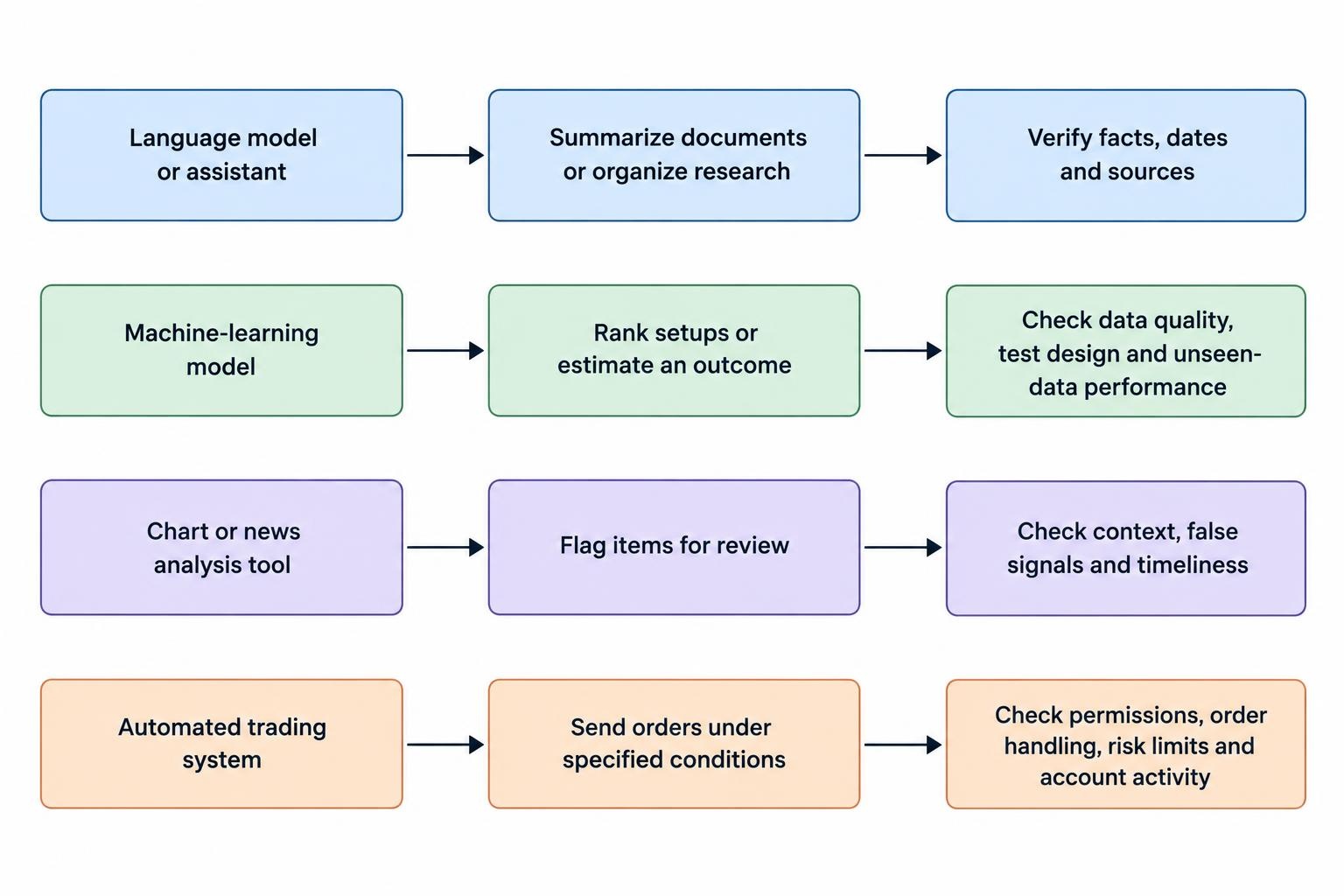
| Tool or task | Potential use | What still needs checking |
|---|---|---|
| Language model or AI assistant | Summarize documents, explain code or organize research questions | Figures, dates, source links and claims against the original material |
| Machine learning model | Rank setups or estimate a defined outcome from structured data | Data quality, test design, uncertainty and performance on unseen data |
| Chart or news analysis tool | Flag patterns, headlines or changes for human review | Context, false signals, timing and whether the information is current |
| Automated trading system | Send orders after specified conditions are met | Permissions, order handling, risk limits and account activity |
The difference between AI, algorithmic rules and automated execution is worth keeping clear. A system can be automated without using AI, and an AI model can generate analysis without placing a single order. If the distinction affects a tool choice, AI trading versus algorithmic and automated trading explains how those terms relate.
Language models and machine learning models also have different strengths. A language model works with text and can help summarize or extract information, while a forecasting model may use structured observations to estimate a defined result. The categories can overlap, but a chatbot’s ability to discuss a chart does not show that it has been validated as a market forecasting system. The differences between machine learning and large language models in trading can help clarify what a product is claiming to do.
How to judge an AI trading claim
Start by asking what the system actually does. Does it summarize news, produce a score, suggest a trade or submit orders? What data does it use, how often is that data updated, and what period was used to test the model? A credible explanation should make it possible to understand the signal and its limits. If a provider relies on phrases such as “self-learning,” “institutional-grade” or “predicts the market” without explaining the method, treat the language as marketing rather than evidence.
Next, check how the performance was measured. A screenshot of a winning trade or a high backtest return does not tell you how many strategies were tried, whether losing periods were included, or whether the figures account for trading costs. Ask whether results were generated on data the model had not seen during development, and whether the test reflects realistic order execution. Even a sound historical test does not establish future profitability; it only provides evidence about the strategy under the assumptions and data used.
Claims of guaranteed returns deserve particular caution. FINRA has warned about auto-trading services that use AI claims to promote unrealistic or unsupported performance, including claims of consistent returns or risk-free trading. It also flags “AI washing,” where a service overstates or falsely claims its use of AI. A provider’s claims about technology should be assessed separately from its regulatory status, fees, account access and performance evidence. FINRA’s warning on unregistered auto-trading services and AI claims describes risks associated with such services.
Keep control of account access and activity. A tool that only analyzes data has a different risk profile from one that requests trading permissions or can send orders. Review the permissions requested, use the narrowest access available, and monitor the account if any system can act on it. FINRA also advises investors to research providers and be wary of unsupported claims. For additional context on misleading AI investment pitches and generated information, see the joint investor alert on AI and investment fraud.
Use AI as support, not as proof
A sensible starting point is a narrow task with a clear way to check the output. Ask an assistant to summarize a company filing, then verify the figures and relevant statements in the filing itself. Use a model to flag possible setups, then compare those signals with written rules and a test that accounts for costs. Ask AI to review code, but run independent checks before trusting the results. The point is to keep the tool’s output testable rather than letting a polished answer stand in for evidence.
For any strategy, record what the model saw, what it produced, what decision followed and what happened next. That record can show whether the AI adds useful information, duplicates a simpler rule or encourages unnecessary trades. It can also expose a mismatch between a model’s intended role and how it is being used. A filter that helps narrow a watchlist may be useful even when it cannot identify the best entry price. For a practical framework, see using AI as a trade filter instead of automating every decision.
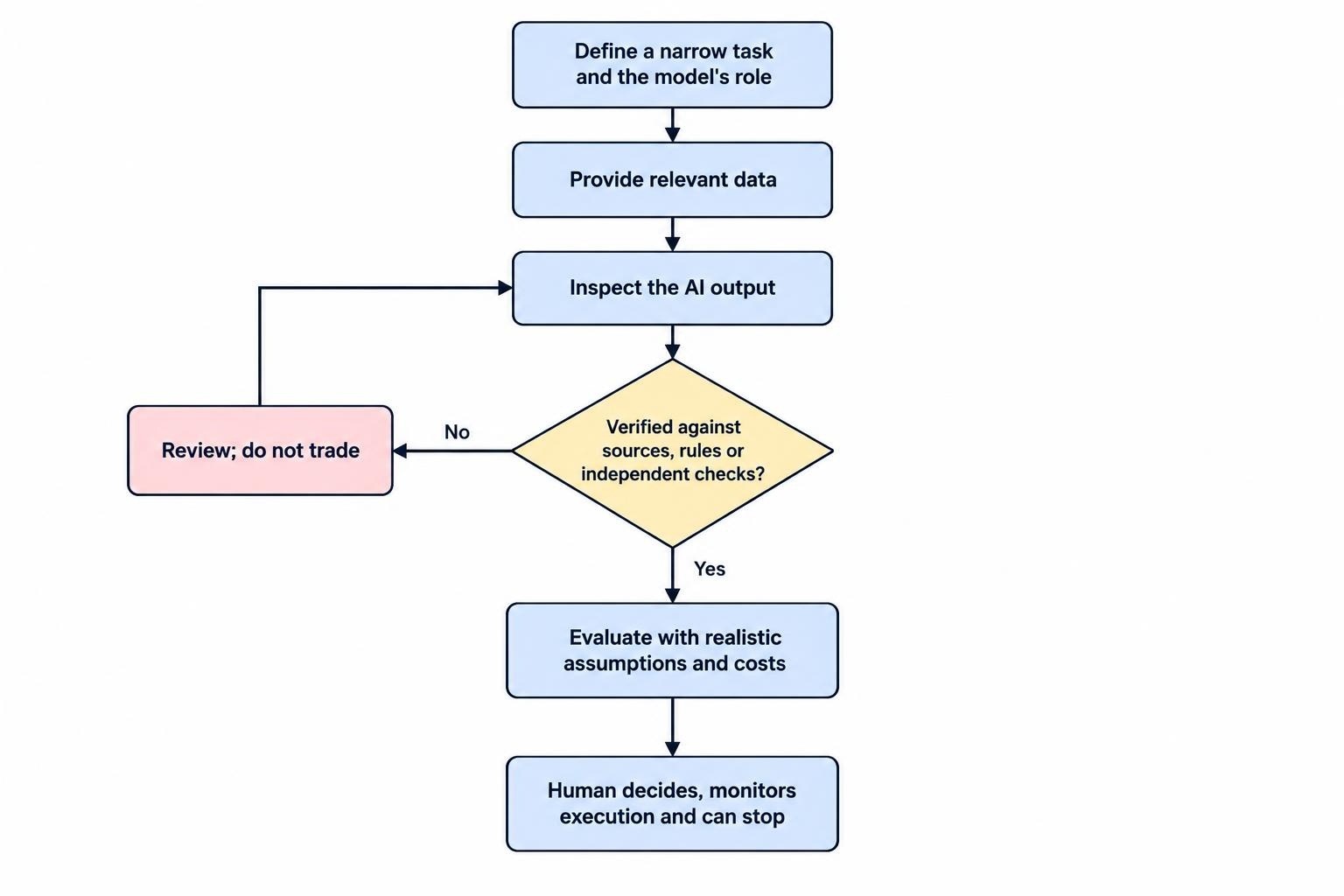
Set limits before connecting any tool to live execution. Decide how much the system may trade, which instruments it may access and what conditions should stop it. Keep a way to disable the system, and verify that orders and positions in the account match what the software reports. Automation can act faster than a person can review each decision, so technical safeguards and human oversight remain necessary even when the signal model appears to work.
AI can reduce clerical work, help structure research and generate hypotheses worth testing. It cannot certify its own answers, promise a market outcome or replace evidence that a strategy works outside the data used to build it. Retail traders get the most defensible use from AI when the task is narrow, the result can be checked and the risk stays under human control.