Artificial intelligence can help a retail trader sort information, test a strategy, or monitor a defined set of conditions. It cannot remove market risk, guarantee a profit, or make a weak trading idea sound. The practical question is not whether a tool uses AI, but whether it solves a clearly defined problem and produces results that can be checked.
Retail traders encounter AI in several forms: chat assistants that summarise documents, software that classifies price or news data, strategy builders that generate signals, and systems that send orders automatically. These tools do different jobs and carry different risks. A chatbot that helps organise research is not the same as a model that forecasts returns, and neither is the same as a bot with permission to trade in a brokerage account.
This guide is an entry point to the retail AI trading topic. It explains where AI may fit into a trading process, what it cannot reliably do, and how to assess a tool before relying on its output. It also points to more detailed guides on AI trading tools, strategy development, testing, automation, and risks and trader protection.
What retail traders mean by AI trading
“AI trading” is an umbrella term, not one method. It can describe machine learning models that classify patterns in data, language models that work with text, or software that automates a rule based on a signal. Some products use AI to generate ideas but leave every decision to the trader. Others send orders to an account with little or no review at the point of execution. The label alone tells you little about what the software actually does.
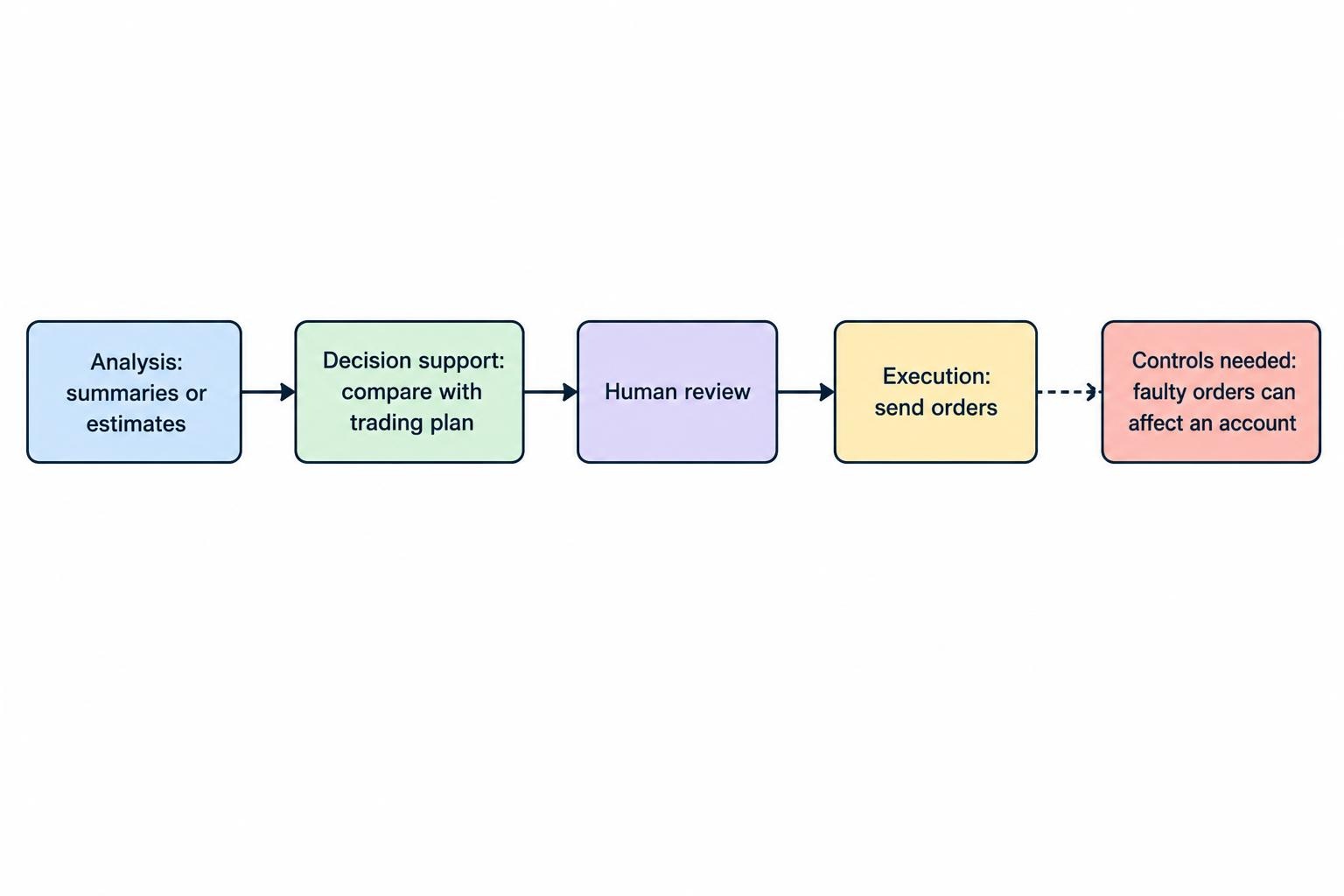
It helps to separate three stages: analysis, decision support, and execution. Analysis turns inputs such as prices, volumes, filings, or news into summaries or estimates. Decision support helps a person compare those outputs with a trading plan. Execution sends orders. A tool can cover one stage or several, but each added stage raises the need for controls. An incorrect summary may waste time; a faulty order can affect an account before the user has time to respond.
AI can also mean different underlying techniques. A language model predicts and generates text, so it may help summarise a report but can produce plausible sounding errors. A machine learning model may estimate a category or probability from structured historical data, but its output depends on the data, target, and test method. Rules based automation may not use AI at all. For the distinctions, see AI trading versus algorithmic and automated trading and machine learning versus language models in trading.
Where AI may fit in a trading process
For many individuals, the most sensible first use is assistance with bounded tasks rather than handing over trading decisions. An assistant might extract dates and figures from a set of company filings, organise watchlist notes, or help turn a vague hypothesis into testable conditions. A model might flag data that matches a pattern the trader has already defined. In each case, the trader still checks the input, decides whether the output is relevant, and determines whether any action fits the plan.
AI can also help with repetitive work. A script may apply the same screening rules across a list of instruments, while a journal tool can group trades by setup or time of day. The value is practical: less manual sorting, clearer records, and a more consistent review. It is not proof that a strategy will make money. A tidy report can still be based on bad data, an unsuitable assumption, or a pattern that disappeared after the period being studied.
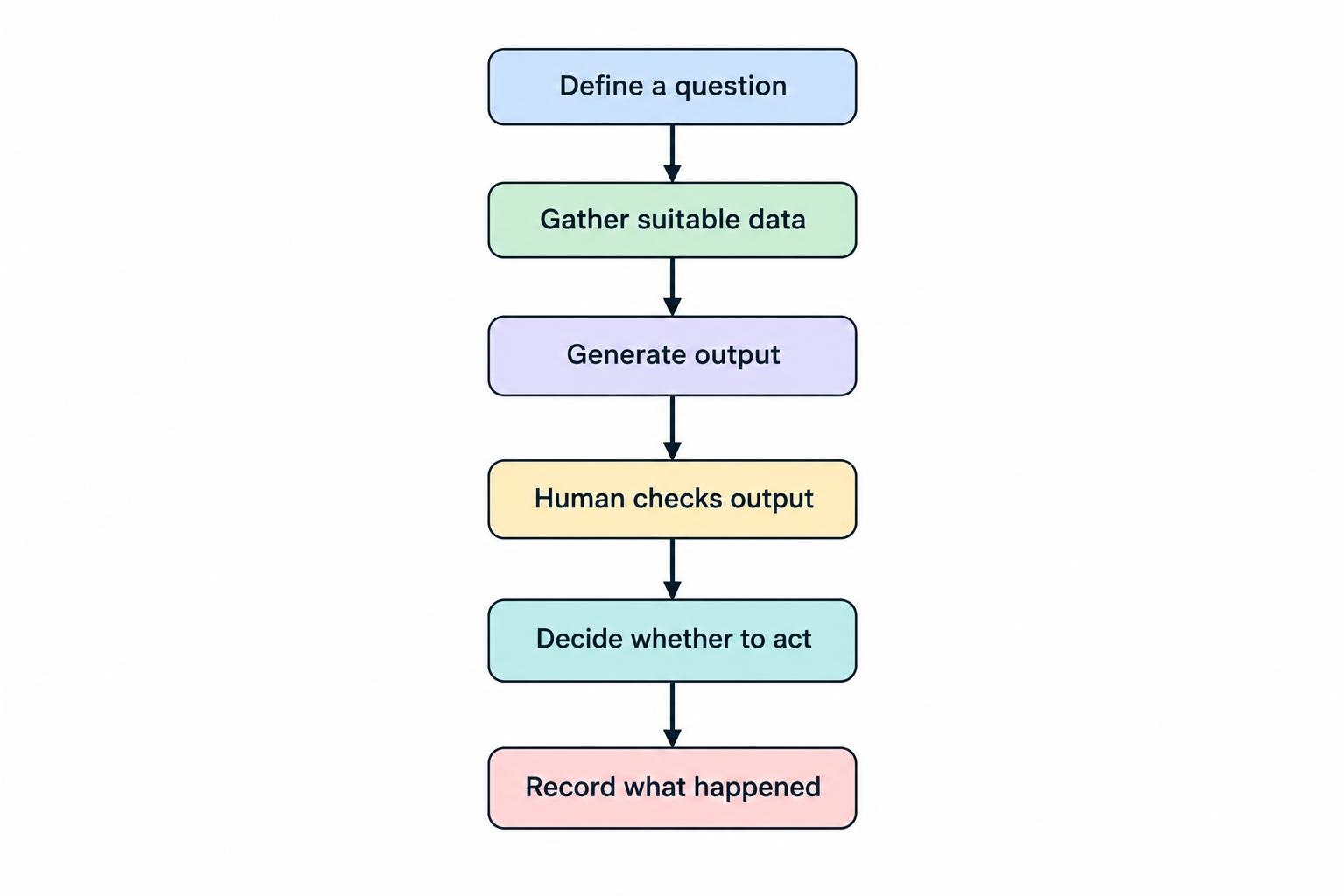
A useful workflow keeps the steps visible: define a question, gather suitable data, generate an output, check it, decide whether to act, then record what happened. The AI-assisted trading workflow guide covers those stages in more detail. Traders who want to use an assistant for research can also read about using AI assistants to research markets and check ideas.
| Use | Possible role | What still needs checking |
|---|---|---|
| Research support | Summarise or organise material | Original documents, dates, figures, and omitted context |
| Screening | Find instruments that meet stated conditions | Data quality, criteria, and whether the result fits the plan |
| Signal development | Estimate a probability or classify a setup | Test design, costs, stability, and real market performance |
| Execution | Submit or manage orders automatically | Permissions, order status, exposure, and failure controls |
What AI cannot establish by itself
A model output is not a verified fact simply because it is detailed or confident. A language model can misstate a company event, blend information from different dates, or invent a reference. A signal model can produce a probability that looks precise without being well calibrated. A chart tool can mark a pattern while missing a wider change in market conditions. The output needs an independent check proportionate to the decision it may influence.
AI cannot know that a past relationship will continue into the future. Markets change, data can be incomplete, and a strategy that appears effective in historical testing may fail when conditions differ. A backtest is evidence about how a set of rules behaved under particular assumptions; it is not a promise about future returns. Results can also be distorted if the model was tuned repeatedly on the same data or if realistic trading costs were left out. See the guides on overfitting and data leakage and fees, spreads, slippage, and financing costs in backtests.
Simulated trades have limits as well. They may not capture the prices, fills, liquidity, or decisions a trader would face when placing real orders. The CFTC warns that hypothetical results can misrepresent how a system might perform in live conditions, including by omitting spreads, fees, and execution effects. Its advisory on commodity trading systems and hypothetical results describes these concerns. Testing should therefore compare more than a headline return; the assumptions and the path of gains and losses matter.
Choosing tools without getting distracted by the label
Start with the task, not the marketing. If the problem is reviewing a trading journal, look for features that support accurate records and useful comparisons. If it is a screening task, check which data the tool uses, how often it updates, and whether the criteria can be inspected. If the product claims to forecast prices, ask what it predicts, over what time horizon, and how its results were tested. “AI powered” does not answer any of those questions.
Then check the practical details. Understand the subscription, data, and computing costs; find out whether the tool stores prompts, account information, or trading records; and identify what permissions it needs. Be cautious about sharing brokerage passwords or granting broad account access. If a service can place orders, learn how to pause it, revoke access, inspect activity, and respond when a connection or data feed fails. The dedicated AI platform evaluation guide provides a fuller review checklist.
For US investors, registration and the identity of the service provider may also matter, depending on what the service offers. A company’s use of AI does not verify its claims or establish that it is authorised to provide a financial service. The SEC, NASAA, and FINRA warn investors about investment fraud promoted using AI and urge caution with claims of guaranteed returns. Their AI and investment fraud investor alert includes steps for checking firms and investment professionals. Rules differ by product and jurisdiction, so check the relevant regulator rather than assuming one registration check covers every activity.
Testing a strategy before risking capital
Testing starts by stating the idea in terms that can be checked. Define the market, data inputs, signal, entry and exit conditions, and the period the signal is meant to cover. Decide what success means before reviewing results. Otherwise, it is easy to keep changing the model until the historical chart looks attractive, then mistake that fit for evidence of a durable edge.
Keep separate data for model development and evaluation, and avoid using information that would not have been available at the time of a historical decision. Test against a simple baseline, include plausible trading costs, and examine losing periods as carefully as profitable ones. A useful result should survive reasonable changes to assumptions; if tiny changes reverse the outcome, the apparent advantage may be fragile. The walk-forward testing guide explains one approach to checking performance across successive periods.
After historical tests, paper trading can help reveal operational problems, such as confusing signals, delayed data, or orders that do not behave as expected. It cannot show exactly how live execution or a trader’s response to real losses will work. Treat simulated results as one checkpoint, not a graduation certificate. Before going live, define a small, affordable risk limit and a clear condition for stopping the system if its behaviour changes.
Manual, assisted, and automated approaches
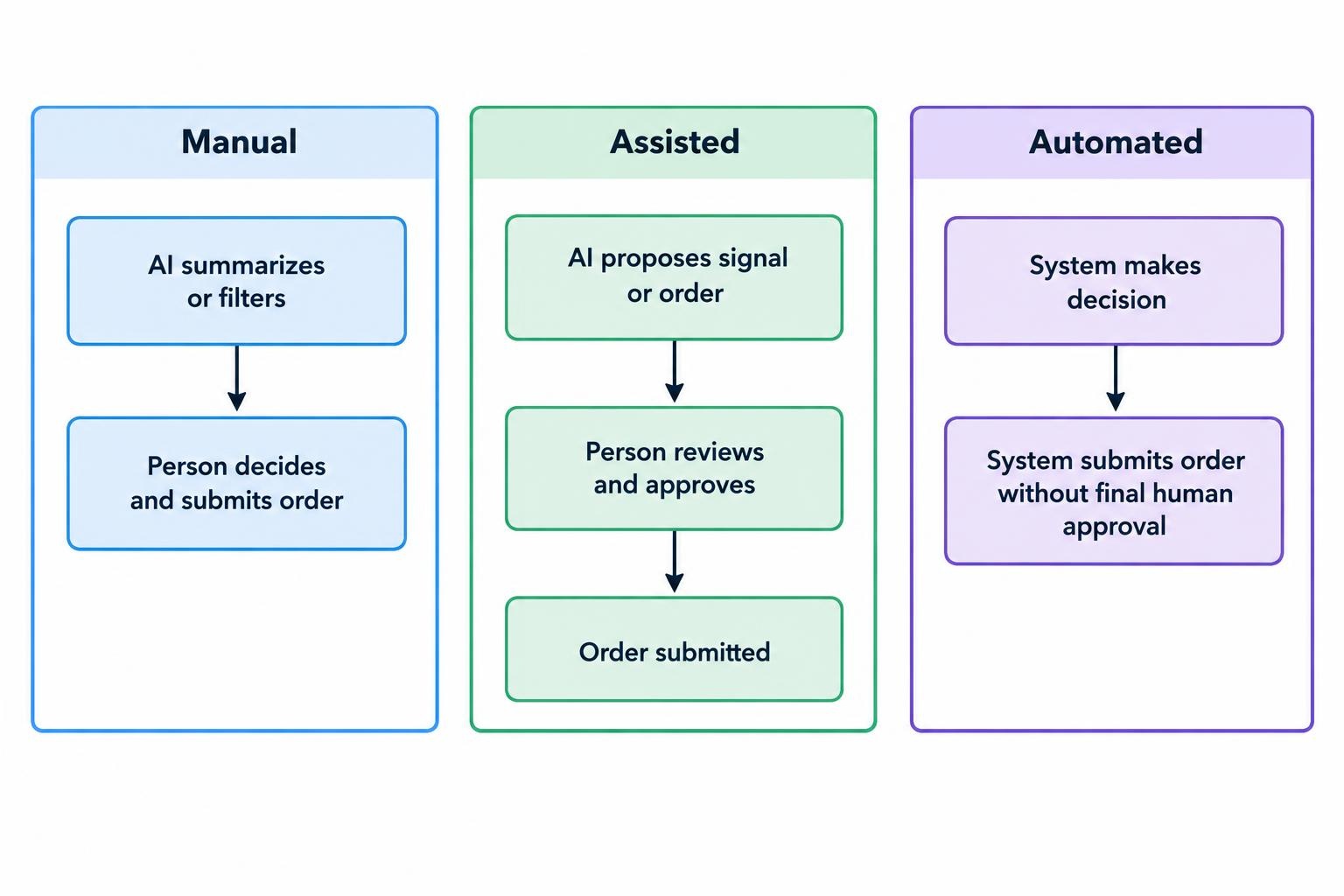
AI trading does not require full automation. A manual trader may use a tool to summarise documents or filter a watchlist, then make every trading decision. An assisted approach may generate a signal or proposed order that a person reviews before submission. A fully automated system can act without that final approval. There is no universal best level; the appropriate choice depends on the task, the person’s technical skill, and how well the system’s behaviour can be monitored.
Automation can reduce repetitive actions, but it can also repeat a mistake quickly. A model that misreads a data feed, a rule that produces duplicate orders, or an expired connection can create problems without a person watching every step. Systems that send orders need safeguards, clear records, position checks, and a way to stop trading. The separate guide to trading limits, kill switches, and human oversight focuses on those controls. If a service makes decisions in an account on the user’s behalf, understand its permissions and monitor account activity.
FINRA has warned about auto-trading services that make unsupported performance claims, overstate their use of AI, or seek sensitive account credentials. Its guidance on auto-trading services and unregistered entities recommends checking providers and treating claims of extraordinary or guaranteed returns with caution. For individuals, the basic test is straightforward: can you explain what the system does, see what it has done, and stop it when needed?
Recognising claims that deserve extra scrutiny
Claims of guaranteed gains, a near perfect win rate, or unusually high monthly returns should prompt careful checking, not a rush to subscribe. Ask for a complete record, clear test assumptions, and evidence that results are not cherry picked. Be wary if a seller will show only winning trades, refuses to explain basic methods, pressures you to pay quickly, or insists that a proprietary AI prevents losses. A polished dashboard is not independent verification.
The CFTC specifically cautions that AI cannot predict the future or sudden market changes, and describes schemes that used bot claims to attract customers. Its AI trading bot advisory gives examples of misleading promises. More practical checks are covered in the guides to claims about win rates, backtests, and guaranteed returns and recognising AI trading bot scams.
A sensible starting point for retail traders
Choose one modest task and define what a useful result would look like before trying a tool. For example, test whether it can consistently extract a short list of figures from documents, or use a simple screen to flag candidates for human review. Check its output against the underlying material, record errors, and include the full cost of the service in your decision. Do not connect an account or grant trading permissions just to see whether a demo looks impressive.
Build up only when the first use is reliable and the next step has a clear purpose. Keep the reasoning for each trade understandable, preserve a record of inputs and outputs, and review performance with realistic assumptions. If a tool’s value depends on claims you cannot independently verify, or you cannot explain how it affects a decision, keep it out of the live trading process. AI may support a disciplined method; responsibility for deciding what to trust, what to risk, and when to stop remains with the trader.